
Introduction
Hosting solutions act as a lifeline for businesses and applications to function effectively. Hosting is one of the most critical factors that determines the performance, speed, and security of the website. Basically, the two most common hosting solutions are Virtual Dedicated Server (VDS) and Virtual Private Server (VPS). Both of them provide complete flexibility and scalability as compared to traditional dedicated hosting, at feasible rates and fulfilling varied needs. However, deciding between them can be tricky if you’re unsure of what they offer.
This article will walk you through everything you need to know about hosting types, including the features, benefits and difference between VPS vs VDS hosting. By the end, you’ll have a detailed understanding of which one suits your needs and how to get it started. Let’s dive in!
What is Hosting?
Simply put, “Hosting” can be defined as a service that hosts websites and applications on its servers and provides access to the internet. In layman’s terms, it gives the home for your website or software, hence making it accessible to users online. Without hosting, no one would be able to access your content, files, or services.
Types of Hosting
There are several types of hosting available in the market, each designed for specific purposes.
- Shared Hosting
A web hosting where multiple websites are hosted on a single server and resources like CPU, RAM and hard disk are shared. Shared hosting is affordable and best suited for small websites and beginners. Explore the complete guide on what is shared hosting to learn more.
- Dedicated Hosting
Using the dedicated server hosting, you get an entire server for your website. It is ideal for large businesses or websites that require complete access and do not share resources with any other sites.
- Cloud Hosting
A cloud hosting utilizes a network of virtual servers instead of physical servers, hence offering scalability and flexibility. Here, the resources are shared dynamically depending on the requirements.
What is VPS (Virtual Private Server)?
A virtual private server refers to partitioning one physical server into multiple virtual servers. Every server works independently using its own set of resources like CPU, RAM, and storage. VPS hosting is ideal for businesses requiring an affordable solution and good performance. Here, the virtual private server has more control than shared hosting with a lower cost as compared to dedicated servers. Explore the complete guide on what is VPS hosting.
Get Free Trail Offer: VPS Hosting in India with Free Trial
How VPS Works?
In VPS Hosting, a physical server gets divided into several virtual environments with the help of Hypervisor. Here, each of them behaves like an independent server, having their own operating system, applications and files. The virtualization keeps the track record of performance ensuring that VPS is not affected by others.
Benefits of VPS Hosting
Let’s explore some of the key benefits of VPS hosting a perfect choice for businesses:
- Flawless Performance: Using Virtual Private Server hosting, it ensures that other users will not slow down the website.
- High Security: The chances of breaches are reduced as they have isolated environments.
- Customization: Easy-to-install custom scripts and software.
- Affordable Solution: Offers dedicated resources at an affordable price in comparison to a dedicated server.
- Resources: The resources can be upgraded based on the needs.
- Cost: Feasible pricing structure as compared to a dedicated server.
If you want the dedicated resources and control of VPS hosting with greater flexibility and scalability, Cloud VPS hosting is another option worth considering.
VPS use cases
Some of the uses of a VPS Server are listed below:
- Hosting Websites: It is highly suitable for websites with high-traffic or eCommerce sites.
- Forex VPS hosting: The traders use VPS to run their trading platforms most of the time with low latency.
- Running applications: A VPS Server is utilized to leverage various software and applications that require a stable environment.
- Email Servers: These can be used to manage private email servers.
- Testing Environments: Developers can create test environments for projects.
Linux VPS Server vs. Windows VPS Hosting
With VPS, one has to choose between Linux VPS Server and Windows VPS Hosting.
Linux VPS Hosting
- Open-source and cost-effective.
- Ideal for web developers familiar with Linux commands.
- It supports the programming languages PHP, Python, and Ruby.
- User-friendly interface.
- Compatible with ASP.NET and .NET applications.
- Licensed, so a bit more expensive.
Not sure which VPS OS to choose? Read our detailed comparison of Windows vs Linux VPS to find the right fit for your workload.
What is VDS (Virtual Dedicated Server)?
VDS full form
VDS stands for Virtual Dedicated Server, which is very similar to VPS. However, it can boast of a higher level of resource allocation. Here, in VPS, resources are shared on one physical server, while in VDS, resources are all given out to users separately. Actually, VDS is closer to a dedicated server because of better performance and isolation. Read our full article on what VDS is.
How Does VDS Work?
VDS Hosting involves the division of a physical server at the hardware level, thereby actually providing each user with a completely independent virtual machine. That is how such a setup ensures that no other user on the server will be able to affect your performance. Unlike VPS, which shares the resources of the physical server, VDS Work guarantees exclusivity.
Advantages of VDS Hosting
Some of the top benefits offered by VDS are as follows:
- Superior Performance: A Virtual Dedicated Server provides guaranteed CPU, RAM, and storage with no resource sharing, ensuring consistent and reliable performance.
- Full Control: With Root access, you can personalize the server according to your needs.
- Improved Security: Better data protection due to full isolation.
- Resources: Dedicated resources prevent disruptions caused by other users, ensuring high stability.
- Customizability: Tailor the server to meet your specific requirements.
- Reliability: Lower risk of downtime or performance problems due to other users.
Uses of VDS Server
The VDS Server is widely used by many. Let’s explore them!
- Private Cloud Storage: Holds file-sharing and backup capabilities.
- Database Hosting: Supports MySQL, PostgreSQL, and other databases for rapid and secure access.
- Forex & Tradebots: Guarantees 24×7 uptime for trading automation.
- SaaS Applications: Enables software and business offerings.
- Development & Testing: For software programs’ coding, testing, and deploying.
- Website & App Hosting: Ideal for high-traffic websites, eCommerce, and business apps.
VDS vs VPS: Key Difference
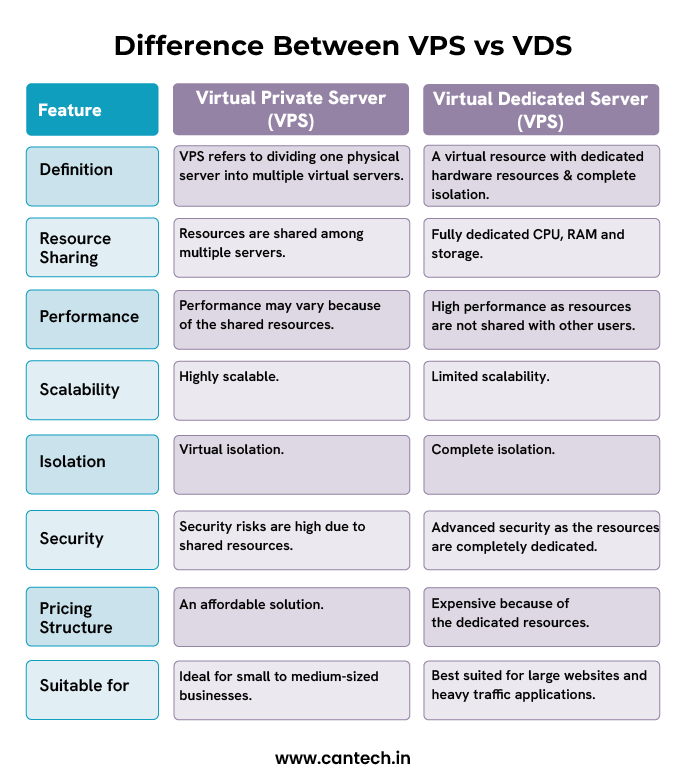
The virtual private server (VPS) and virtual dedicated server (VDS) are virtualization-based hosting solutions. However, both of them differ in performance, resource allocation and many others. The table showcases the major differences:
Conclusion
Which is better: VPS or VDS?
Choosing the right hosting solution may vary based on an individual’s need. If you’re a small or medium-sized business and looking for scalability and cost-effectiveness, then VPS hosting can be the perfect solution.
Whereas VDS server hosting is the way to go if you require high-end performance, dedicated resource allocation and advanced security for most demanding websites. Additionally, I would recommend that having a stable and reliable hosting provider like Cantech can satisfy all your hosting needs, either in VDS or VPS hosting solutions.
Before proceeding further, analyze the needs, budget and future development for your website. Doing so, will help determine your exact needs and aid you in making the right decision to avail the best hosting service.
FAQs on VDS vs VPS
What is the Difference Between VDS and VPS?
Virtual Dedicated Server offers dedicated resources for high performance and isolation, while a Virtual Private Server provides server resources.
What is VPS Hosting used for?
Generally, the VPS hosting service is widely used for hosting websites, managing applications, running email servers and many more. Additionally, Forex VPS hosting is utilized for trading platforms.
Explain the Basic Working of VPS Hosting.
A VPS Hosting leverages virtualization technology to divide a single physical server into multiple virtual environments.
Is it possible to use a Linux VPS Server to Host Websites?
Yes, using a Linux VPS server can be the ultimate choice for hosting websites if you’re searching for an affordable hosting solution.
What is Recommended to use for Hosting Applications?
It is highly recommended to use Windows VPS Hosting for managing applications built on .NET and ASP.NET.