Introduction
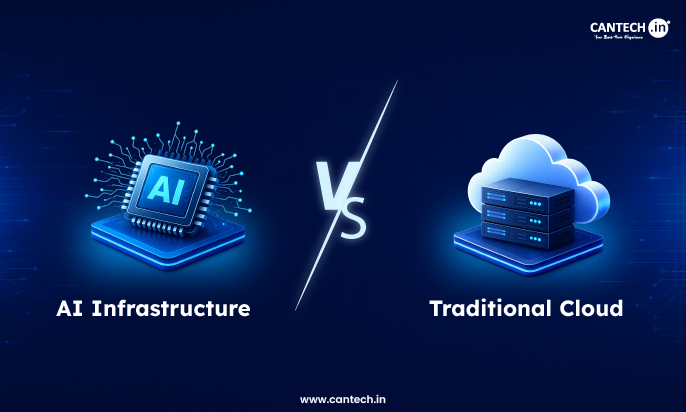
For almost two decades, the cloud was about general-purpose computation: virtual servers rented by businesses that want the flexibility and cost savings of not having to own their own data centers. Even if they built their own custom silicon, companies like AWS, Azure, and Google would rent out their virtual machines, disks, and databases. But there’s another kind of cloud now, one that was born from the particular demands of large-scale AI, and it has different costs and constraints. This is critical to understand if you’re trying to decide where to host your models or if you’re a CEO looking to buy or build a cloud infrastructure business. This blog explores key features and differences between AI infrastructure and traditional cloud.
What is Traditional Cloud Computing?
Traditional cloud computing is a paradigm of providing by means of the network access to the shared pool of configurable virtual machines, storage, databases, and other resources. It uses standardized CPU hardware platforms and virtualization to isolate different customers’ workloads. Such heavy virtualization allows different software systems to share the same physical hardware without interacting with each other. The services provided by Amazon Web Services, Microsoft Azure, Google Cloud, and other companies have become the backbone of the modern business software and website ecosystem.
For businesses that need isolated and scalable virtual resources without the cost of dedicated hardware, cloud VPS can be a practical traditional-cloud option.
Traditional cloud features
Some of the traditional cloud features are:
- Virtualization and multi-tenancy, allowing many customers to share the same physical hardware.
- Elastic scaling of compute/storage resources, typically on demand and/or metered by the second or hour.
- Breadth of services, from databases to serverless functions to content delivery and identity services.
- Geographic distribution, to provide low-latency service to all customers.
- Mature tools for redundancy, failover, and recovery.
What is AI Infrastructure?
The AI infrastructure typically refers to specialized hardware and associated systems that are designed to accelerate the intensive mathematical processes involved in training and operating large-scale machine learning models, including deep learning algorithms and especially large language models. This definition emphasizes particular technologies that are relevant to big AI, but it also points to fundamental differences in infrastructure needs between conventional cloud services and organizations that develop and operate large-scale AI models. The former focuses on GPUs or other specialized accelerators, custom interconnects between accelerators, and data center configurations that are optimal in terms of power densities.
Meanwhile, the cloud provides virtualization and abstraction of hardware resources. Finally, while the two areas are closely related, they are not entirely overlapping. Most of the AI infrastructure is provided as a service by big hyperscalers, but the underlying implementation details differ radically.
For a detailed explanation, see what is AI infrastructure and how it supports modern AI workloads.
AI infrastructure features
Some of the AI infrastructure features are:
- High-performance accelerators, often including tens of thousands of individual chips for a given training job.
- High-bandwidth, low-latency interconnects that make the whole system behave as a single computer (e.g., NVLink, InfiniBand).
- High-density power and cooling infrastructure.
- Dedicated, non-over subscribed capacity, meaning that a given GPU or other accelerator is only working on a single job at a time.
- And specialized orchestration and checkpointing software for coordinating these distributed, continuous-workloads.
Key differences between AI Infrastructure and Traditional Cloud
Here are the differences between AI Infrastructure and Traditional Cloud:
| Aspect | Traditional Cloud | AI Infrastructure |
| Hardware | CPUs, commodity servers | GPUs/Accelerators |
| Network Priority | Independent, Isolated Workloads | High inter chip bandwidth and synchronization. |
| Utilization model | Oversubscription, shared tenancy | Dedicated, fully saturated capacity. |
| Power and Cooling | Standard data center design | High-density power, liquid cooled |
| Payment mode | Pay-as-you-go flexible | Long term reservations |
| Ideal for | Web apps, databases, enterprises software. | Large scale inference, model training. |
When workloads require exclusive access to GPU resources rather than shared infrastructure, a GPU dedicated server can provide isolated compute capacity.
When to Choose AI Infrastructure vs Traditional Cloud
1. Choose traditional cloud when
- You need to run web application, databases or other business software in the cloud, for bursty or unpredictable workloads which need to scale up and down quickly.
- When you need geographic distribution to better serve end-users with lower latency.
- When you are willing to pay for consumption rather than long-term commitments and you need to run only relatively small amount of inference (vs training) for your AI.
2. Choose AI infrastructure when
- You need to train large models which require tens of thousands of GPUs working together.
- When you need the benefit of high-performance interconnect switching rather than just many GPUs.
- When you need exclusive access to the computer power for the duration of months or even years.
- When you are willing to make long-term commitments of computer power in order to get predictable costs.
- And if you need more power than one region can provide, taking into account power distribution and cooling constraints.
If you’re deciding between flexible cloud GPU resources and dedicated infrastructure for machine learning, see our comparison of cloud vs dedicated GPU server solutions.
Conclusion
The fundamental difference between AI infrastructure and traditional cloud is unlikely to disappear, but vendors on both sides are likely to extend their reach into the other’s markets. Traditional cloud providers will continue to enrich themselves with AI features to meet demand, while AI-native infrastructure providers will likely look to offer complementary services to reduce customer hassle. But the physics of the problem, the need for astronomical bandwidth per connection, power density, and coordinated fault tolerance, is going to continue to push AI training towards infrastructure that is architecturally significantly different from what hosts your everyday website or application.
The practical implication of this for managers is that you need to consider cloud provisioning choices for AI as a separate decision from traditional cloud. The appropriate infrastructure choice depends critically on whether one is talking about training or serving, the sensitivity to network topology, and the willingness to pay for bandwidth and other resources that can provide the needed level of isolation and performance. And this consideration is increasingly going to become a competitive differentiator.
FAQs
Is AI infrastructure not just a cloud with some GPUs attached? Are there additional factors making it fundamentally different from cloud infrastructure?
Yes, there are additional factors. These are the need for specialized interconnects, dedicated capacity, and a much higher power density than a traditional cloud data center is designed to support.
Can one use AI infrastructure as a small player, or does it always require large-scale investment on the corporate level?
It can be leveraged by smaller players through rented capacity from “neocloud” providers (CoreWeave, Lambda, Crusoe) or GPU-centric cloud providers. Businesses that need exclusive resources can also rent GPU dedicated server capacity instead of investing in their own hardware. For strategic reasons, it may be beneficial not to build a cluster and rely on third-party managed infrastructure instead.
Traditional cloud vs. purpose-built AI infrastructure: which is better for inference? Which is better for training?
Traditional cloud or hybrid infrastructure is better for inference because it usually does not benefit from the scale and is much more communication-heavy than training workloads. Training, on the other hand, can leverage the capacity advantage and benefit from higher power density.
Can traditional cloud providers not build the same type of interconnect infrastructure that neoclouds have? What is the barrier to entry for them?
They can, but it requires a significant amount of capital expenditure (CAPEX) to reconfigure existing facilities or build new ones utilizing dense power architecture and innovative cooling mechanisms like immersing servers in a liquid. This is why specialized AI infrastructure providers emerged.