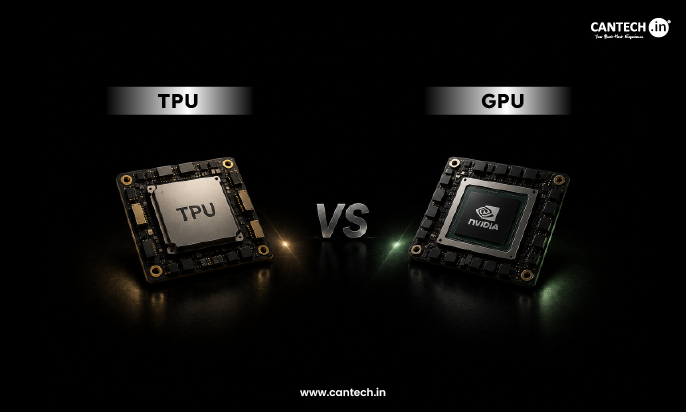
Artificial intelligence and Deep learning have seen significant innovations over the past few years. These technologies heavily depend on specialized hardware and train and run models efficiently in terms of performance. While GPUs (Graphical processing units) have been the most preferred choice for deep learning and AI since nearly a decade, TPUs (Tensor processing units) – Google’s custom AI accelerators are being used massively to power deep learning, machine learning and LLM workloads at a large scale.
In this blog we explore what are the key differences between TPUs vs GPUs in terms of features, and performances.
What is a TPU?
Tensor processing units (TPUs) are application specific which are integrated circuits (ASICs) developed by Google to improve machine learning workloads, especially effective for large scale tensor operations like training and neural inference. They excel at tensor operation because of their unique architecture which supports system speed while also offering scalability. Besides this they are widely used in large language model (LLM) training of AI and ML technologies.
Use Cases of TPU
TPU has several use cases and applications which includes Image classification, computer vision, recommendation systems, large language models, research in federated learning and On-device AI.
Key Features of TPU
Some of the top features of TPU:
- Increased performance: Designed specifically for machine learning and deep learning workloads, to deliver better performance than general purpose CPUs.
- Tensor operations: TPU is used at most at matrix multiplications and tensor operations which are foundations of neural network computations.
- Faster processing: Thousands of processing elements work simultaneously which enables faster training and inference for AI models.
- Cost efficient: Offers high performance per watt, which makes large scale AI deployments cost effective and sustainable.
- Efficiency at scale: Multiple TPUs can be connected into large clusters (TPU Pods) to train large AI models efficiently and at scale.
What is a GPU?
A GPU or Graphic processing unit is an electronic chip originally designed to increase the speed of image rendering and animations on computers and gaming platforms. Over time, it has expanded to a high-performance processor which is well suited for data intensive operations in areas like artificial intelligence (AI), machine learning, and high-performance computing (HPC). Unlike a CPU which has little but more sophisticated cores for sequential tasks. It has the ability to handle several operations concurrently.
Use Cases of GPU
GPU has several use cases and applications which includes graphics rendering, gaming, crypto currency mining, general AI research, scientific simulations, and mixed workloads.
Key Features of GPU
Some of the top features of GPU:
- Massive parallel processing: It is designed to process vast amounts of data at the same time. GPUs also excel in workloads like AI training, scientific simulations.
- Faster Access: GPUs offer instant access to large volumes of data via high-bandwidth memory, to reduce bottlenecks in data intensive applications.
- VRAM: It is equipped with specialized video memory for handling graphics, AI models and large datasets.
- Specialized architecture: Designed for vector calculations, floating point computations, and matrix operations. GPUs efficiently manage machine learning, deep learning and graphics workloads.
- Scalability: Multiple GPUs can be combined to manage larger workloads and improve performance.
Difference between TPU vs GPU
Here are the major differences between TPU and GPU in terms of architecture and performance:
| Aspect | TPU (Tensor Processing Unit) | GPU (Graphic Processing Unit) |
| Architecture | It is specialized in systolic architecture built for tensor operations and deep learning acceleration exclusively. | General purpose large parallel architecture with thousands of cores that are capable of managing several compute intensive tasks. |
| Performance Focus | Improves AI training and inference performance, mainly for neural networks. | It balances AI performance with flexibility for different workloads. |
| Latency | Relatively low latency for AI inference tasks. | Higher latency for AI-specific operations compared to TPUs. |
| Inference Performance | Great for high-volume inference in production environments. | Better at inference performance with great work flexibility. |
| Power Consumption | Offers high performance per watt in AI workloads. | Generally more power consuming for AI workloads. |
Which one should you choose between TPU and GPU
Below we have listed reasons on which one is ideal for you among TPU and GPU.
Choose TPU:
- If your workloads are mainly deep learning and neural networks.
- If you’re looking for training for LLM models or large transformers.
- If you require maximum AI performance and energy efficiency.
- If your infrastructure is primarily cloud based especially on Google cloud TPU.
- If you largely utilize Tensorflow.
Choose GPU:
- If you are looking for on-premise deployment options.
- If you work with AI frameworks such as PyTorch, JAX and Tensorflow.
- If you need a larger ecosystem of libraries and tools like CUDA.
- If you are looking for a general purpose accelerator.
- If your use case is analytics, video processing, graphics rendering or simulations.
For language-focused AI workloads, LPUs are another specialized option worth considering; see our LPU vs GPU comparison to understand how they differ from GPUs in terms of architecture, performance, and use cases.
Conclusion
GPUs and TPUs both significantly accelerate AI workloads, yet their core advantage lies in different domains. The right choice mainly depends on your use cases and other factors like cost efficiency, performance and architecture and scalability. Looking forward, innovations in performance per watt, memory bandwidth, and numeric precision further expands boundaries of AI acceleration.
FAQs
Is a TPU better than a GPU?
GPUs have been the most preferred choice for general computing and AI workloads for a long time. However, TPUs are no less, they are highly specialized chips which are faster and cost efficient than GPUs and are ideal for large scale AI training and tensor workloads.
Does ChatGPT use GPU or TPU?
ChatGPT currently runs on GPUs hosted on Microsoft Azure cloud AI supercomputers. They are optimized for large transformer models and it also supports frameworks used in OpenAI’s infrastructure.
Can TPUs replace GPUs?
TPU can be better than GPU for certain use cases. However, performance wise it can differ based on factors like software optimizations, architecture, precision requirements. In most cases, an ideally optimized GPU can be on par or outperform TPU performance.
Is A100 a GPU or TPU?
NVIDIA A100 is a GPU that offers great acceleration for data centers for AI, data analytics, and HPC.
Why are GPUs more preferable than TPUs for DL tasks?
GPUs are preferred by many due to their large availability, versatility, development ecosystem, and are usually cost-effective for a diverse range of users and small -scale operations due to their broader market presence and competition. TPUs also offer significant advantages for specific, and usually larger scale, deep learning tasks.