Deep learning needs a massive amount of computing power. Usually, high performance graphic processing units (GPUs) are ideal because they can handle a large volume of calculations in multiple cores with a large amount of memory available. But handling several GPUs on premise can create a large demand on internal resources and can turn out to be very expensive to scale. Whereas, field programmable gate arrays (FPGAs) provide versatile solutions which are also expensive and provide both sufficient as well as reprogrammable flexibility for evolving applications.
In this blog we compare GPUs and FPGs side by side and discuss their strengths and weaknesses in terms of features and performances.
What is FPGA?
FPGAs are programmable silicon chips that are configurable to be compatible with multiple applications. Unlike application specific integrated circuits (ASICs), which are built for specific purposes, FPGAs are meant for flexibility, especially in custom low-latency applications. This benefit makes FPGAs very useful for real-time processing in AI-powered applications and new project prototypes.
Key Features of FPGA
The features of FPGA are as follows:
- FPGA can be reconfigured after the development to assist in new functions, updates, or evolving requirements for reprogramming.
- It has the ability to perform multiple functions parallely by delivering high throughput for computational heavy workloads.
- It processes the data directly in hardware, to enable near real-time performance with low delay.
- It enables developers to design application specific circuits optimized for tasks like networking, AI and signal processing.
- It is energy efficient as it consumes optimum power for specialized workloads by removing unnecessary processing expenses.
What is GPU?
A GPU is a specialized computer processor. Sometimes people call them graphics cards or video cards. As the name implies, GPUs were designed to process computer graphics which includes images, 3D graphics, and videos so that the CPU can focus on other general purpose computing tasks. However, over time it is also being used extensively for rendering images, videos and enabling advancements in artificial intelligence (AI), machine learning, computer vision, and more. GPUs remove the possible processing bottlenecks for faster results, more capabilities and improved user experience.
Key Features of GPU
The features of GPU are as follows:
- GPUs contain thousands of small cores which allows them to process vast amounts of data simultaneously.
- Has built -in hardware encoders that can handle high-quality video recording, streaming and exporting without compromising on performance of the rest of your system.
- It comes with dedicated memory that sits next to GPU cores to store heavy visual assets and large neural network parameters.
- Dedicated hardware on board the GPU handles, encoding, allows streamers and content creators to stream or record with minimum impact on performance.
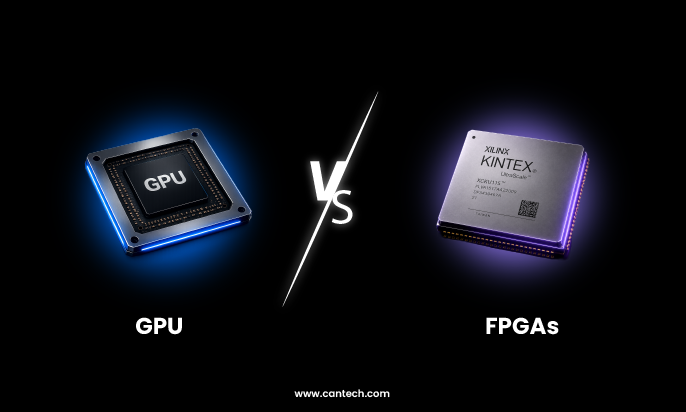
Differences between FPGAs vs GPU
Here are some of the key differences between FPGAs vs GPU:
| Aspect | FPGA | GPU |
| Core design | Reconfigurable logic fabric | Fixed silicon with CUDA/Shader cores |
| AI/ML Training | Limited | Industry standard for AI training |
| Latency | Ultra-low , deterministic | Higher , non-deterministic |
| Flexibility | Hardware can be customized for specific applications | Software programmable and easier to adapt |
| Throughput | Moderate | Extremely High |
| Memory Bandwidth | Limited on chip BRAM + External DDR | Very High |
| Power Consumption | Low to Moderate | High |
| Cloud availability | Limited | Abundant |
| Where it struggles | Rapid prototyping, Irregular/Unpredictable data patterns. | Deterministic hard real time,ultra low latency, custom precision. |
Which Should You Choose between FPGAs and GPU?
Below we have listed reasons on which one is ideal for you among FPGAs and GPU.
Choose FPGA:
- If you require ultra-low latency and real-time processing.
- If your business requirement is low power consumption.
- If your workload is fixed and can benefit from hardware acceleration.
- If your business is based in telecom, networking, aerospace or industrial automation.
Choose GPU:
- I am looking to train AI and machine learning models.
- If you want faster deployment and easy development.
- If your workloads change frequently.
- If you prioritise high-performance oriented computing, graphics rendering and data analytics.
Conclusion
Selecting between FPGAs and GPU is a crucial decision, it depends on your nature of applications, performance, power constraints and budget considerations. Whereas, GPUs provide broad applicability and cost-effectiveness which makes them an ideal choice for many high-performance computing tasks.
FAQs
Are FPGAs better than GPU?
FPGAs are perfect for applications that need low latency and deterministic execution, whereas GPUs are much better for high-throughput workloads where latency is of low priority.
Can I use an FPGA as a GPU?
FPGAs have the flexibility to be programmed to function similar to GPU, ASIC, or other configuration. They can be programmed and optimized for specific algorithms, which can be efficient in workloads where general-purpose hardware might not be sufficient.
Does FPGA have a future?
FPGAs are expected to have more demand due its adaptable and reprogrammable hardware solutions across a range of industries.