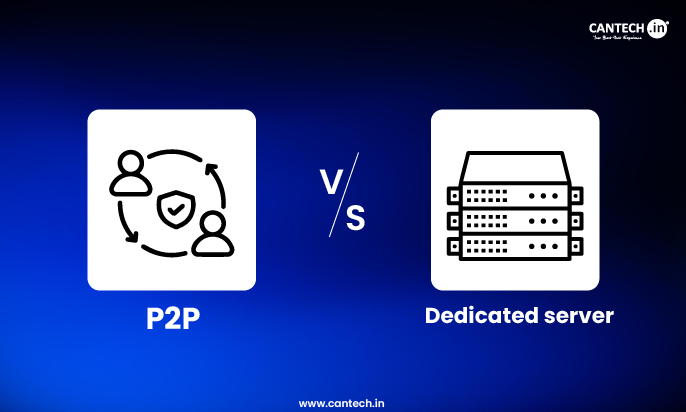
A P2P (Peer-to-Peer) network has no central server. Every device connected to the network shares the load. A Dedicated Server is a single, powerful machine that manages everything from one place. P2P is decentralised and low-cost. Dedicated Servers are controlled, reliable, and built for performance.
Both P2P networks and Dedicated Servers are ways to share data and run services online. But they work very differently and suit very different needs.
If you are building a game, running a business application, or trying to understand what sits behind popular tools like torrents or blockchain, this guide will make the difference clear.
What is a P2P Network?
In a Peer-to-Peer network, every device is both a client and a server. There is no central machine in charge. Each device, called a peer, connects directly to other peers to send and receive data.
Think of it like a group of people passing notes directly to each other without going through a teacher. Anyone in the room can talk to anyone else without needing someone in the middle.
The more peers in the network, the more resources are available. But remove enough peers and the whole thing slows down or breaks apart.
Common uses of P2P
- File sharing through torrent clients like BitTorrent
- Cryptocurrency networks like Bitcoin and Ethereum
- Decentralised communication apps
- Some multiplayer games that use peer-hosted sessions
- Distributed storage systems
What is a Dedicated Server?
A Dedicated Server is a physical machine rented entirely for your use. It runs continuously, manages all requests, and acts as the single authoritative source for whoever connects to it.
Think of it like having a post office. Every letter goes through that one building. It is always open, always staffed, and you know exactly where to find it.
Nothing is shared with other customers. All the processing power, memory, and storage belong to you.
Read our guide on what is dedicated hosting to understand how it provides full server control, high performance, and maximum reliability.
Common uses of Dedicated Servers
- Multiplayer game servers with stable, low-latency connections
- Business websites and web applications with high traffic
- Database hosting for applications that need fast, reliable reads and writes
- VPN services and private networks
- Enterprise software and internal tools
- Media streaming and content delivery
Discover why you need a dedicated server to understand when your business requires maximum performance, security, and full control over resources.
P2P vs Dedicated Server: Side by Side
| Feature | P2P Network | Dedicated Server |
| Control | Distributed, no single owner | Full control by one party |
| Performance | Varies by peers online | Consistent and reliable |
| Security | Hard to enforce | Fully configurable |
| Uptime | Depends on active peers | 24/7 guaranteed uptime |
| Cost | Usually free or low cost | Monthly hosting fee |
| Scalability | Grows with peers | Scales with hardware upgrades |
| Best For | File sharing, crypto, torrents | Games, apps, business tools |
| Admin Access | None or limited | Full root access |
The Key Differences That Actually Matter
Control
P2P networks have no central authority. Nobody owns the network. Rules are enforced by code or consensus, not by an admin. This makes governance messy and security harder to enforce.
A Dedicated Server gives you full control. You decide who connects, what software runs, how data is handled, and how security is configured. Everything is under one roof.
Performance and Reliability
P2P performance depends entirely on how many peers are online and how much bandwidth they contribute. If peers drop off, service degrades. There is no guaranteed uptime.
A Dedicated Server runs 24 hours a day, 7 days a week. Performance stays consistent because your resources do not depend on anyone else. This is critical for anything that needs to be always available.
Security
Security is a weak point for most P2P networks. Data passes through unknown peers. There is no way to verify who is handling your information or whether those machines are compromised.
On a Dedicated Server, you control the firewall, user access, encryption, and every security layer. You know exactly where data lives and who can touch it.
Cost
P2P has almost no infrastructure cost. The network itself is built from the devices of its participants. This is why torrents, blockchain, and decentralised apps can operate without a hosting bill.
Dedicated Servers cost money. You pay for the hardware, bandwidth, and uptime. But that cost buys you consistency, security, and control that a P2P network simply cannot offer.
Scalability
P2P scales naturally as more peers join. A torrent with more seeders downloads faster. A blockchain with more nodes becomes harder to attack. The network grows itself.
Dedicated Servers scale through hardware upgrades or by adding more servers to a cluster. It takes more planning but gives you predictable, managed growth.
P2P vs Dedicated Server in Gaming
This comparison comes up a lot in gaming. Many older or smaller multiplayer games use P2P, where one player’s machine acts as the host. It works but comes with problems.
- If the host leaves, the session ends or migrates, often disrupting the game
- The host has a connection advantage over other players
- Performance depends on the host’s internet speed and hardware
Dedicated Game Servers fix all of this. The server runs independently of any player. No host advantage. No session drops when someone leaves. Consistent performance for everyone.
Most serious multiplayer games and esports titles run on Dedicated Servers for exactly this reason.
When to Choose P2P
P2P makes sense when:
- You need decentralisation by design, like a blockchain project
- Infrastructure cost needs to be zero or near zero
- Uptime is not critical and the network can survive peers going offline
- You are building a distributed system where no single party should be in control
When to Choose a Dedicated Server
A Dedicated Server makes sense when:
- Your application needs to be available around the clock
- You need consistent, predictable performance
- Security and data control are non-negotiable
- You are running a business, game, or application that users depend on
- You need admin access to configure the environment exactly how you want it
How Cantech Can Help
At Cantech, we offer Cloud Dedicated Server plans built for businesses and developers who need reliability, full control, and consistent performance. Whether you are hosting a game server, a business application, or a high-traffic website, we have a plan that fits.
Our team can help you figure out the right server specs for your workload and get you set up quickly. No overcomplication. Just a server that works.
Talk to us and we will find the right setup for you.
Frequently Asked Questions
What is the difference between P2P and a Dedicated Server?
A P2P network has no central machine. Every device shares the load equally and connects directly to other devices. A Dedicated Server is a single machine that manages all connections and data from one controlled location. P2P is decentralised and low-cost. Dedicated Servers are reliable, secure, and fully controllable.
Is P2P faster than a Dedicated Server?
Not reliably. P2P speed depends on how many peers are active and how much bandwidth they share. A Dedicated Server delivers consistent speed because its resources are fixed and not dependent on outside participants.
Which is more secure, P2P or a Dedicated Server?
Dedicated Servers are generally more secure. You control every security setting. In a P2P network, data passes through unknown machines, making it harder to enforce security standards or verify data integrity.
Why do games use Dedicated Servers instead of P2P?
Dedicated Servers give all players an equal connection with no host advantage, deliver consistent performance, and keep the session running even when individual players disconnect. P2P game hosting creates lag, host advantages, and session interruptions that hurt the player experience.
Can a Dedicated Server replace a P2P network?
It depends on the use case. For most business applications, games, and websites, yes. But for genuinely decentralised systems like blockchain or censorship-resistant file sharing, a Dedicated Server cannot replicate the core properties of P2P by design.
Is P2P illegal?
P2P technology itself is not illegal. It is the content shared through P2P that can create legal issues. Torrenting copyrighted material without permission is illegal in many countries. Legitimate uses of P2P include open-source software distribution, blockchain networks, and legal file sharing.
What is a Dedicated Game Server?
A Dedicated Game Server is a machine that runs a multiplayer game environment independently of any player’s device. It handles all game logic, player connections, and match data. No player acts as host, which creates a fair and stable experience for everyone.
How much does a Dedicated Server cost?
Dedicated server price in India vary by provider and hardware specs. Entry-level Dedicated Servers start from a few hundred rupees per month for basic configurations, going up significantly for high-performance machines. Most providers offer monthly plans with options to scale up as your needs grow.