With the growing technology landscape, businesses increasingly rely on robust IT infrastructure to ensure seamless operations. One of the most common questions organizations face today is choosing between cloud hosting vs dedicated hosting. Selecting the right hosting solution plays a critical role in website performance, scalability, security, and cost efficiency.
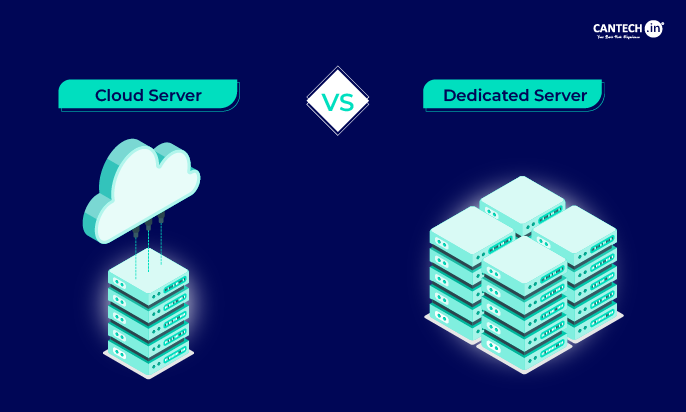
Among the various hosting options available, cloud servers and dedicated servers are the most widely used. While both offer distinct advantages, understanding the difference between a cloud server vs dedicated server is essential for making the right decision.
If you’re new to this concept, start with our guide on What is a Dedicated Server? to understand how it works and when you should use one.
Cloud Hosting vs Dedicated Hosting: Quick Comparison
| Cloud Hosting | Dedicated Hosting |
|---|---|
| Virtual cloud-based server | Physical server |
| Scalable on demand | Fixed resources |
| Pay-as-you-go pricing | Fixed monthly cost |
| Flexible performance | Consistent high performance |
| Best for growing traffic | Best for heavy traffic |
What is Cloud Hosting (Cloud Server)?
A cloud server is a virtual server that runs in a cloud environment for computer processing. Usually, the cloud servers are hosted and serviced through the web; computer processing is accessible through the web on an on-demand basis. Dedicated Cloud servers run over underlying servers, but in a virtual environment, and for that reason, a number of cloud servers can run in a single underlying server.
Cloud hosting is widely preferred for applications with fluctuating traffic, development environments, and businesses that need rapid scalability without investing in physical hardware. Read our detail guide blog on what is cloud hosting.
How Cloud Servers Work?
Cloud servers use cloud computing technology, comprising multiple servers that can be placed together in a flexible and expandable environment. Here, the users can rent a server and leverage it as per their requirements.
For instance, let’s say your website might be facing a sudden increase in traffic at a time when the cloud server can dynamically allocate resources based on the requirements to handle the ongoing demand. As soon as the visitors are reduced, the resources can be decreased, hence providing an affordable cloud hosting solution, i.e. pay as you go pricing structure.
Types of Cloud Servers
Mainly, the cloud servers are classified into three categories listed below:
Public Cloud Servers:
The public cloud servers provide shared infrastructure run by a third party. It is the best choice for companies looking for cost-effective and scalable solutions. To know more about What is a public cloud, how it works, and its benefits, have a look at our detailed guide.
Private Cloud Servers:
The organizations using private cloud servers are offered a single server with advanced security and control, hence making it ideal for businesses dealing with sensitive data. Explore our detailed blog on What is Private Cloud?
Hybrid Cloud Servers:
It is a combination of both i.e. public and private cloud servers, providing high-end flexibility and vast customization opportunities. Hybrid Cloud Servers is the go-to choice for businesses looking to manage cost, performance and security. Dive into our full article explaining What is Hybrid Cloud?
Willing to explore the key differences between public, private and hybrid cloud servers? Check here.
Benefits of Cloud Servers
Let’s check out the top benefits of cloud servers and what they can offer!
High Flexibility
Cloud servers are highly flexible, scalable and best suited for a large website or a simple website. It facilitates users to utilize resources based on demand. For example, during peak times, an online store can expand its resources to manage the ongoing demand. Whereas startups can use them when the business grows.
Cost-Effectiveness
One of the best advantages is that cloud servers offer a pay-by-use pricing model. You must pay for only consumed usage, whereas, for dedicated servers, one pays for an entire server. It is ideal for startups and businesses with limited budgets.
Cloud Disaster Recovery
Cloud servers have in-built cloud disaster recovery capabilities. In case of failure in hardware, natural disasters, and even a cyberattack, cloud servers will make your information secure and accessible at all times. Additionally, it even provides automated backups and quick recovery options for businesses.
Accessibility
Cloud servers can access anywhere with an internet connection. They work best for remote teams that have to collaborate on a project. Businesses with several locations require shared access to information.
What is Dedicated Hosting (Dedicated Server)?
A dedicated server is a single server for one individual organization using individually. However, they are not shared with anyone and have complete access to software, and hardware.
Dedicated hosting is commonly used for high-traffic websites, enterprise applications, financial platforms, and workloads requiring consistent performance and strict compliance.
How Dedicated Servers Work?
Dedicated servers run under the hosting providers’ administration. No one else will occupy the dedicated server hosting; users have guaranteed performance, high security, and full access to resources.
For example, in a high-trafficked web store, one server will utilize all of a server’s capabilities for your site, and do not have to endure performance degradation at the expense of use by other visitors.
Benefits of Dedicated Servers
Let’s dive through some of the top benefits of dedicated servers!
High Performance
No resource sharing ensures optimal performance for resource-intensive applications. Dedicated servers are ideal for heavy websites with massive traffic and more loading time. In addition to that, it is used for resource-intensive applications that require video processing and big-data analysis.
Enhanced Security
Dedicated servers offer added security and are ideal for sensitive information and compliance-intensive industries. On the other hand, it even provides complete access to the server exclusively for your organization and can easily implement custom firewalls, encryptions, and additional security settings.
Full Customization
Users can tailor software and settings to match specific workloads. Server specifications such as CPU, RAM, storage, operating system, and network capabilities can be fully customized, with support for both Linux dedicated servers and dedicated Windows servers based on application and OS requirements.
Cloud Hosting vs Dedicated Hosting: Key Differences
To better understand the differentiation between cloud servers and dedicated servers, let’s contrast them in a range of important factors:
1. Resource Allocation
Cloud Server: Sharing and Scalability of resources. Users can dynamically add and remove assets (e.g., RAM, CPU) based on an individual’s requirements.
Dedicated Server: All resources are single-owned and static in nature. Users have complete access to use all of a server’s hardware but cannot exceed its physical capacity.
2. Performance
Cloud Server: Performance can vary with shared infrastructure loads, but high-performance alternatives in newer cloud platforms.
Dedicated Server: Consistent performance as no one else can utilize your resource. It is ideal for high-traffic websites and high-resource software programs.
3. Scalability
Cloud Server: Most flexible. Users can add and delete resources purely in terms of requirements, which is ideal for companies with changing demand.
Dedicated Server: Scalability is restricted. To upgrade, one must make hardware modifications, a slow and expensive process.
4. Cost
Cloud Server: Pay-as-you-use pricing model. Clients pay for assets consumed, and for that reason, it is economically beneficial for startups and small businesses.
Dedicated Server: Higher startup cost. Clients pay for an entire server, regardless of its purpose, which is ideal for high-performing companies with ongoing and predictable workloads.
5. Security
Cloud Server: Security is vendor-dependent. Security in public cloud environments depends on provider controls, while private cloud environments offer enhanced isolation.
Dedicated Server: Greater security with no shared server. Best for companies dealing with sensitive information or with compliance requirements for stringent laws and regulations.
6. Maintenance
Cloud Server: Maintained by cloud service providers. Users don’t have to worry about the maintenance and updating of servers.
Dedicated Server: Users must update, maintain, and debug but can pay for a managed hosting service.
Cloud Hosting vs Dedicated Hosting
| Features | Cloud Hosting | Dedicated Hosting |
| Definition | A virtual server hosted on a cloud platform, sharing resources with multiple users, is termed as a cloud server. | A dedicated server can be termed a physical server dedicated to a single organization or a user. |
| Scalability | Highly scalable. Resources can be allocated based on the demand. | Limited scalability as it requires hardware upgrades. |
| Performance | Shared resources may lead to a change in performance. | As dedicated resources are allocated, hence it offers consistent performance. |
| Pricing Structure | Pay-as-you-go pricing model and a more cost-effective solution. | Costly enough as it requires consistent performance. |
| Resource Allocation | Shared resources from multiple physical servers. | All the resources are shared with a single user. |
| Security | Security depends on cloud type (public, private, hybrid) and provider controls. | Highly Secure. |
| Customization Capabilities | Limited customization abilities. | Complete control over software and hardware. |
| Ideal for | Businesses that require high flexibility and a limited budget. | Businesses that require high performance and complete control. |
Cloud vs Dedicated Server- Which One is Right for You?
Choosing the right alternative between a cloud server and a dedicated server ultimately depends on your needs, budget, and workload demand. To make a well-informed decision, you simply need to check the following points:
When to Opt for a Cloud Server?
Requires high-end flexibility and scalability.
Variable workload.
Limited Budget.
Seek the benefit of cloud disaster recovery.
When to Opt for a Dedicated Server?
Require consistent performance.
Require high-end security, dealing with sensitive information.
Predictable workload.
Require complete access to the server.
To make a fully informed decision, it’s also worth understanding the difference between cloud hosting and web hosting– as both differ significantly from dedicated setups in terms of flexibility, cost, and resource allocation.
In short, cloud hosting is ideal for flexibility and scalability, while dedicated hosting is best for performance, security, and control.
Public Cloud Servers and Private Cloud Servers
Before considering cloud servers, it is essential to have a better understanding of public cloud servers and private cloud servers.
The shared resources run and operate for a third party for public cloud servers. It is highly beneficial for organizations looking for affordable and expandable options. Similarly, there is a dedicated infrastructure for a single organization for private cloud servers with advanced security. The examples include a private cloud implementation with VMware.
Conclusion
Both cloud servers and dedicated servers have certain advantages. But, selecting the best hosting solution ultimately depends on the specific requirements. Cloud servers are generally flexible, expandable and cost-effective and thus, best suited for companies with unpredictable workloads.
Similarly, Cantech’s dedicated server India offers unparalleled performance, advanced security and complete access, hence feasible for companies with consistent workloads and containing sensitive information. So, whether you choose a rented server in the cloud or a dedicated server, both platforms offer a solid and effective solution.
FAQs
Is Cloud Hosting better than Dedicated Hosting?
Cloud hosting is better for businesses that need scalability, flexibility, and lower upfront costs, while dedicated hosting is better for organizations that require consistent performance, complete control, and enhanced security.
Explain the basic Difference Between a Dedicated and a Cloud Server
A cloud server leverages cloud computing technology with a virtual server in a cloud environment, shared with multiple resources, whereas a dedicated server is a single physical server for one organization with complete access to software and hardware.
Which is the best pocket-friendly alternative: a Dedicated or Cloud Server?
A cloud server is cost-effective as it offers a pay-as-you-use pricing model. Here, one is required to pay for the utilized resource only. Similarly, you have to make a payment for the entire server for a dedicated server, which involves a considerable amount.
Does Dedicated Servers provide more security?
Dedicated servers provide the highest level of security as the resources are not shared with others. Whereas when talking about the public cloud servers having shared security vulnerabilities. And, private cloud servers offer a high security level.
Which server is best for websites with heavy traffic?
A dedicated server can be the go-to choice for websites with heavy traffic, as it requires consistent performance and complete access to resources. They can use cloud servers, but the performance may vary because of the availability of resources.
Is it possible to have a custom Cloud Server, such as a Dedicated Server?
It is not possible to have customization on cloud servers as they are not easily accessible. Whereas complete customization for the operating system, hardware, etc., can be carried out easily for a dedicated server.
Are Cloud Servers more scalable?
Yes, Cloud Servers are highly scalable, as they offer resources depending on the demand and requirements. Whereas dedicated servers require hardware upgrades, making them highly scalable and costly.
Which server offers backup and disaster recovery capabilities?
The cloud servers provide in-built disaster recovery and automated backup solutions, offering advanced security, hence preventing cyberattacks.