
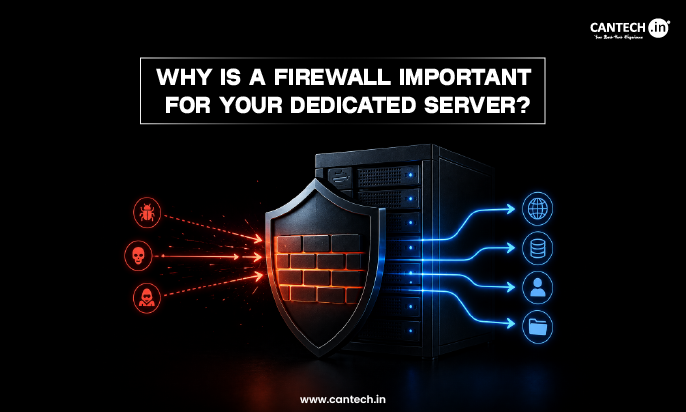
Why is a Firewall Important for Your Dedicated Server?
A firewall is a system that filters traffic on your dedicated server, blocking unwanted data flows and preventing attacks and damage, while allowing traffic through securely and keeping your data safe, your systems compliant and your service running smoothly.
Introduction
If you have a dedicated server, it means that you rent a computer located on the internet on which you will host your website or online services. Unlike shared hosting, where the server is managed by the web hosting provider, with the dedicated server, the responsibility for its security lies with you. It is essential to know why a firewall is crucial for your dedicated server. A firewall is the first line of defense against possible attacks, and it filters the data sent to the server and allows you to block or allow specific requests. In this blog we will discuss the importance and benefits of firewalls to dedicated servers.
The Importance of a Firewall
A dedicated server is usually used to host websites, applications, databases, or other critical data and processes. Each of these elements has information valuable enough to be a target for potential hackers and bot scans. A firewall is crucial for dedicated IP servers for several reasons:
They are usually an open target for attacks
The servers have their own IP address on the internet, meaning that they are constantly scanned by bots looking for possible vulnerabilities.
Firewalls act as a first barrier against attacks
They are usually the point of entry to the system, which means that the traffic coming there has to be carefully filtered.
Firewalls are essential because they filter at a network level
It means that the network traffic has to pass through the firewall, allowing it to be filtered according to specific rules.
Help reduce the attack surface
Firewalls help protect servers by reducing the number of attack vectors.
Reduce unnecessary network traffic
A part of the network traffic can be hijacked and used to attack the server directly. It also means that the server has to process more information than necessary.
Protect the business from downtime
A firewall is particularly useful in cases when the server is hosting an e-commerce system or other software valuable to the business
Benefits of Using a Firewall on a Dedicated Server
Some of the common benefits of using firewall on dedicated server are:
- Prevents unauthorized access by controlling the flow of traffic in and out of the server. This includes limiting access to specific ports and services, such as HTTP or HTTPS, and blocking access to other services like SSH, databases, or management panels unless they are accessed from authorized IP addresses.
- Helps to prevent distributed denial-of-service (DDoS) attacks by limiting the number of requests that can be sent to the server and by filtering out traffic that is not legitimate.
- Helps to prevent malware and other security threats by blocking traffic from known malicious sources or by analyzing traffic for signs of an attack.
- Helps to protect critical data and assets by providing an additional layer of security, such as by masking internal IP addresses or by protecting against common exploits.
- Helps to reduce the load on the server by filtering out unwanted traffic.
Common Uses of a Firewall on a Dedicated Server
Some of the uses of firewall on a dedicated server:
Securing remote administration
Restrict SSH, RDP, or control panel access to specific IP ranges or VPNs to prevent brute-force attacks.
Protecting web applications
Filtering HTTP/HTTPS traffic to block common exploit vectors, SQL injection attempts, and malicious bots.
Isolating services
Segregating traffic between different applications, databases, and services on the server to contain potential breaches.
Compliance enforcement
Enforcing network security policies mandated by regulatory standards like PCI-DSS or HIPAA for servers handling sensitive data.
Monitoring and auditing
Logging connection attempts and traffic patterns to identify reconnaissance activities or anomalous traffic that may indicate an attack.
Conclusion
A Firewall is an essential part of your infrastructure security and helps to protect your server in case of various kinds of attacks available nowadays on the Internet. Regardless of the business you are running, you need to configure the firewall rules when launching your server. The money and time spent on its configuration are worth the price of a single DDoS attack that can take your website offline and steal all your data.
But if you are unable to get firewall configuration or find it challenging, Cantech Hosting offers you managed dedicated servers that take care of most of the tasks. Our staff is always available to make sure that your firewall rules are up-to-date and the server is protected against attacks at any moment. With our professional team monitoring your server 24/7, you do not have to worry about any security issues, whether it be IP spoofing or DDoS. So contact us and configure a robust and strong Firewall for your dedicated server to keep hackers out!
FAQs
Is a firewall necessary if I already have antivirus software on my server?
Yes, you will need a firewall regardless of antivirus programs because they serve different purposes. While antivirus software detects and removes malicious programs from your system, a firewall monitors traffic entering and exiting your system to keep unauthorized traffic out.
What is the difference between a hardware and a software firewall?
A hardware firewall is a type of firewall that exists as a physical device whereas a software firewall is a program that runs on the computer it protects. In most cases, hardware firewalls are typically located at network infrastructure level (i.e., by the hosting provider), while software firewalls offer greater versatility at the server level.
Will having a firewall affect my server performance?
A properly configured firewall should have little to no effect on your system performance. In fact, it may improve it by blocking unwanted traffic from utilizing your system resources. Poorly optimized firewall rules can cause performance issues.
Can I use a free firewall for my dedicated server?
Yes, you can use a free firewall solution for your dedicated server. iptables, firewalld, and ufw are some of the most popular free and open-source firewall tools available for Linux-based systems.
How often should firewall rules be reviewed?
It is good practice to review and update your firewall rules periodically. At a minimum, firewall rules should be reviewed and updated when new services are installed or whenever your IT infrastructure undergoes significant changes to reduce the risk of security incidents.