Cloud hosting is a web hosting solution that uses multiple interconnected virtual servers to host websites and applications, instead of relying on a single physical server. When one server fails, others take over automatically, ensuring near-perfect uptime, seamless scalability, and consistent performance regardless of traffic spikes. It is the most flexible and reliable hosting option for growing businesses, high-traffic websites, and applications that cannot afford downtime.
What is Cloud Hosting?
Cloud Hosting Definition
Cloud hosting is web hosting that uses multiple virtual servers to distribute resources, ensuring better scalability, reliability, and performance.
It is a modern solution that enables the best performance and can help you overcome your challenges with flexibility and scalability. It is a forward-thinking approach to web hosting that prepares you for the future.
What is a Cloud Server?
A cloud server is a virtual server created from physical hardware using virtualisation technology, running independently within a cloud hosting environment. It provides dedicated computing resources including CPU, RAM, and storage that can be scaled up or down on demand.
How Does Cloud Hosting Work?
Many beginners ask what is cloud hosting and how does it work. The answer starts with understanding how virtual servers distribute resources across multiple physical machines automatically.
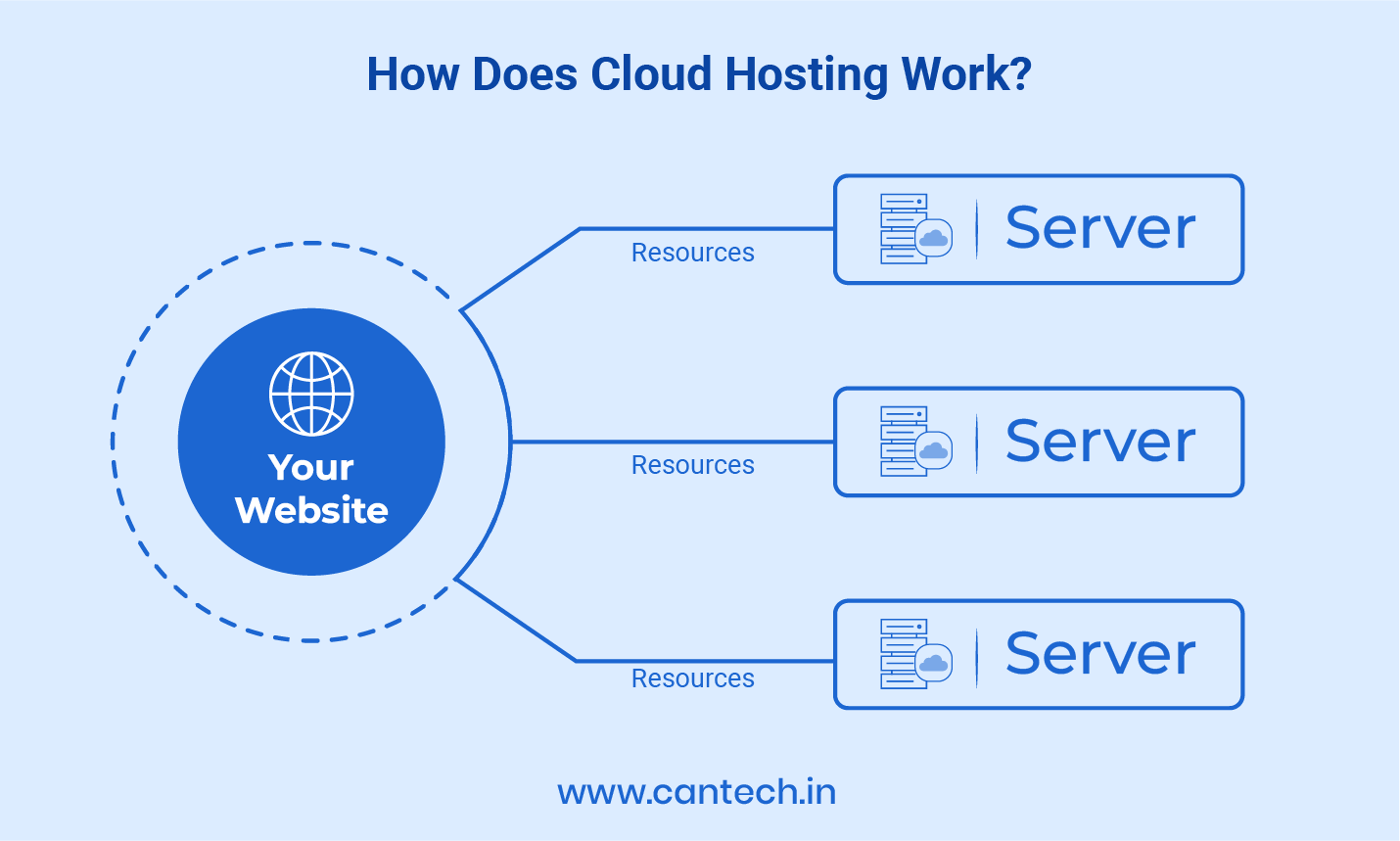
A virtual server draws resources from multiple cloud sources. So, even if any one server suffers it won’t crash your app or website as the other servers would be intact. Due to this reason, it offers great performance and high uptime.
Moreover, this network of numerous virtual cloud servers is distributed across different locations on which you can host your app or site. Whereas traditional hosting services include physical servers that work from fixed premises or are rented from the hosting providers.
Thus, cloud hosting is not dependent on a single server; it uses a network of interconnected cloud servers. Basically, you can get access to the computing resources from a shared pool of cloud server resources. Therefore, it offers a flexible and scalable nature of hosting for your platform by eliminating the challenges of resource provisioning.
It is cost-effective and does not need your own data centers like traditional dedicated servers. You can outsource your resource needs to the service providers. Thus, you can scale as per your growing needs without any operational expenses or investments in hardware.
So, what is Cloud Hosting? It is a modern and efficient web hosting solution through virtualized server environments managed by third-party providers. The future of hosting lies in the cloud.
What are the Key Features of Cloud Hosting?
-
High Availability – Runs on multiple servers to ensure minimal downtime and continuous uptime.
-
Pay-As-You-Go Pricing – Pay only for the resources you actually use, reducing infrastructure costs.
-
Load Balancing – Automatically distributes traffic across servers for consistent performance.
-
Resource Pooling – Uses shared infrastructure for efficient resource allocation and flexibility.
-
Automatic Backups – Enables data backups and faster recovery during failures.
-
Disaster Recovery – Ensures business continuity with redundancy and failover support.
-
Flexible Infrastructure – Quickly deploy, modify, or upgrade servers and applications.
-
Global Accessibility – Access applications and data from anywhere with an internet connection.
Why Cloud Hosting is Better?
The above section on Cloud Hosting meaning and working explains how flexible, scalable, and reliable it is. The below points further add to when and why you should consider it:
- You can customize your server resources as per your requirements. Cloud hosting can withstand the huge resource requirements of your application like processing power, bandwidth, RAM, and storage space; for example, heavy blogs or news publication sites, search engines, rich media, etc. It offers reliable data backup and disaster recovery solutions. Read more about what is bandwidth in web hosting in our detailed blog guide.
- Need an ideal web hosting that can manage sudden website traffic rise? Cloud hosting’s distributed infrastructure is right in scenarios like promotions, seasonal traffic, or unexpected flow.
- You can implement advanced security and compliance measures for eCommerce stores, social media networks, or other platform types requiring specialized security.
- Enterprise-level projects with high traffic combine cloud hosting with content management systems (CMS) like WordPress for enhanced, flexible, and easy website development and management.
What are the Key Advantages of Cloud Hosting?
Now, what is cloud hosting in terms of its benefits for your website or application? Let us summarise how virtual cloud servers can give your platform the best performance, convenience, and other advantages.
No Technical Knowledge Required
The cloud hosting service provider takes care of end-to-end server management and maintenance. They handle the backend operations so you need not have any technical know-how of the server operations.
High Uptime
It delivers high uptime by running across multiple servers simultaneously. If one server goes down, traffic is automatically rerouted through load balancing to other available servers, keeping your website online without interruption. Most cloud hosting providers guarantee 99.97% or higher uptime through this redundant infrastructure.
Scalable
Cloud hosting lets you scale server resources, CPU, RAM, storage, and bandwidth up or down in real time based on your actual needs. Unlike traditional hosting where you pay for fixed resources regardless of usage, it adjusts dynamically to your traffic and workload. This makes it ideal for businesses with seasonal spikes, growing websites, or unpredictable traffic patterns.
Security
It stores data across multiple servers, so if one server is compromised or experiences a hardware failure, your data remains protected on other servers in the network. Hosting providers offer regular security framework updates, firewalls, encryption, and access controls to keep your infrastructure safe. Combined with automated daily backups, It provides enterprise-level data protection for businesses of all sizes.
Cost Effective
Cloud hosting follows a pay-as-you-go pricing model; you only pay for the CPU, RAM, storage, and bandwidth you actually consume. This eliminates the need for large upfront hardware investments and ongoing maintenance costs of physical servers. For businesses with variable workloads, this model can reduce hosting costs greatly compared to fixed-price dedicated or VPS plans.
Also Read: Cloud Cost Optimization
Faster Deployment
You need not wait while the traditional hosting servers are purchased, set up, and tested. So, with cloud hosting service providers, you can start getting the benefits of modern technology faster than the slower traditional hosting development process.
Global Accessibility
It has data centers all over the world. Thus, it reduces latency and increases availability to your website or application across various geographic locations.
What are the Disadvantages of Cloud Hosting?
Cloud hosting is a popular modern hosting type. However, it does have its share of limitations discussed below –
Internet Connectivity
It depends on an internet connection so if it is lost your website becomes inaccessible. Thus, you must have a contingency plan so that the business operations continue during such downtime.
Complex Customization
Cloud hosting platforms do not provide more advanced or complex customizations & tailored systems. You may choose other hosting types like dedicated servers, unmanaged hosting, Virtual Private Server (VPS), etc that may offer more flexibility.
Security Protocols
You need to evaluate the security protocols of the provider and implement additional measures if needed for the data stored remotely in offsite storage.
What are the Types of Cloud Hosting?
Cloud hosting can be deployed in different ways depending on how infrastructure is owned, managed, and shared. These deployment models determine security, scalability, and control.
| Types of Cloud Hosting | Description |
| Public Cloud Hosting |
|
| Private Cloud Hosting |
|
| Hybrid Cloud Hosting |
|
What are the Cloud Hosting Service Models?
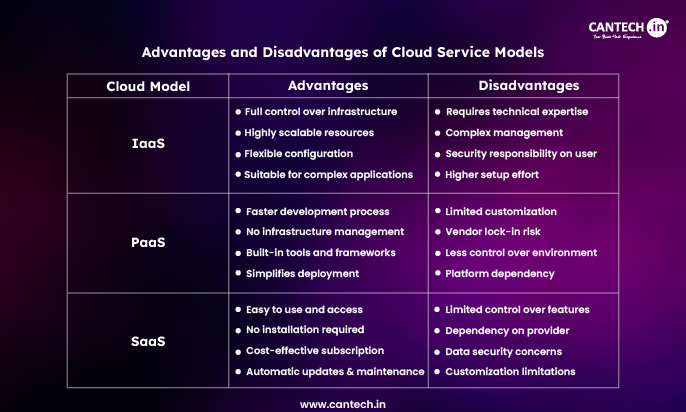
The types of Cloud Hosting include four main categories discussed below. They are divided as per the control and flexibility that they provide.
Infrastructure as a Service(IaaS)
With IaaS, you get the virtualized hardware resources for your software environment installation. Thus, you need not build and maintain physical data centers and simply rent the server and computing resources. Also, you only pay for your usage. This category of cloud hosting offers high scalability too.
Platform as a Service(PaaS)
This category enables speedy development and deployment of web applications with the software environment that it provides. It is a full application deployment platform that requires manual scaling. The management of the cloud server resources is in the hands of the PaaS providers. Thus, you need not worry about infrastructure management and create software with convenience. You can keep your focus only on your project.
Software as a Service(SaaS)
When you get the ready software applications over the internet it is called SaaS. The vendor offers them on a subscription basis. The applications can be accessed on any device as they are hosted on a cloud. You need not have an in-house server and get enterprise-grade software without huge upfront investments and operation costs.
Serverless Computing
You can execute functions or microservices in response to events using serverless computing without the need to manage the infrastructure. The server management tasks are handled by the providers. Thus, it speeds up the application-building process and brings down the operational challenges. It scales automatically as per the variable workloads.
How Does Cloud Hosting Compare to Traditional Hosting?
What is cloud hosting compared to other hosting types i.e. Cloud hosting vs. Web Hosting, VPS, Shared, and Dedicated Hosting?
Cloud Hosting vs. Web Hosting
Web hosting includes various hosting types including cloud hosting. Check out the difference between cloud hosting and web hosting to get further clarity –
| Feature | Cloud Hosting | Web Hosting |
| Meaning | Cloud Hosting setup involves a cluster of multiple servers interconnected to each other for sharing resources. | Web hosting is a comprehensive term for various types of hosting solutions such as shared, VPS, cloud, and dedicated hosting services. You can choose one depending on your specific needs. |
| Performance | Cloud hosting distributes resources across multiple servers. Thus, it can offer better performance during high traffic. | Depends on the type of server you choose based on your needs. However, web hosting relies on a single server so performance depends on its capacity. |
| Security | Cloud hosting stores data across multiple servers, therefore, it can improve security with redundancy and faster recovery. | A single server is responsible for security so it can have risks of data loss during attacks or hardware failures. However, it depends on the type you choose, for example, a dedicated server offers advanced security and compliance. |
| Scalability | Cloud hosting allows real-time scaling of resources without interruptions. It quickly adapts to traffic spikes. | Scaling resources are limited to physical upgrades and it may get downtime. |
Cloud Hosting vs. VPS Hosting
VPS Hosting is similar to cloud hosting. It partitions a physical server into multiple virtual servers using virtualization. The differences between cloud hosting vs VPS hosting are discussed below:
| Feature | Cloud Hosting | VPS Hosting |
| Resource Allocation | It uses multiple cloud servers on a physical server distributed across various locations. | It has a single physical server that is partitioned into multiple virtual servers. |
| Management and Customization | It does not require technical skills because the cloud hosting provider manages it. However, it is less customizable and provides limited control. | It requires technical know-how as it is often self-managed with root access. Thus, it offers more control over server configuration and software installation. |
| Security | It has multiple virtual machines and offers isolation so it is highly secure. | It is secure as it offers dedicated resources and a dedicated IP address. |
Cloud Hosting vs. Shared Hosting
Shared hosting means when one server allocates its resources between multiple websites. The differences between cloud hosting vs shared hosting are discussed below:
| Feature | Cloud Hosting | Shared Hosting |
| Performance and Scalability | It has features like traffic load balancing to ensure high performance. It does not share the resources with other apps or sites. Also, it is easily scalable. | The performance can be affected due to other websites on the same server as the resources are shared. It offers limited resources and scalability. |
| Security | More secure with dedicated virtual isolated environments. | It can cause a security threat even if one website on the server suffers a breach. |
| Maintenance and Ease of Use | The hosting provider manages and maintains the server. Thus, it is suitable for users of all skill levels. | This hosting type is also managed and maintained by the hosting provider. It is ideal for small-scale and beginners. |
Cloud Hosting vs. Dedicated Server
The dedicated server hosting type allocates all its resources to a single site or app with complete access, control, and customization of server configuration, settings, installation, etc. The differences between cloud hosting and dedicated server hosting are discussed below:
| Feature | Cloud Hosting | Dedicated Server |
| Cost | It is cost-efficient, you can pay as per your usage of server resources. | It is high in cost as it offers dedicated resources. |
| Performance and Scalability | It ensures high performance with a load-balancing feature. Also, it offers easy scalability. | It gives the best website or app performance because all server resources are dedicated to one website. It is scalable as per the hosting provider’s offerings. |
| Management and Control | The hosting provider manages and maintains cloud hosting. Thus, it reduces the need for technical skills. However, it offers lesser control. | Requires advanced skills to manage and maintain the server, but offers full control. |
| Security | It offers high security. | The complete control and customised configurations of the server ensures the best security with proper server management. |
| Resource Allocation | It draws resources from a shared pool of multiple servers. | All server resources are dedicated to a single website or app. |
How to Choose the Right Cloud Hosting Plan?
To ensure effective management of resources and that the site performs well, you need the right cloud hosting plan. So, you should carefully evaluate several factors based on your unique needs —
- Evaluate your website’s needs in terms of estimated traffic and the storage, processing power & bandwidth you will require for the same.
- Compare hosting packages for features and pricing structures. Understand what each of them offers in terms of services, performance, reliability, and uptime guarantees.
- Prioritise security features when choosing a hosting plan. Take into account the data protection measures and policies. necessary compliance standards, and privacy regulations.
Consider additional features like ensuring that backup and recovery solutions are part of the package. Also, confirm that the hosting provider integrates well with other tools or services you may use.
Why Choose Cantech for Cloud Hosting?
What is Cloud Hosting like with Cantech? We offer robust cloud infrastructure and ensure the best performance optimization with our services. Our plans start at just ₹640 per month with premium features that guarantee high uptime and super-fast load times. They include unlimited email accounts, databases, bandwidth, free SSL certificates, and more.
Our cloud hosting server management becomes easy with an intuitive cPanel interface that comes with our services. You can easily oversee your website, manage emails, and scale resources using the same. Also, we provide 24/7 technical support. Any business type from a startup to an enterprise can rely on and scale with Cantech’s Cloud Hosting and Enterprise managed hosting.
Conclusion
This comprehensive blog on ‘what is cloud hosting’ covers various important aspects because choosing the appropriate hosting type with an ideal provider is essential. These decisions can ensure the efficiency and reliability of your website or application.
Cloud hosting is a modern solution with a lot of benefits such as optimal performance and scalability. It has better features compared to traditional hosting options. With Cantech, you can ensure consistent performance and uptime due to our advanced features and around-the-clock support. Get in touch today!
FAQs On Cloud Hosting
What Does Cloud Hosting Mean?
Cloud hosting services include virtual servers in the cloud to facilitate hosting for your website or app. It provides access to resources from multiple interconnected servers. Thus, you get great flexibility and high availability.
Why Cloud Hosting?
Cloud hosting provides server resources and infrastructure to host websites, applications, and data storage. It is highly suitable if they need scalability, better performance, and reliable uptime.
What is Cloud Based Web Hosting?
Cloud-based web hosting means your website is hosted on multiple connected servers instead of a single server. This keeps your site online, serves increased traffic and is fast in operation since resources are sourced through a network of servers.
Is Cloud Hosting the best?
The main benefits of cloud hosting include scalability, flexibility, and high uptime. It is the best for these reasons but the best hosting depends on the specific requirements of a website or application.
Is Cloud Cheaper than Dedicated Server?
Cloud hosting is usually cheaper than a dedicated server for most businesses because you pay only for the resources you use, without upfront hardware or maintenance costs. Dedicated servers involve fixed monthly costs regardless of usage, making them less cost-efficient for variable workloads. However, for consistently high and predictable resource needs, a dedicated server can sometimes be more cost-effective long term.
What Are the Best Cloud Hosting Providers?
You can choose from several top cloud hosting providers that offer unique features and pricing. Some popular choices include –
- Cantech
- Hostinger
- MilesWeb
- HostGator
- A2 Hosting
How Do I Choose a Cloud Hosting Provider?
You need to consider several factors and compare different cloud hosting providers for their offerings, pricing, performance, customer reviews, scalability, security, technical support, etc. Discuss with them and ensure they are reliable for your website needs.
Who should use Cloud Hosting Solutions?
If a site or app experiences fluctuating traffic, needs high performance & uptime, or requires the ability to scale resources quickly, they may prefer cloud hosting solutions.
What are the different types of Cloud Hosting Services?
The different types of cloud hosting services include public cloud, private cloud, hybrid cloud, and multi-cloud hosting. They differ in terms of resource control, security, and scalability.
Is Cloud Hosting cheaper than Shared Hosting?
Cloud server cost in India plans have higher charges than shared hosting as they provide modern infrastructure, scalable resources, and various advanced features for higher performance.
What Is the Difference Between Cloud Hosting and Saas?
Cloud-hosted services provide the infrastructure to host websites and applications. Whereas, Software as a Service (SaaS) is a cloud-based software delivery model with which you can access software over the internet without management responsibilities of infrastructure.
What Is the Difference Between Cloud Hosting and Computing?
Cloud hosting uses virtual servers to provide hosting services. Whereas, cloud computing is related to providing various IT resources like storage, processing power, and networking through the internet. It not only involves hosting, it is more than that for other functions like data analysis and machine learning
What Is the Difference Between Web Hosting and Cloud Hosting?
When an interconnected network of virtual servers on a physical server is used to host websites then this setup is called cloud hosting. It uses multiple virtual servers on a physical server. These servers are across various locations distributing resources. Whereas Web hosting uses one server for your website’s files. Thus, It is more scalable, flexible, and reliable. It offers high performance, security, and faster loading times.
Why is Cloud Hosting better than On-Premise?
Cloud hosting is better than on-premise hosting in terms of greater scalability, uptime, and reduced maintenance. Businesses need not incur high upfront costs of buying and maintaining physical servers.