Cloud architecture is the structural design of all the technology components hardware, software, networks, and services that work together to build and deliver cloud computing solutions. It acts as a blueprint that defines how cloud resources are combined, virtualised, and delivered to meet specific business needs. A well-designed cloud architecture ensures scalability, security, high availability, and cost-efficient performance for any workload or application.
What is Cloud Architecture Definition?
Cloud Architecture refers to the structural design of a business’s information technology systems, which involves databases, applications, servers, and networks, and how they will deliver cloud computing services to users. This design works with virtualization, scales to meet the demands of different organizations, and offers cloud services and solutions (IaaS, PaaS, and SaaS).
How Does Cloud Architecture Work?
Here’s a breakdown of how cloud architecture works:
Selecting a Deployment Model
The organization must decide on the most appropriate deployment model for their cloud services. Some of the options are public, private, hybrid and multi-cloud.
Provisioning Resources
The organization provisions the virtual machines, resources and capacities in the cloud of its choice through a web interface or an API, thus removing the necessity to buy and provision physical hardware.
Hosting the Applications
Applications will be hosted in the cloud as virtual machines or containers. This removes the need to develop and maintain applications and instead allow developers to utilize their time and effort to deploy and maintain applications in the cloud. Developers can also create and deploy applications in a virtual machine hosted in the cloud to conduct tests before deploying the final application to the production platform.
Scaling
The organization can manually scale up applications in the cloud or utilize automatic scaling to utilize more resources when there is an increase in demand and reduce capacity when traffic decreases. For example, a medical organization can automatically scale up its patient portal during winter when more individuals are likely to seek healthcare services.
Continuous Monitoring and Management
The organization monitors the performance of the systems and applications deployed in the cloud and manages the cloud environment. Monitoring activities are critical and should be continuous to ensure systems and applications are operating as intended.
Overall, cloud architecture provides an organization with the necessary components to satisfy their technological needs without the need to acquire and maintain hardware infrastructure. It allows individuals and organizations to achieve a wide range of applications while still being able to utilize existing infrastructure, software, and equipment.
What are the Cloud Architecture Components?
Cloud architecture consists of several key components that work together to deliver cloud services.
1. Frontend
The clients or the users interact with this layer called Frontend. In other words, devices, apps, and interfaces through which they interact with cloud services are called Frontend. For example – a browser or an app to access your saved files on the cloud.
2. Backend
Most of the operations happen here in the backend, therefore, it is a very important layer and component. The servers, storage, virtual machines, etc run in the backend. Their role is to manage resources for security and smooth performance of the apps or site. The backend cloud architecture components –
- Applications in the backend meet various client’s needs for resources (storage, processing power, data processing, etc).
- The service component handles and ensures you get the service that you subscribe to i.e. SaaS, PaaS, or IaaS. Service is the heart of architecture where all tasks are handled and resource access is managed.
- Runtime Cloud creates the environment where applications or virtual machines run. Thus, it provides the necessary execution layer for backend operations.
- Storage components manage and store data with flexible solutions such as simple file storage or even advanced databases.
- Infrastructure – Hardware components (storage, CPU, network, etc) and software tools fall into this component type.
- Management systems manage resources in real-time as per the user requirements. They ensure everything works smoothly and securely. Also, management software (middleware) is important for the backend and frontend coordination and communication related to resource needs.
- Security protocols like backups, firewalls, debugging, etc. offer end-to-end protection for everything within the cloud.
3. Network
The network is the medium between frontend and backend with which the data can flow smoothly. Thus, it includes the internet or a private network (like an intranet) or intercloud.
4. Cloud-Based Delivery Models
Well, the Cloud delivery models determine how cloud computing services are offered and consumed. So it is an important component of working of architecture –
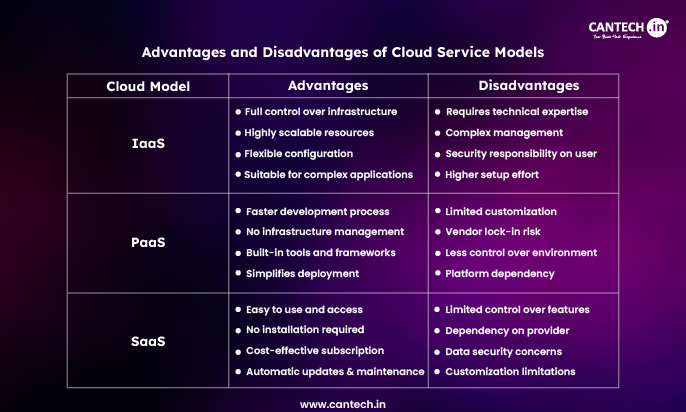
Infrastructure as a Service (IaaS)
IaaS provides virtual servers, storage, and networking access that you rent in the form of backend infrastructure to run your apps. Thus, you do not own physical servers and can easily scale without investing in hardware.
Platform as a Service (PaaS)
PaaS includes a full-fledged development environment to build, test, and deploy applications. It has tools, frameworks, and runtime environments that simplify app development. You use the platform without needing to manage the underlying infrastructure.
Software as a Service (SaaS)
You get ready-to-use software over the internet without needing to install or maintain it under the SaaS model. You can simply log in and start using the service. For example – Gmail, Zoom, and Salesforce.
What are the Benefits of Cloud Architecture?
We define cloud architecture, and now let us discuss a host of advantages that it offers for modern businesses.
1. Scalability
You can scale resources up or down based on your current needs to handle sudden traffic fluctuations or business growth.
2. Cost Savings
You pay only for usage and can save money as you do not need to make any upfront investments in hardware.
3. Disaster Recovery
You are prepared for any emergency as Cloud services include data backups that are replicated across multiple locations.
4. High Performance
The advanced cloud infrastructure provides fast processing and high-speed access to applications and data.
5. Security
The advanced security protocols from cloud providers protect your data and resources from threats and vulnerabilities.
6. Easy Maintenance
You always have access to the latest technology as providers handle updates and maintenance.
7. Compliance
You can easily meet regulatory requirements for your business as cloud platforms often adhere to global compliance standards.
What are the Cloud Deployment Models?
Below are the 4 main types of cloud deployment models:
Public Cloud
Public cloud setup is when users get the services over the internet but they are shared among multiple users for general use. This is highly cost-effective and accessible. Read our full article covering: What is a Public Cloud?
Private Cloud
When one organization uses the cloud services, dedicated to it with the best security and control, then it is called Private Cloud. It is highly suitable for industries with strict data privacy needs. Learn more in our blog: What is Private Cloud?
Hybrid Cloud
In the hybrid model, businesses can use the private cloud to store sensitive data and public cloud for less critical operations. Check out our in-depth guide on what is hybrid cloud?
Hybrid Multi Cloud
Businesses can choose the most suitable multiple cloud provider for your needs flexibility under hybrid multi cloud.
Conclusion
Cloud architecture provides amazing cost-efficient solutions. Using them, businesses can innovate and grow flexibly due to their great scalability and accessibility. You get endless opportunities in modern computing. Cantech offers top-notch affordable cloud hosting and computing services. Host your site/app or use our Cloud Platform-as-a-Service (PaaS) and get scalable and high-performance solutions. Reach out today!
FAQs
What is a Cloud Architect?
A professional who handles designing and managing cloud solutions is called a cloud architect. They ensure the solution meets the business’s goals. Also, they optimize performance and security for the same.
What are the Technologies in Cloud Architecture?
The architecture of cloud computing involves two key technologies –
Virtualization – When the physical hardware is divided into virtual machines, virtualization technology is used. This way, the physical resources are shared & optimised and users can have internet-based access.
Automation – This technology simplifies cloud management as it reduces manual tasks. Also, it enables faster deployment and cost savings. Moreover, DevOps processes like testing, building, and monitoring highly benefit from this technology.
What are Cloud Architecture Best Practices?
Below are the key practices –
- Automation tools reduce costs and help improve reliability, availability, and security.
- Optimise data usage to cut costs and simplify operations.
- Select suitable platforms as per your workload for performance and efficiency.
Will AI Replace Cloud Architect?
Artificial intelligence will not take over cloud architects. Instead, it will assist them in automating routine and repetitive tasks. However, architects will remain in charge of making strategic business decisions for the organization.
How to Design a Cloud Architecture?
The first step is to identify the organization’s requirements, which include the system’s scalability, budget, compliance, and performance needs. Then, one has to determine which cloud service (computing, storage, networking, or database) to adopt and design the infrastructure according to the selected solution’s security, availability, and fault tolerance requirements. It is also essential to follow the well-architected framework to help build reliable cloud systems that are cost-optimal and perform well. Finally, one should document the design and establish procedures for scaling and monitoring the system.