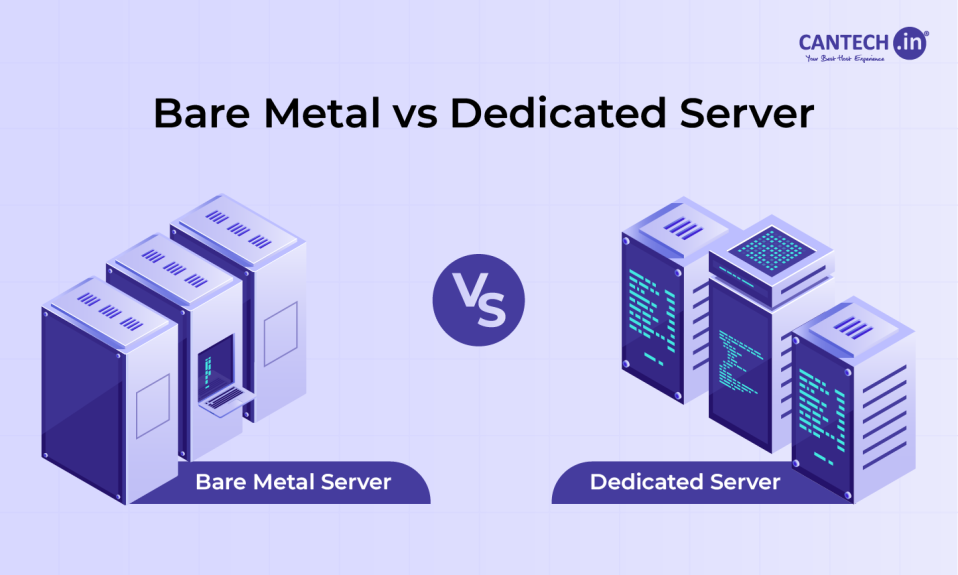
Bare Metal vs Dedicated Server: What’s the Difference?
A bare metal server is a physical server dedicated to a single tenant without a virtualization layer, offering maximum performance and hardware control. A dedicated server is also allocated to one customer, but the term is broader and may include managed services or hosting-specific configurations. In many hosting environments, bare metal servers are considered a specialized type of dedicated server optimized for performance-intensive workloads.
Introduction
Ever came across dedicated servers while searching for a bare metal server or vice versa? You’ll find the terms used as if they’re synonyms, but trust me, they’re not!
This confusion can cost businesses real loss when they sign a contract assuming one model and get another one instead. This comparison article of bare metal vs dedicated servers breaks down the actual technical and commercial differences so IT decision-makers can stop guessing and start taking the best decision for their workloads.
Bare Metal vs Dedicated Server: Quick Comparison
| Feature | Bare Metal Server | Dedicated Server |
|---|---|---|
| Physical Hardware | Dedicated | Dedicated |
| Virtualization | Typically None | Usually None |
| Performance | Highest | High |
| Customization | Extensive | Moderate to High |
| Cost | Higher | Lower |
| Scalability | Moderate | Moderate |
| Management | Requires Expertise | Easier with Managed Plans |
| Best For | AI, Big Data, Gaming | Websites, Databases, Business Apps |
Bare Metal vs Dedicated Server: Which One Should You Choose?
| Requirement | Recommended Option |
|---|---|
| Maximum Performance | Bare Metal Server |
| AI & Machine Learning | Bare Metal Server |
| Gaming Servers | Bare Metal Server |
| Enterprise Applications | Bare Metal Server |
| High-Traffic Websites | Dedicated Server |
| Business Hosting | Dedicated Server |
| Managed Hosting | Dedicated Server |
| Budget-Friendly Option | Dedicated Server |
Bare Metal Server vs Dedicated Server: Key Differences
Although Bare Metal Servers and Dedicated Servers both provide exclusive access to physical hardware, they differ in terms of performance, customization, management, and pricing. Understanding these differences can help businesses choose the right hosting solution for their specific requirements.
Performance
- Bare Metal Servers are designed to deliver maximum performance by providing direct access to the underlying hardware without any virtualization layer. This results in lower latency, faster processing speeds, and predictable performance, making them ideal for resource-intensive workloads such as AI, big data analytics, gaming, and high-performance computing.
- Dedicated Servers also offer reliable performance through dedicated resources, but they are generally optimized for traditional hosting requirements such as websites, databases, and business applications.
Cost
- Dedicated Servers are typically more affordable and offer predictable monthly or annual pricing. They are a cost-effective choice for businesses that require dedicated resources without the need for extensive hardware customization.
- Bare Metal Servers often come at a higher cost due to their premium hardware configurations, advanced customization options, and enterprise-grade performance capabilities.
Customization
- Bare Metal Servers provide greater flexibility for hardware and software customization. Businesses can select specific processors, storage configurations, memory capacities, and networking options to meet demanding workload requirements.
- Dedicated Servers also support customization, but the available options may depend on the hosting provider’s predefined server configurations and service plans.
Management
- Dedicated Servers are commonly available with managed hosting services, where the provider handles server maintenance, monitoring, security updates, and technical support. This makes them easier to manage for businesses with limited in-house IT expertise.
- Bare Metal Servers generally require a higher level of technical knowledge and are often preferred by organizations that need complete control over their infrastructure.
Scalability
- Both Bare Metal Servers and Dedicated Servers can scale vertically through hardware upgrades such as additional RAM, storage, or processing power.
- However, Bare Metal Servers integrated with cloud environments may offer greater flexibility for scaling workloads and adapting to changing business demands. Dedicated Servers are better suited for applications with predictable and consistent resource requirements.
Quick Summary
If your priority is maximum performance, extensive customization, and support for demanding workloads, a Bare Metal Server is the better choice. If you need reliable performance, easier management, and cost-effective hosting for websites and business applications, a Dedicated Server is often the ideal solution.
Bare Metal vs Dedicated Server: Meaning, Features, Benefits & Use Cases
In this section, let us evaluate Bare Metal vs. Dedicated Server with the meaning, features, and reasons to use the specific server type for your business.
What Is a Bare Metal Server?
A Bare Metal Server is a physical server type. It is dedicated solely to a single user and does not include a virtualization layer, hypervisor, or sharing of resources. It offers direct access to the server’s hardware components (CPUs, memory, and storage). Bare Metal Servers have built-in cloud compatibility. Thus, users benefit from optimal performance and efficiency; highly suitable for high-demand scenarios i.e. where performance and reliability are essential.
All in all, bare metal servers support businesses to achieve peak performance levels without latency and resource contention like in virtualized environments.
Discover more about Bare Metal Servers and their benefits for high-performance hosting.
Features of Bare Metal Servers
- Bare Metal Servers do not have a virtualization layer. In other words, the server’s entire capacity is available to the user with faster processing times and reduced latency. Moreover, applications that require intense computational power and speed must opt for bare metal servers.
- Root access with users’ complete control over the operating system and server configurations allows them to customize setups such as software installations, security settings, and performance optimizations as per specific business requirements.
- Users have custom control panel options like cPanel or Plesk to manage server operations and hosting environments effectively. They offer user-friendly interfaces to manage websites, databases, email accounts, and other server functions. Hence, administration tasks get better and simplified.
- Its advanced hardware such as the latest SSDs, NVMe drives, and high-speed networking capabilities offer top-tier performance and the best server capacity. It can handle high-speed data transfers and large volumes of transactions.
- Its DDoS protection and isolated IPs enhance security and prevent attacks. Also, the physical isolation from other servers and dedicated security measures reduce the risk of cyber threats and unauthorized access. All in all, it provides a secure environment for sensitive data.
Why use Bare Metal Servers?
Bare Metal Servers can offer businesses raw performance, control, and customization. As discussed, you get direct access to hardware without virtualization; great for high-performance tasks and applications. Moreover, the flexible billing models and advanced security features make them a preferred choice for demanding applications.
Well, the answer to ‘Why use Bare Metal Servers?’ can further be clarified with the benefits and use cases of bare metal servers:
Benefits of Bare Metal Servers
Below is the summary of the advantages of bare metal servers:
- Bare Metal Servers offer high performance, faster processing, and reduced latency. These advantages are highly valuable for applications that require rapid data processing and minimal delays.
- Isolation of server resources means enhanced security. It has a more secure infrastructure for handling sensitive information.
- Its flexible plans come with pay-as-you-go pricing. Thus, this flexibility is ideal for businesses with variable workloads as they can scale resources based on demand and avoid paying for unused capacity.
Use Cases of Bare Metal Servers
Bare Metal Servers are suitable for applications that demand high performance and reliability such as below:
- Enterprise Applications
ERP systems and CRM software need robust processing power and necessary resources to handle such complex enterprise applications and large-scale data operations efficiently.
- High-Performance Computing
Big data analysis and complex simulations are other examples that need direct hardware access and high-speed processing capabilities for data-intensive computations and simulations.
- Gaming
Online gaming platforms need low latency and high-speed hardware for smooth user experiences. Gamers can benefit from bare metal servers that help to enhance the overall gaming experience with minimal latency and performance.
- Financial Services
Bare Metal Servers offer high-performance and secure environments that make them ideal for processing financial transactions and conducting real-time risk assessments and analysis. Also, they can handle large datasets securely.
What Is a Dedicated Server?
A Dedicated Server is a web hosting type in which a physical server is allotted to a single user who gets complete access to the same. This setup ensures that the server’s processing power, memory, and storage are dedicated to one user. Moreover, dedicated Servers offer a traditional hosting approach with no virtualization. It offers reliability, control, and consistent performance.
Dedicated Servers are often used for applications that require reliable performance and large resource allocations including high-traffic websites and enterprise databases.
Learn more about Dedicated Hosting and how it compares to other hosting solutions.
Features of Dedicated Servers
- Full resource access means complete control over CPU, RAM, and storage without sharing them with other users. This dedicated access ensures that all resources are available for the user’s applications. It offers consistent performance and reliability.
- It offers the ability to customize hardware configurations in the server. Users can choose and configure hardware specifications according to specific needs for processors, memory, and storage as per their requirements. Also, it can meet your websites’ or apps’ custom security settings and compliances.
- With a highly stable environment, users get consistent performance for mission-critical applications. Users get exclusive use of the server and their performance is not affected by other users or applications.
- Physical isolation from other servers offers better security. It reduces the risk of security breaches and unauthorized access. Hence, users get a highly secure environment for sensitive data.
- Operating System Choice: Freedom to choose between Linux dedicated hosting and dedicated server with Windows allows users to run OS-specific applications and software stacks. This flexibility ensures compatibility with business tools and development environments. It supports a wide range of workloads without platform limitations.
Why use Dedicated Servers?
Dedicated Servers offer businesses a reliable and high-performance hosting environment. Users get complete control over the server’s resources and configurations. Thus, they are suitable for applications that have demanding performance and custom security needs. Their reliability, stability, and predictable costs make them an ideal choice for long-term projects and high-traffic websites. Below are the benefits and use cases, to explain why use Dedicated Servers.
Benefits of Dedicated Servers
- Reliable and consistent performance with dedicated resource availability benefits applications that rely on steady and reliable server operations.
- Customizable configurations and settings can enable you to tailor the server to meet your specific business requirements. Also, the users can adjust hardware and software configurations as per their operational needs and preferences.
- It has fixed monthly or annual fees so it offers cost predictability. Hence, businesses can budget more effectively for their hosting expenses.
Use Cases of Dedicated Servers
Below are some of the use cases of dedicated servers:
- High-Traffic Websites
Optimal performance and reliability are crucial in high-traffic websites. Dedicated Servers can handle such large volumes of traffic so it is ideal for popular websites and online applications.
- Enterprise Databases
Databases run efficiently and handle large datasets effectively with the dedicated resources of these servers for large amounts of storage and processing power.
Other use cases of dedicated servers include websites or applications that require custom security compliances, mission-critical nature, multiple platforms, etc.
Related: Advantage and Disadvantage of Dedicated Server Hosting
Comparison & Difference between Bare Metal and Dedicated Servers
The Bare Metal vs. Dedicated Server comparison is easier to understand through the meanings and uses discussed above. Now, below is the summary to get a clearer picture of their differences & similarities.
| Feature | Bare Metal Server | Dedicated Server |
|---|---|---|
| Definition | A physical server dedicated to a single tenant with direct access to hardware resources. | A physical server allocated to a single customer for exclusive use. |
| Hardware Access | Full direct access to underlying hardware. | Full access, but customization may depend on the hosting provider. |
| Virtualization Layer | Typically no virtualization layer. | May or may not include virtualization depending on configuration. |
| Performance | Maximum performance with minimal latency and overhead. | High performance suitable for most business applications. |
| Resource Allocation | 100% dedicated resources with no sharing. | Dedicated resources with no sharing. |
| Customization | Extensive hardware and software customization options. | Moderate to high customization based on provider offerings. |
| Scalability | Scaling often requires hardware upgrades or additional servers. | Similar scalability options, though often easier through managed hosting plans. |
| Security | Excellent isolation and security for sensitive workloads. | Strong security with dedicated resources and customizable controls. |
| Management | Usually requires greater technical expertise. | Available in both managed and unmanaged configurations. |
| Deployment Time | May require longer provisioning depending on hardware requirements. | Generally faster deployment through standardized configurations. |
| Cost | Typically more expensive due to premium hardware access. | Usually more cost-effective for standard business workloads. |
| Best For | High-performance computing, AI/ML, big data, gaming, and enterprise applications. | Web hosting, databases, business applications, ERP, and growing websites. |
| Maintenance Responsibility | Often managed by the customer unless a managed service is purchased. | Can be fully managed by the hosting provider. |
| Multi-Tenancy | Single tenant only. | Single tenant only. |
| Use Case Example | Running large-scale analytics workloads requiring maximum CPU and storage performance. | Hosting business websites, applications, and databases with predictable resource needs. |
Bare Metal vs Dedicated Server Hosting: Choosing One with Cantech
Deciding between bare metal and dedicated servers depends on your website or application needs, workload requirements, and budget. Cantech offers robust options for both server types with ensured high performance, security, and reliability:
Cantech Bare Metal
Cantech’s affordable bare metal servers provide excellent reliable performance with top-of-the-line hardware, transparent and flexible pricing, and super-fast connectivity. Our Tier-4 data centers are located in India to ensure these servers offer low latency and optimal performance to our valuable Indian users. Cantech also offers 24/7 multi-channel support and robust security measures. Thus, our bare metal servers are a reliable choice for businesses with demanding applications.
Cantech Dedicated Server
Cantech’s dedicated servers with exclusive access to server resources offer custom storage choices, enhanced security, and diverse control panel selections. The performance is guaranteed and reliable, ideal for high-traffic websites, gaming servers, enterprise databases with Enterprise Managed Hosting, and more. This web server hosting type includes 24/7 technical support and robust DDoS protection. We ensure your dedicated server operates smoothly and securely.
All in all, we can meet all your web server hosting needs with affordable pricing plans, 24/7 expert support, migration services, and any other feature requirements as per your customized business requirements.
Conclusion
It can be clear from the above Bare Metal vs. Dedicated Server Hosting comparison table that both bare metal and dedicated server hosting offer similar features but bare metal server hosting type can prove to be more advanced. They offer high performance and flexibility making it suitable for dynamic and resource-intensive applications. Whereas, dedicated servers provide consistent performance and high security that provides to be ideal for long-term and stable hosting environments. You can evaluate your requirements to reach a conclusion by consulting Cantech to find the perfect hosting solution for your business.
Bare Metal vs. Dedicated Server FAQs
What Is a Bare Metal Server?
A physical machine is dedicated to the needs of a single user’s server hosting and allows them to fully customize the server’s performance, security, and configuration without sharing any resources with others. Managed web hosting providers can deploy it on-premises or cloud service providers can deploy bare metal as a service.
Why Use Dedicated Servers?
It is an ideal choice of server if your website or application has high traffic and/or needs extensive data storage. Also, if it requires advanced or custom security settings and compliance. In Bare Metal vs. Dedicated Server, a dedicated server is suitable for long-term projects that require predictable fixed costs.
What Is a Bare Metal Hypervisor?
A bare metal hypervisor is a type of software under virtualization technology. Thus, it can create and manage multiple virtual machines on a single server and allows multiple operating systems to run on it. Because this type runs directly on the physical hardware of a server, it provides better performance compared to hosted hypervisors that run on an operating system of the server.
What Is a Bare Metal Server vs Virtualization?
A bare metal server is a dedicated physical server for a single client use. In other, words, it does not share its resources with others. Also, it does not have any overheads such as hypervisors and the complete server is dedicated to one user.
Whereas, virtualization runs multiple virtual servers on a single physical server. Thus, it allows optimization of resource use. Also, you can run different operating systems on the same physical hardware using virtualization technology.
What is the Main Difference between Bare Metal Servers and Dedicated Servers?
The main difference is that Bare Metal Servers have non-virtualized hardware with cloud flexibility and scalability offering high performance. Whereas, dedicated Servers also provide reliable performance and enhanced security using the complete isolation of resources. Also, Bare Metal Servers can be provisioned faster. It often comes with a pay-as-you-go pricing model. On the other hand, Dedicated Servers have plans with fixed monthly or annual fees which provide predictable expenses.
What Is Bare Metal vs Physical Server?
The “bare metal” term means a server does not have any virtualization layer. It provides direct access to the hardware for maximum performance. So, they are for specific tasks requiring high performance and dedicated resources.
On the other hand, a physical server is a term generally used for any actual hardware server.
All bare metal servers are physical servers but all physical servers may not be in the form of bare metal. They can have overheads placed or can be used as shared servers, depending on the website/app needs and plans.
Can Dedicated Servers Be Integrated With Cloud Services?
Yes, it is possible but the process may not be as smooth as with Bare Metal Servers. Bare Metal Servers has built-in cloud compatibility with various features like API-driven operations and automated management.
Does Cantech provide Dedicated Servers for countries other than India?
Yes! Cantech extends its dedicated server services internationally. Available server locations are:
- Dedicated Server India
- Dedicated Server USA
- UK Dedicated Server
- Germany Dedicated Server
- Dedicated Server Dubai
- UAE Dedicated Server
- Singapore Dedicated Server
- Dedicated Server Netherlands