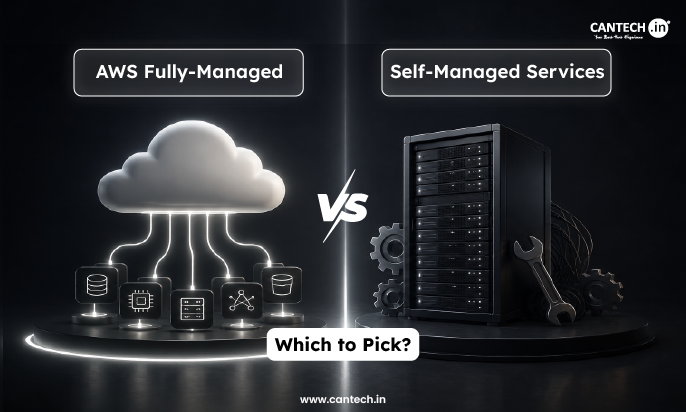
Fully Managed vs Self-Managed AWS: Which is Better?
Fully managed AWS is better for businesses that want AWS without managing the infrastructure themselves. A managed AWS provider handles monitoring, security, patching, backups, troubleshooting & optimization. Self-managed AWS gives you more control but requires your own team to manage everything.
Introduction
AWS offers you a powerful infrastructure and full control, but it’s not without work. The first step is just to start an EC2 instance. You still need to manage resources, apply patches, secure the environment, manage backups, optimize performance, manage scaling, troubleshoot issues and keep cloud costs under control.
So, businesses have only one question to ask themselves: Do you want to manage AWS in-house or do you want to let an experienced provider do it for you?
Fully managed AWS Services is a better option for companies that don’t have a dedicated AWS team or DevOps team. You get the flexibility of AWS while a managed provider takes care of the day-to-day infrastructure, allowing your team to focus on your applications and business.
AWS Managed Services vs Self-Managed AWS: Key Differences
The real difference between fully managed and self-managed AWS comes down to who takes care of the cloud environment. With fully managed AWS, a provider handles the agreed infrastructure and operational tasks, while your internal team remains responsible for those tasks with self-managed AWS.
| Factor | Fully Managed AWS | Self-Managed AWS |
| Infrastructure management | Provider | Your team |
| Monitoring | Provider-managed | Customer-managed |
| Security maintenance | Provider-assisted | Customer |
| Patching | Provider | Customer |
| Backups | Provider-managed | Customer |
| Troubleshooting | Provider support | Internal team |
| Performance optimization | Provider | Customer |
| Cost optimization | Provider-assisted | Customer |
| 24/7 operations | Managed team | Internal/on-call team |
| Control | Shared | Maximum |
| Technical workload | Lower | Higher |
| Best for | Businesses without AWS ops teams | Experienced cloud teams |
The trade-off is straightforward: managed AWS takes routine infrastructure work off your team’s plate, while self-managed AWS gives you greater control but requires more hands-on expertise and ongoing effort.
Fully Managed vs Self-Managed AWS: Who Handles What?
The main difference comes down to who is responsible for managing the AWS environment.
In Fully Managed AWS
A managed AWS provider handles the infrastructure operations based on the agreed service scope. This can include:
- Infrastructure management
- 24/7 monitoring
- OS patching & updates
- Security maintenance
- Backup management
- Performance optimization
- Troubleshooting & incident response
- AWS cost optimization
Your business still controls the application code, business logic, data decisions & application-level configuration.
In Self-Managed AWS
Your internal IT or DevOps team handles the infrastructure operations. This means your team is responsible for configuring servers, monitoring resources, applying patches, managing security, maintaining backups, troubleshooting issues, optimizing performance, scaling resources & controlling AWS costs.
The simple choice: Managed AWS lets your team focus on the application while a provider manages the infrastructure. Self-managed AWS gives you greater control, but also greater operational responsibility.
AWS Managed Services Pricing vs Self-Managed: Which Costs More?
You can only get the wrong answer by comparing the AWS bill. Self-managed AWS might seem more affordable because you’re paying AWS directly, but that’s not the only cost – there are people, tools & time costs to consider.
Businesses can expect to have to factor in the AWS infrastructure bill, cloud engineer or DevOps salaries, monitoring and security tools, backup solutions, on call coverage, maintenance time, training, certifications and the cost of downtime with self-managed AWS.
The cost is typically AWS infrastructure usage plus the fee charged by the managed service provider with managed AWS. The provider then handles the agreed infrastructure management tasks, which means that your internal team doesn’t have to do as much work.
So, is managed AWS more costly than self-managed AWS? Not necessarily. Self-management might be a viable option for a business that already has a skilled cloud team. However, for businesses with no AWS expertise, managed AWS can provide more value, by lowering staffing needs, technical burden & operational risk.
The better comparison is the total cost of ownership, rather than just the AWS bill.
What Are the Benefits of Fully Managed AWS?
Fully managed AWS is not about relinquishing control, it’s about relinquishing infrastructure work. Your team can focus on what matters most: building and operating applications on AWS, while avoiding the hassle of managing all the operational details.
Less Infrastructure Work
You don’t have to deal with your servers, resource problems or regular maintenance. A managed provider handles the agreed infrastructure tasks, allowing your team to focus on more valuable tasks.
24/7 Monitoring & Support
AWS environments require attention outside of normal business hours. Resource monitoring and availability or performance issues can be detected early with continuous monitoring, and technical support provides a team to rely on in case of problems.
Proactive Security Maintenance
Security of cloud infrastructure is an ongoing process. Managed services can include patching, security configuration and infrastructure monitoring, which can help minimize the risk of overlooking issues.
Faster Issue Resolution
If an infrastructure issue comes up, your team doesn’t need to begin troubleshooting from the ground up. AWS seasoned engineers can explore the environment and determine the root cause of the problem and move toward a solution.
Better Performance & Cost Control
A managed provider can regularly audit resource usage, infrastructure performance and AWS spend. This will help to avoid the silent cost creepers of overprovisioned resources without impacting workloads.
More Time for Business Growth
The obvious benefit is that your team can concentrate on business development and growth rather than infrastructure management. You retain the flexibility of AWS, and the operational overhead is taken care of by a seasoned managed service team.
When Should You Choose Self-Managed AWS?
Self-managed AWS makes sense when your business already has the expertise and resources to operate its cloud environment. It gives your team greater control over infrastructure configuration, security policies, scaling & performance tuning.
It can be a good fit if you have experienced AWS or DevOps engineers, established monitoring and security processes, and enough technical coverage to respond to infrastructure issues when they arise. It is also useful for workloads that require highly customized configurations or frequent infrastructure-level changes.
However, that control comes with ongoing responsibility. Your team must stay on top of patching, backups, monitoring, security, troubleshooting and AWS costs.
In short, choose self-managed AWS when you have the people, expertise and operational processes to manage AWS confidently without relying on an external provider.
When Should You Choose Fully Managed AWS?
Fully managed AWS is a better fit when you want the capabilities of AWS without taking on the day-to-day responsibility of managing the infrastructure. Instead of building an internal cloud operations team, you can have an experienced provider handle the technical side.
It works particularly well for startups, small and medium-sized businesses, SaaS companies, e-commerce businesses and agencies that may not have dedicated AWS or DevOps engineers. It is also useful for businesses moving from traditional hosting to AWS and teams that need continuous infrastructure monitoring and technical support.
Businesses evaluating their options can also learn more about what to look for in an AWS managed service provider.
The biggest advantage is the time saved. Your developers can concentrate on applications, customers and growth while the provider looks after the underlying AWS environment.
If your business needs AWS but does not want to build and maintain an in-house cloud operations team, fully managed AWS is usually the more practical choice.
AWS Fully-Managed vs Self-Managed: Which Should You Pick?
The right choice depends less on the AWS infrastructure itself and more on who will manage it every day.
Choose self-managed AWS if you already have skilled AWS or DevOps professionals, mature cloud processes and enough time to handle monitoring, security, patching, backups and troubleshooting internally.
Choose fully managed AWS if you want AWS infrastructure without carrying the daily operational workload. This is often the better fit for SMBs that do not have a dedicated cloud operations team.
So, when comparing AWS fully-managed vs self-managed services, look beyond the server price. Consider control vs responsibility, infrastructure cost vs total cost of ownership, and internal expertise vs managed expertise.
Why Choose Cantech for Fully Managed AWS Services?
Ongoing time and technical expertise is required for managing AWS infrastructure. Cantech’s fully managed AWS services take care of the operational aspects of your environment, allowing your team to concentrate on applications and business priorities rather than infrastructure tasks.
What Cantech Manages
Cantech provides 24/7 proactive monitoring, AWS infrastructure management, security support, OS updates and patching, backups, performance optimization, incident response and cost optimization. It is supported by AWS-certified technical expertise and continuous support.
Let Cantech Handle Your AWS Infrastructure
It’s a simple concept: you run your business on AWS, and Cantech manages the infrastructure. According to Cantech, the company’s service offers 24/7/365 infrastructure monitoring and reports 99.97% uptime on its service page.
Looking for less AWS management overhead? Dive into Cantech’s Fully Managed AWS Services.
Conclusion
Self-managed AWS provides you with the most control. Fully managed AWS provides you with that cloud capability without the infrastructure burden.
Self-management is a good option if your business already has a strong AWS team in place. However, if you are looking for AWS scalability and flexibility without having to create an entire cloud operations team, fully managed AWS is the better choice.
Your team can focus on growing the business, rather than maintaining AWS, with Cantech managing the infrastructure.
Explore Cantech’s Fully Managed AWS Services.
FAQs
What is the difference between AWS managed and self-managed services?
Managed AWS involves a provider taking care of agreed infrastructure activities like monitoring, patching, backups, security and troubleshooting. Self-managed AWS means that your internal team takes care of these responsibilities. Managed AWS minimizes the operational burden, and self-managed AWS gives more control.
Is managed AWS better than self-managed AWS?
This depends on the skills of your team. Self-managed AWS is ideal for businesses that have an experienced AWS or DevOps team. Fully managed AWS may be a better option for businesses that don’t have cloud expertise, as a provider takes care of the ongoing management of the infrastructure.
Is AWS managed hosting more expensive than self-managed AWS?
Not necessarily. Staffing, monitoring, security, maintenance and other operating costs are also included in self-managed AWS. Managed AWS is an extra cost from the provider but can save in-house staff and workload. It’s not the AWS bill, it’s the total cost of ownership.
Who manages servers in fully managed AWS?
A fully managed AWS is when a managed service provider takes care of the infrastructure based on the agreed service scope. This can involve server maintenance, monitoring, patching, security maintenance, backups, troubleshooting and performance optimization.
What does an AWS managed service provider handle?
An AWS managed service provider can manage infrastructure monitoring, security, patching, backups, performance optimization, incident response and cost management. Specific tasks vary by provider and managed AWS plan.
Is self-managed AWS suitable for small businesses?
It can be, as long as there are AWS or DevOps experts in the business to manage the environment. Fully managed AWS can be more convenient for small businesses that lack in-house cloud expertise, as it takes the burden of infrastructure and offers continuous technical assistance.