If a company relies on fast data processing, server clusters are an ideal solution to lower system failures to minimum and significantly improve the efficiency of IT infrastructure. Especially in sectors where every second is crucial like health, finance or e-commerce where interruptions can be really expensive, dedicated servers can also provide predictable resources for demanding workloads. In this blog, we discuss server clusters, their importance and advantages to business.
What is a Server Cluster?
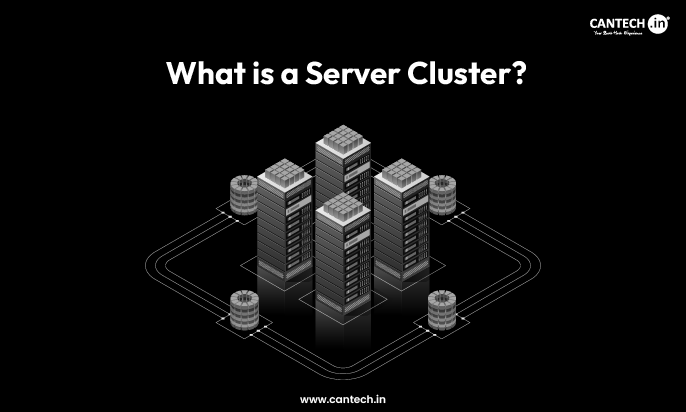
A server cluster is a group of physical or virtual servers when combined provides great availability, better reliability and higher computing power. These servers work together and share tasks like data processing, network requests and storage management. In case, one of these servers also known as nodes fails for whatever reasons, the others step in and keep the operations running smoothly without any disruption.
To understand the underlying technology, see what is a virtual server.
Why are Servers Clusters Deployed?
Businesses deploy server clusters for the below reasons:
- Prevent site outages: Server clusters help maintain system accessibility during unexpected network or infrastructure disruptions.
- Mitigate application failures: They ensure continuous operation when specific applications encounter issues.
- Avoid hardware failures: To prevent a complete system shutdown when physical server components malfunction.
- Saves from performance degradation: The cluster architecture is ideal for businesses suffering from performance degradation. It allows them to split off the database server to enable fast and uninterrupted performance for high volume workloads.
How does Server Cluster Work?
Here’s how exactly the server cluster work:
- Users send the request to a website, application and service hosted on a server cluster.
- Next, a load balancer receives requests which then distributes them across multiple servers in the cluster.
- Cluster servers process the requests simultaneously, sharing the workload to improve the performance and responsiveness.
- The system performs continuous health checks to see if all servers are working properly.
- If any server fails, the cluster automatically redirects the traffic to healthy servers to maintain service availability.
- When demand rises, additional servers can be added to the cluster, which allows it to scale and manage the traffic efficiently, similar to how cloud hosting enables resources to scale based on workload requirements.
Components of Server Cluster
A cluster consists of important components that jointly work to ensure performance, reliability and coordination across the multiple nodes. Every component plays a specific role in how a workload is distributed, how data is stored and how the system responds to failure.
1. Nodes
Nodes are individual machines that continuously process workloads or store data. Each node helps in computing, memory or storage resources that allows the cluster to handle larger workloads than a single system.
2. Master Node
A central node that manages coordination, scheduling and orchestration. The master node implements control to regulate, monitor, and implement policies for the cluster which ensures cluster health, assigning tasks, and makes sure that all nodes are working together.
3. Database Node
These nodes handle queries and handle data. These nodes store and retrieve data which most often replicate data across multiple instances to support high availability and fault tolerance.
4. Network
It connects to multiple nodes and allows communication between them. A reliable network is very important for co-ordinating workloads, to sync data and maintain stable performance across the cluster.
5. Load Balancer
Load balance distributes incoming requests to lower uneven resource distribution and helps in even distribution of workloads across the nodes. This helps maintain system performance and prevents any single node from becoming a bottleneck.
Types of Server Clusters
Modern servers are designed to vary performance, availability and scalability needs by organizations with different goals.
Here are the four main types of server clusters:
1. High performance clusters
HPC clusters bring multiple nodes together to perform computational tasks that demand immense computing resources. It utilizes customizable infrastructure, administrators can pair the same type of machines or blend different ones to process scientific simulations. For workloads requiring direct access to physical hardware and consistent performance, bare metal servers can be a suitable infrastructure choice.
In this type, each node contributes to parallel processing power to form a single efficient computing environment which is capable of handling the most demanding workloads.
For AI, machine learning and other highly parallel workloads, GPU server hosting can further accelerate computationally intensive tasks.
2. High availability clusters
High availability clusters use the active passive configurations, where one node is for standby when the other stops working. These systems are known as the foundation of crucial services, which reduces single points of failure. They mostly depend on tightly coupled architecture that keeps the data synchronized in little blocks which ensures uninterrupted access for users even during the maintenance or any failover events.
3. Load balancing clusters
Load balancing clusters are designed to manage volumes of data, like handling the traffic of real-time web hosting or streaming. The load balancing cluster focuses on distributing workloads equally across several servers. This type of cluster uses a loosely coupled architecture, where two or more servers share requests independently and also maintain stability at the same time.
4. Storage server clusters
Storage servers work together to store data securely and offer instant redundancy. By combining hardware resources across the node, these clusters ensure reliability for analytics, backups and large scale data systems.
The design supports stability and elasticity which gives organizations an adaptable foundation for long-term storage growth and performance consistency.
Benefits of Server Clusters
Some of the benefits of server clusters are:
- Reliability: With several nodes working together, a server cluster is more reliable than a single server. If one node fails, the others keep working.
- Scalability: It is simple to add additional nodes to a cluster as your needs grow. This makes server clusters a flexible solution for businesses of all sizes.
- Easy Maintenance: With a server cluster, you can take one node offline for maintenance without shutting the whole system. This makes the updates and repairs much easier.
- Cost-Effective: While setting up a server cluster might cost more initially, it can save money in the long run. You prevent costly downtime and can use the resources more efficiently.
Conclusion
Server clustering is a great way to enhance reliability, scalability and performance of your online services. If you are running a small business website or large enterprise application, a server cluster can help ensure your services remain stable and keep running smoothly.
FAQs
What are the challenges of server cluster?
Server clustering introduces significant challenges such as steep architectural complexity, network dependencies, high upfront costs, and data synchronization hurdles.
What is the purpose of server clustering?
The main purpose of clusters is to balance workload among servers. Servers that are a part of a cluster are called cluster members. When you install an application on a cluster, the application gets automatically installed on every cluster member.
What are the Use Cases for Server Cluster
Clusters are used many environments which includes:
- Web applications: Server clustering ensures uptime during high traffic in web applications.
- Data Processing: It manages large databases across the distributed systems.
- Database Management: It can manage queries across multiple database servers.
- Cloud Infrastructure: It also helps scalable applications across multiple instances. Server Managed services help customers lower cost and simplify cluster management.