Introduction
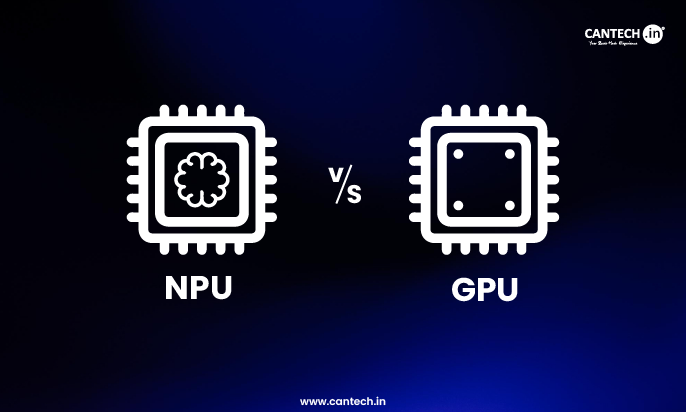
As AI infrastructure and applications are growing at an increasingly unimaginable pace in modern digitalization, the hardware associated with them should also evolve at the same pace. Neural processing units (NPUs), and the Graphics processing unit (GPU) are both great in machine learning tasks in different ways.
Whereas, GPUs and NPUs are different processors designed for AI tasks, GPUs are great in parallel processing and rendering, whereas NPUs are created specifically for improving facial recognition and deep learning with less disadvantages. In this blog we explore what are the key differences between NPU vs GPU.
What is Neural Processing Unit (NPU)?
An NPU is a specialized processor which is built to replicate the behavior of neural networks. The hardware consists of multiplication and accumulation (MAC) units tied up with on-chip memory that minimizes latency during inference. The parallel architecture allows thousands of operations to run continuously to maximize outputs for real-time AI tasks. NPUsare trained for inferences which makes them perfect for latency sensitive applications.
Key NPU Specifications
Some of the features of NPU are:
- Specialized compute units: These specialized chips are dedicated hardware for multiplication and accumulation, which is important for neural network inference and training.
- High-speed integrated memory: The NPUs allow quick access to model data to minimize issues related to memory access.
- Energy efficiency: NPUs provide the highest performance with low power consumption in localized and integrated AI processing data batches.
- Parallel architecture: NPUs excel in running hundreds if not thousands of operations at the same time, while being faster than the general purpose computing chips.
What is Graphics Processing Unit (GPU)?
GPU is an electronic microprocessor which was designed to render graphics but evolved into programmable parallel computing engines such as 3D modeling, video editing and gaming. With thousands of small cores they are great for vector and matrix operations central to deep learning. Their general purpose design offers a broad range of tasks beyond AI. Besides this, they also have the ability to process large data volumes in parallel is the main factor that keeps those chips the lead to manage large language models.
Read more about what is a GPU with detail guide.
Key GPU Specifications
Some of the features of GPU are:
- Resource availability: GPUs have been on the market for years and come with large community support, documentation, resources and high availability.
- Incredible Performance: GPUs are versatile because of their rendering features.
- Tensor cores: Graphics cards come with built-in features to offer support for crucial AI applications, some of them consist of neural network acceleration and matrix multiplication.
- Availability of resource: GPUs have been on market for years and come with great customer support, documentation, resources and high availability.
Difference between NPU vs GPU
The difference between NPUs and GPUs lies in how each of them handle the computation, power and memory. Both of them process the workloads in parallel. Yet their architectures are optimized for different outcomes.
Here are some of the key differences between NPUs and GPUs:
| Aspect | GPU (Graphics processing unit) | NPU (Neural Processing Unit) |
| Design | Designed to condense large image processing tasks into smaller operations that run parallelly. | It replicates the human brain with dedicated modules that improves addition and multiplication with an improved on-chip memory. |
| Performance efficiency | Great parallel computing at the cost of higher power consumption. | Can be on the same level or exceed GPU level parallelism for the repetitive short calculations. It is designed for the matrix multiplications across large scale datasets utilized in neural networks. |
| Specialisation | It is more specialized than CPUs and still suited to general purpose computing across a broad range of workloads. | Built for machine learning and AI tasks. Takes away the GPU features unrelated to AI to maximize energy efficiency. |
| Accessibility | Available to both professionals and hobbyists. NVIDIA’s CUDA language allows straightforward GPU programming with open-source support across operating systems. | Usually less accessible. Proprietary NPUs may not be publicly available. AMD and Intel NPUs have comparatively smaller developer communities. |
Use Cases of GPU vs NPU
NPU Use Case
- Runs and accelerates LLM inference workloads with lower power draw.
- Supports deep learning and image recognition for efficient classification and object detection in visual data streams.
- Assists blockchain and AI integration to handle AI driven computation within blockchain environments.
- Enables matrix multiplication at scale to accelerate the core mathematical operations that are underperforming neural networks.
- Helps in AI offloading to pair with GPUs to manage heavy AI tasks and minimize GPU load.
GPU Use Case
- Assists in gaming for real time rendering, graphics optimization for high performance games.
- Helps in computer animation such as image processing, visual effects rendering for films and 3D content.
- It helps data centers for high throughput parallel workloads across large scale server infrastructure.
- Supports crypto mining for large parallel hash computations for blockchain validation.
- It helps in AI model training for large neural networks by processing big datasets in parallel.
Conclusion
NPUs are specifically designed hardware components that are architecturally designed for running neural network operations, which makes them good at small and repetitive tasks related to AI/ML operations. At face value, GPUs sound very similar, hardware components are created to achieve small tasks simultaneously. But NPUs are designed for neural workloads for their operations such as matrix multiplication and activation functions. This makes NPUs slightly better than GPUs when it comes to managing deep learning computations, in terms of speed and efficiency.
Cantech offers GPU infrastructure with localized support, data compliance, and competitive pricing. Whether you need a GPU for training a language model, running simulations, or powering up your AI product, Cantech’s cloud GPU solutions are built to handle serious workloads without the complexity of setting up international accounts.
FAQs
Which is better, GPU or NPU?
Neither of them can be called better, as they are built for different workloads. A GPU is important for graphics, gaming and heavy AI model training but not as fast as neural processing unit (NPU). GPU on the other hand is great for parallel processing for AI training but does not have neural network optimization which makes NPUs efficient for on-device AI inference.
Can NPU replace GPU for AI?
No, a GPU cannot replace an NPU, but it can manage some AI tasks satisfactorily. GPUs can run many Microsoft Copilot tasks.
Which is the most powerful GPU for AI?
NVIDIA RTX 5090 is the most powerful GPU for AI inference because of its next generation architecture and large compute performance.