Introduction
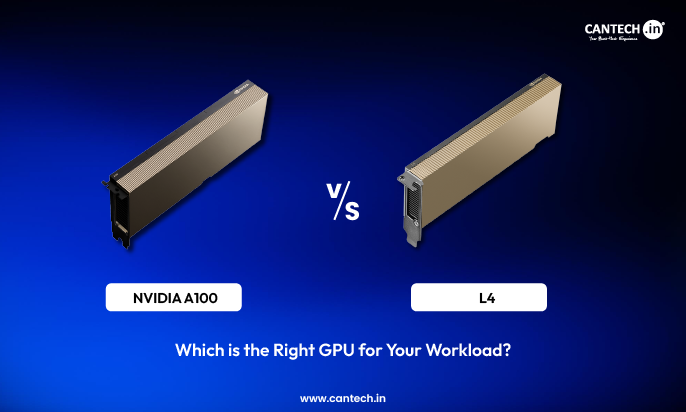
Modern businesses need powerful hardware for artificial intelligence and data processing. The debate NVIDIA L4 vs. A100 GPUs is a popular comparison for engineers and researchers. The two cards have unique advantages in various digital tasks. The NVIDIA A100 can process large data sets for complex training. NVIDIA L4 is efficiency-oriented in order to achieve real-time results. Choosing the right hardware is cost-efficient and time-saving for your projects.
NVIDIA L4 vs. A100 GPUs – Meaning
NVIDIA A100 GPU is a powerhouse that is based on the Ampere architecture. It offers high memory bandwidth to develop large-scale AI. This card is compatible with deep learning models such as GPT-4 and BERT. It has third-generation Tensor Cores to perform quick mathematical computations. Many data centers rely on this hardware for scientific simulations and molecular modeling.
The newer Ada Lovelace architecture is used in the NVIDIA L4 GPU. It targets low-latency performance and energy efficiency. This card uses minimal power in comparison with the high-end enterprise models. It has fourth-generation Tensor Cores to support modern AI activities. The L4 is a single-slot card that can easily be installed in standard server racks.
Core Hardware Specifications: NVIDIA L4 vs. A100 GPUs
The differences between the L4 Graphics Processor and the A100 PCIe Graphics Processor can be clearly observed in the technical data of these two cards.
| Feature | NVIDIA A100 | NVIDIA L4 |
| GPU Architecture | Ampere | Ada Lovelace |
| VRAM Capacity | 80GB HBM2e | 24GB GDDR6 |
| Memory Bandwidth | 2,039 GB/s | 300 GB/s |
| FP32 Performance | 19.5 TFLOPS | 30.3 TFLOPS |
| Power Consumption | 400W | 72W |
| NVLink Support | Yes | No |
| Form Factor | Dual-Slot / SXM | Single-Slot PCIe |
Comparing Performance and Efficiency – NVIDIA L4 vs. A100 GPUs
The differences between L4 Graphics Processor and A100 Graphics Processor affect the speed of your AI to generate tokens.
A100 has significantly higher memory bandwidth for intense workloads. This bandwidth enables the GPU to read large model weights quickly. The L4 has a higher number of raw floating-point operations per watt of power. With simple inference tasks, you save more energy with the L4. The A100 is the king of raw throughput for massive neural networks.
Key Performance Pillars
- Training Capabilities: A100 supports Multi-Instance GPU technology for better resource sharing. One A100 can be divided into seven smaller units for different users.
- Inference Speed: The L4 handles real-time requests with very low latency. It is ideal with chatbots and voice recognition systems.
- Video Processing: The L4 includes hardware for AV1 encoding and decoding. The A100 does not have dedicated video hardware to do media tasks.
- Precision Support: The L4 supports native FP8 precision for modern AI models. Most calculations are performed using FP16 or INT8 in the A100.
- Cooling Needs: The L4 uses passive cooling and stays quiet during operation. A100 needs liquid cooling or high-airflow fans in the data centers.
Affordability to Modern Business
The L4 is much cheaper per hour than the A100. It is more suitable for small models that can fit in 24GB of memory. The L4 costs less to use in terms of electricity and cooling. The A100 is a larger initial investment for your infrastructure. It pays off when you need to train models from scratch.
- Reduced Operational Costs: Low power consumption translates to less utility bills.
- Easy Deployment: The L4 is small and can be easily installed in edge devices.
- Scalability: You can run multiple L4 cards for the price of one A100.
- High Concurrency: A100 supports a large number of simultaneous users thanks to its huge memory.
- Maintenance: L4 passive cooling leads to a reduced number of mechanical failures in the long run.
Related blog: NVIDIA L4 vs L40s Comparison
NVIDIA L4 vs. A100 GPU Solutions from Cantech
Cantech offers high performance server solutions for your business requirements. You can compare and rent A100 PCIe vs L4 hardware through flexible plans, backed by our Dedicated Server infrastructure.
Our servers make sure that your projects run without any delays or interruptions. We give complete root access to enable you to install your own software. Our team monitors the health of the GPUs 24/7. You get dedicated resources for your particular AI workloads.
Cantech Service Features
- Guaranteed Resources: You do not share your GPU power with other users.
- Expert Support: Our technical team will help in setting up the server and troubleshooting.
- High Uptime: We will ensure that all our GPU hosting services have a 99.97% uptime.
- Security: Enterprise firewalls will secure your sensitive AI data from external threats.
- Customization: We customize RAM and storage to your project needs.
- Fast Networking: High bandwidth ensures quick data transfers for your applications.
Conclusion
A comparison of NVIDIA L4 vs. A100 GPU shows that both have a place in the market. A100 is ideal for heavy training and huge data sets. The L4 is the cost-effective inference and video task winner. The decision you make will be determined by your budget and the size of the project. Most startups find great value in the efficient L4 for daily operations. Larger institutions prefer the A100 for its unmatched raw power.
FAQs
Is the L4 GPU faster than the A100?
The L4 has a higher FP32 TFLOPS score than the A100. However, the A100 has a much faster memory bandwidth. The A100 processes large AI models more quickly than the L4.
The L4 is faster only for specific video encoding tasks. Most users find the A100 more powerful for overall AI throughput.
Which GPU is better than the A100?
The NVIDIA H100 GPU and NVIDIA B200 GPUs are more powerful than the A100. These newer models are based on the Hopper and Blackwell architectures. They provide better performance for generative AI and large language models.
A100 is a highly dependable option for many data centers. It is also very useful in training and high-performance computing.
Is the L4 better than the A100?
The L4 is better for energy efficiency and low-cost inference. It uses a lot less power than A100.
A100 is more suitable for training large models such as GPT-4. The L4 is the one you should select in case of a tight budget. The A100 would be the one you should pick when you require the highest memory capacity.
Which is more cost-effective for LLaMA 3 8B?
The NVIDIA L4 is more cost-effective for the LLaMA 3 8B model. This model can easily fit in the 24GB memory of the L4. The L4 hardware will give you more tokens per dollar.
The A100 is overkill for such a small model. The L4 saves you a lot of money in hourly hosting charges.
L4 or A100: Which is better to run vLLM?
A100 is more suitable for running vLLM with large batches of users. It has a large memory bandwidth that enables vLLM to create tokens much faster.
The L4 works well for vLLM if you have few users. It provides a cheaper way to serve the model at low scales. The A100 is the standard choice for production-grade vLLM deployments.