Introduction
Behind most of the chatbots, fraud alerts and recommendations you encounter each day lies a complex technology ecosystem known as AI infrastructure. As organizations embark on AI journeys that involve generative and agentic AI, the infrastructure underpinning these systems is becoming an increasingly important area of focus. In this article, you will learn what AI infrastructure is, as well as key factors to consider when choosing AI infrastructure.
AI Infrastructure: Definition
AI infrastructure refers to the combination of hardware and software used to support the functioning of artificial intelligence systems, including training and operational needs. Unlike traditional IT infrastructure, which focuses on supporting core operations such as email and ERP systems, AI infrastructure is specifically geared towards supporting the substantial data and analytics requirements of AI and deep learning platforms.
This term encompasses both the tools and systems that organizations use to run the AI applications they develop, including virtual assistants, fraud detection systems, recommendation engines, and increasingly, agentic AI systems that execute multiple steps to achieve goals such as planning and executing autonomous decisions. With few exceptions, all such AI platforms rely on underlying AI infrastructure that enables them to perform their intended functions. Understanding What is AI computing provides a deeper look at the computational resources and technologies that enable these AI workloads.
Why AI Infrastructure Matters?
AI infrastructure plays a critical role in enterprise AI strategies for two primary reasons. First, AI workloads, particularly those associated with large language models and generative AI, require substantially more data and processing power than traditional line-of-business applications. To understand these computing demands in more detail, see our guide on what is an AI workload. This means that AI-specific infrastructure often offers a more effective solution in terms of processing power and storage capacity.
Second, many organizations face mounting pressures to impose constraints on where and how AI data and models may be accessed and stored, including the need to safeguard sensitive data under data sovereignty requirements. Furthermore, with the rise of agentic AI systems that operate in a more strategic and independent manner, many organizations feel the need to have more control over the underlying infrastructure to mitigate risks that could arise if such systems malfunction.
Core Components of AI Infrastructure
AI infrastructure consists of a range of components that can be broadly grouped into hardware and software categories.
Hardware
- In terms of hardware, AI infrastructure typically requires graphical processing units (GPUs) and tensor processing units (TPUs), which are primarily responsible for enabling AI infrastructure to perform calculations at a much faster rate than traditional central processing units (CPUs). or organizations that need flexible access to accelerated computing, cloud GPU servers can provide scalable GPU resources for AI workloads.
- AI infrastructure also relies on GPU dedicated servers that can support the unique demands of AI workloads, which can be deployed on-premises, in the cloud or at the edge.
- Other hardware components that comprise AI infrastructure include networking hardware that provide the high-speed connectivity such as InfiniBand (which can support hundreds of Gbps), and storage infrastructure such as object storage, which is needed to store the voluminous unstructured data that feeds into most AI applications.
- Finally, AI data centers which comprise all the infrastructure components needed to support AI applications also form part of AI infrastructure.
Software
- The software component of AI infrastructure also comprises diverse data preparation tools that enable data to undergo the extensive cleansing and preprocessing steps needed prior to model training.
- Some of the most important software components of AI infrastructure include machine learning frameworks such as TensorFlow and PyTorch. These frameworks are instrumental in enabling developers to perform various tasks associated with model building and deployment.
- MLOps and AIOps tools meanwhile enable organizations to operationalize their ML functions while also facilitating automation to enhance model performance throughout the ML lifecycle from data preparation through deployment and ongoing operations.
- Finally, there are a range of tools geared towards optimizing models for faster inference, with some such as vLLM being able to enhance performance by up to 10x. There are also security-focused tools that enhance the security of AI infrastructure and models, including tools that support encryption and access control.
Cloud vs On-Premises: Choosing Between Options
When considering options for AI infrastructure, most organizations must make a choice between relying on cloud-based infrastructure or on-premises alternatives. The former offers significantly more flexibility, allowing organizations to scale up and down their infrastructure requirements as needed. Cloud-based solutions also tend to be associated with reduced costs, particularly for organizations with limited infrastructure needs.
However, on-premises infrastructure tends to offer greater control and compliance, and can also be more cost-effective for organizations that have predictable and consistent infrastructure needs. Some organizations opt to use a combination of both cloud and on-premises hardware for their AI workloads. In most cases, such organizations rely on the hybrid approach to balance the need for scalability and flexibility while also maintaining the level of control and compliance associated with on-premises infrastructure. For organizations that need dedicated resources while retaining cloud-based flexibility, a dedicated cloud server can provide a suitable middle ground.
Edge-based infrastructure, which typically relies on a combination of on-premises and cloud components, also plays an important role in some AI infrastructures, particularly in support of real-time analytics capabilities.
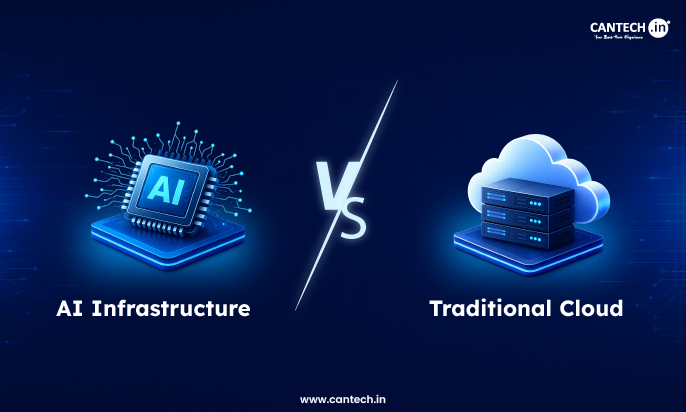
For a deeper comparison of these approaches, see our guide to AI infrastructure vs traditional cloud.
Key Considerations When Building AI Infrastructure
A review of the components that comprise AI infrastructure reveals that there are several core considerations that organizations need to take into account when building AI infrastructure.
- First, there is the question of data storage and management, which is typically addressed by adopting a combination of highly scalable storage solutions and data management tools that enable reliable data governance.
- Second, AI infrastructure must also be sufficiently scalable to accommodate growing data volumes and analytics needs. For startups, these scalability requirements can be particularly challenging, making it important to design AI infrastructure for startups that can grow alongside their workloads and business needs.
- By contrast, infrastructure security considerations are more focused on ensuring the overall infrastructure remains protected against unauthorized access and other cybersecurity threats. In addition, organizations must make strategic choices when it comes to whether to adopt cloud-based or on-premises approaches, as well as how to integrate their broader IT infrastructure with the AI infrastructure.
- Fourth, AI infrastructure must also have robust maintenance and monitoring tools in place to enhance model performance and ensure early identification of issues such as data drift and model drift.
- Finally, it is also important to consider the additional benefits that come with deploying AI infrastructure, including enhanced collaboration and compliance capabilities, improved scalability and performance, and cost optimization.
Real-World Benefits of AI Infrastructure
Organizations that take the time to establish the right AI infrastructure usually realize several benefits that support their overall AI strategy. For starters, most such organizations find that their AI infrastructure delivers on promises of enhanced scalability, performance and compliance. In addition, such organizations also benefit from reduced costs associated with developing and deploying AI applications, particularly when compared to traditional IT infrastructure. Finally, well-designed AI infrastructure enables organizations to take advantage of new opportunities that would not be open to organizations that rely on traditional IT infrastructure, including more widespread use of generative and agentic AI.
Conclusion
AI infrastructure refers to the underlying combination of hardware and software that enable AI applications and systems to function. As organizations continue to embrace generative and agentic AI, choosing the right infrastructure has become a critical priority. This article provided an overview of the key considerations when selecting an AI infrastructure as well as the core components that comprise AI infrastructure.
FAQs
What is the difference between AI infrastructure and traditional IT infrastructure?
Traditional IT infrastructure refers to the combination of hardware and software that are typically used to support core operations such as email and ERP systems. By contrast, AI infrastructure typically consists of hardware and software that are optimized to meet the substantial demands of AI and deep learning workloads.
Do I need on-premises infrastructure to support AI workloads, or can I rely on the cloud?
This depends on the specific requirements of your AI workloads. Cloud infrastructure is typically more flexible and cost-effective and is typically better suited for organizations with more sporadic infrastructure needs. By contrast, on-premises infrastructure often makes more sense for organizations that need greater control and compliance, as well as those that have more consistent infrastructure needs. Most organizations tend to rely on a hybrid approach that combines elements of both options.
What is MLOps, and how does it relate to AI infrastructure?
MLOps refers to the set of tools and practices that enable organizations to standardize, automate, and optimize various stages of the ML lifecycle. As a discipline, MLOps is considered to be part of AI infrastructure, and most especially the software component.