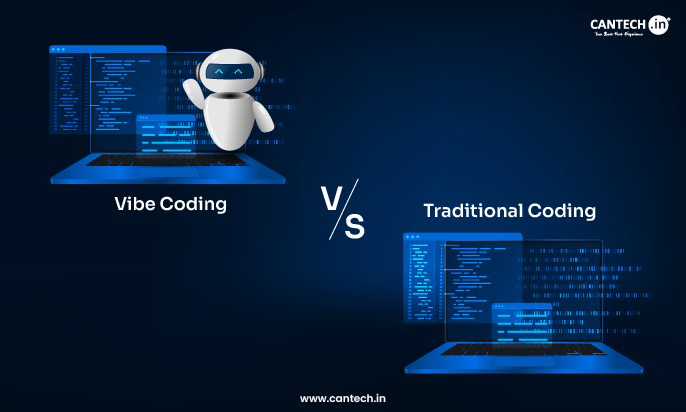
In this blog, we will see Vibe Coding vs Traditional Coding. The Vibe Coding and the traditional coding differ in employment of programming. Traditional coding is about all precision, control, and developing large applications all the way to the bottom. Vibe Coding is a tool based on AI to assist in the development of eye-catching, interactive, and experimental projects. Novices rely on Vibe Coding to quickly experiment and have fun in creative ways, whereas experts rely on traditional coding as a way to maintain safety, growth, and more complex system design. You need to choose the correct one, refer to what you wish to do, the kind of project, and the level of skills you have, and a combination of both is usually the most successful.
What is Traditional Coding?
Definition
The normal coding that programmers use to handcode instructions to make software work is the traditional code.
It focuses on:
- Control- the programmer determines the behavior of the program.
- Predictability the code acts in a similar manner each time.
- Scalability – it is capable of expanding to full-size applications, platforms, and systems.
Key Features
- You must understand the rules of the language and the creation of algorithms and utilization of data structures.
- You are required to write and test the code by yourself in order to make it reliable.
- It is most effective with simple, rational, practical projects as opposed to fun and games.
Examples
- JavaScript, Python, or Java web applications.
- Mobile apps developed using Swift or Kotlin.
- Enterprise software like CRM systems, e-commerce websites and databases.
What is Vibe Coding?
Definition
Vibe Coding is an emerging, AI based approach to programming that puts creative coding, experimenting with new ideas and generating work in the forefront. It combines regular coding logic and AI tools to accelerate design, visual effects, multimedia, and interactive projects.
Key Features
- AI Integration – the AI snips and provides ideas.
- Rapid Prototyping – create pictures, animations, or digital art fast.
- Ease of use – reduces the initiation fee to new users who wish to code creatively.
- Flexibility – ideal in an experiment, non-linear or media intensive project.
Examples
- Developing images or animation using P5.js and AI image generators.
- JavaScript and code assistants in interactive web experiences.
- AI-assisted script music, sound design or generative art.
Core Differences: Vibe Coding vs Traditional Coding
| Feature | Vibe Coding | Traditional Coding |
| Purpose | Creative, AI-assisted, experimental outputs | Functional, precise software development |
| Ease of Entry | Beginner-friendly; AI handles complexity | Steep learning curve; requires programming knowledge |
| Speed of Development | Fast prototyping | Slower; manual coding required |
| Flexibility | High for creative projects | High for structured, reliable systems |
| Reliance on AI | Core part of workflow | Optional; mostly manual |
| Skill Requirement | Can start with minimal knowledge | Requires mastery of coding fundamentals |
| Output Type | Interactive visuals, multimedia, generative art | Applications, software, platforms, APIs |
When to Use Vibe Coding?
- When you need to make visuals, animations, and other media fast.
- When you are new to the codes and require the assistance of AI tools.
- When you need to prototype projects that are either design-oriented or interactive in nature.
- In case you would like to experiment with AI-based solutions without having advanced coding skills.
When to Stick with Traditional Coding
- In case you require complete control of your software and can anticipate its behavior.
- In case you are developing big production apps.
- In case you want to know the basics of programming.
- In case of long-term maintenance requirements and performance enhancements (professional work).
Is It possible to Combine Vibe Coding and Traditional Coding?
Yes. Blending the two methods can provide optimal working process.
- First templates, visuals, or prototypes can be developed with AI-based Vibe Coding.
- Next polish them using conventional code to give them precision, scalability and reliability.
- Vibe Coding allows you to be creative with the coding, and the production components can remain the same using traditional code.
Example Workflow:
- Create interactive graphics to a site with AI.
- Add optimized hand written code to quicken things.
- Backend or data management with traditional coding.
Tools and Technologies
Vibe Coding Tools
- OpenAI Codex / GPT-assistants, make creative code automatically.
- P5.js + TensorFlow.js – interactive output with AI and JavaScript.
- RunwayML / DALL·E – Artificial intelligence to aid in creating images and videos.
- Browser IDEs (Glitch, CodeSandbox) – easy to start locations to test code.
Traditional Coding Tools
- IDEs (VS Code, PyCharm, IntelliJ) – complete coding environments.
- Version control (Git, GitHub) – share and manage projects.
- Frameworks (React, Django, Spring) – Organize web, mobile and backend projects.
Best Practices
For Vibe Coding:
- Combine artificial intelligence and human corrections.
- Clean project folders to ensure that code does not get dirty.
- Test new concepts but document the process that you followed so that you can replicate.
For Traditional Coding:
- Adhere to best habits and follow codes of style.
- Test thoroughly and debug for reliability.
- Use modular designs that are easy to maintain and expand.
Conclusion
Vibe Coding and traditional coding are complementary. Novices use the rapid initiation and trial of Vibe Coding but experts apply the traditional coding system, which ensures control, development, and accuracy. Being aware of what each of them does assists you in choosing the appropriate path to take in your project, or mix them to achieve maximum creativity and productivity.
FAQs
Can beginners start with Vibe Coding?
Yes. AI guides beginners to write code even when they do not know many concepts in programming.
Is traditional coding obsolete with AI tools?
No, still it is required in large and consistent programs which require speed.
Are Vibe Coding and professional usable?
Yes, they apply it to hurry up prototypes, experiment with creative ideas, and insert AI functions into their regular projects.
Vibe Coding or Traditional Coding, which is faster for project creation?
Vibe Coding is faster in creative mockups, whereas traditional coding is slower and provides more precise production code.
Can both methods be mixed?
Absolutely. Most processes combine AI front-end design and standard code back-end and complex logic.