Large Language Models (LLMs) are only as powerful as the frameworks used to run them. As AI adoption grows, developers and businesses are looking for efficient tools to handle inference, speed, and structured outputs.
Two emerging frameworks–SGLang and vLLM-have gained attention for their unique capabilities. But which one is better?
SGLang vs vLLM: Quick Answer
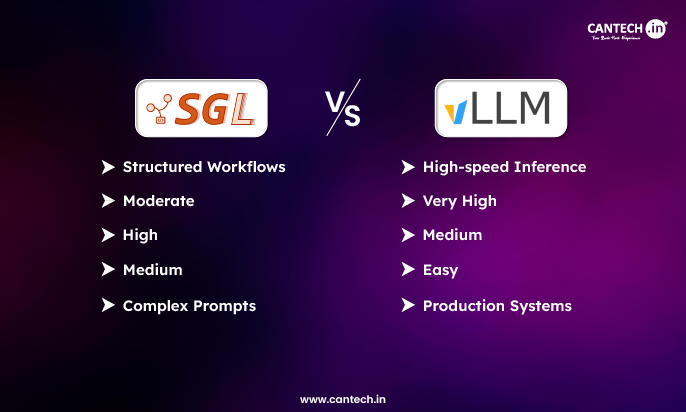
SGLang and vLLM have distinct LLLM use cases: vLLM is designed for fast inference and scale deployments, whereas SGLang is designed to support structured prompting and targeted control of outputs. vLLM is the best choice when performance and scalability are a priority. SGLang is preferable to complex workflows, as well as controlled generation.
What Is SGLang?
SGLang is a system that aims to bring the work of LLM interactions to a more structured and programmable form. It gives developers the ability to specify how models respond based on a mix of prompts, logic as well as constraints.
Key Features of SGLang
-
Structured text generation
-
Fine-grained control over outputs
-
Support for complex workflows
-
Prompt-based programming
SGLang is particularly popular in systems where the form of the output and logic is important to the system, like chatbots, automation systems and multi-step reasoning systems.
What Is vLLM?
vLLM A high-performance inference engine designed to make LLMs work on an efficient scale. It is concerned with the efficiency of using a graphics processing unit and providing rapid token generation.
Key Features of vLLM
-
High-throughput inference
-
Efficient GPU memory utilization
-
Low latency response generation
-
Scalable for production workloads
vLLM is widely used in production environments where speed and performance are critical.
Key Differences Between SGLang and vLLM
The core difference lies in their primary focus:
-
SGLang → Control, structure, and workflow management
-
vLLM → Speed, efficiency, and scalability
While both tools work with LLMs, they solve different problems.
SGLang vs vLLM: In-Depth Comparison Table
| Category | SGLang | vLLM |
|---|---|---|
| Primary Focus | Structured generation, workflows, control | High-speed inference, scalability |
| Core Technology | RadixAttention (dynamic prefix caching) | PagedAttention (memory-efficient batching) |
| Throughput (H100 GPUs) | ~16,000+ tokens/sec | ~12,500 tokens/sec |
| Latency (TTFT) | ~79 ms (faster startup response) | ~100+ ms |
| Inter-token Latency | Lower and more stable (~6 ms) | Slightly higher (~7 ms) |
| Performance Under Load | Stable under high concurrency | Performance may degrade at scale |
| Multi-turn Conversations | Excellent (cache reuse boosts performance) | Good but less efficient |
| Structured Output (JSON, XML) | Strong support | Limited support |
| Prompt Control | High (programmable workflows) | Medium |
| Flexibility | Very high | Moderate |
| Ease of Setup | Moderate complexity | Easy (pip install, quick deploy) |
| GPU Utilization | Efficient with cache reuse | Highly optimized memory handling |
| Concurrency Handling | Strong (consistent token rate) | Strong but can drop under heavy load |
| Best Use Case | AI agents, chatbots, multi-step reasoning | Production APIs, real-time inference |
| Scalability | Good (workflow-oriented scaling) | Excellent (enterprise-scale deployment) |
| Ecosystem & Community | Growing | Mature and widely adopted |
| OpenAI API Compatibility | Yes | Yes |
| Multi-GPU Support | Tensor + data parallelism | Tensor parallelism |
| Cost Efficiency | Better for complex workloads | Better for high-volume simple tasks |
| Learning Curve | Higher | Lower |
Advantages and Disadvantages of SGLang
Advantages of SGLang
SGLang is unique due to the ability to be flexible and to control model behavior.
- Facilitates planned and foreseeable results.
- Perfect in multi level workflows.
- Enables profitable immediate customization.
- Applicable to logic based AI.
Disadvantages of SGLang
Although it has strengths, SGLang has its limitation.
- Weak in terms of speed when compared to perception motors.
- Needs more preparation and knowledge.
- Less than the size of other tools.
- Useful for logic-driven AI applications
Advantages of vLLM
vLLM is performance based and scalable.
-
Extremely fast token generation
-
Optimized GPU usage
-
Handles large-scale inference workloads
-
Strong support for production deployment
Disadvantages of vLLM
vLLM places a strong emphasis on speed at the cost of a trade-off.
-
Limited control over structured outputs
-
Less flexibility for complex prompt logic
-
Not ideal for highly customized workflows
SGLang vs vLLM: Use Case Comparison
Choosing between SGLang and vLLM depends on your specific needs.
Use SGLang When
-
You need structured outputs (e.g., JSON, formatted text)
-
Your application involves complex workflows
-
You require precise control over responses
Use vLLM When
-
You need fast response times
-
You are deploying LLMs at scale
-
Performance and efficiency are top priorities
Performance Comparison: SGLang vs vLLM
Performance is where vLLM clearly excels:
-
vLLM uses advanced memory management techniques to maximize GPU efficiency
-
It delivers faster token generation and lower latency
-
Ideal for real-time applications and high-traffic systems
On the other hand:
-
SGLang focuses on output quality and structure rather than raw speed
-
It may introduce slight delays due to added control layers
When to Choose SGLang vs vLLM
Here’s a simple way to decide:
-
Choose SGLang if your priority is control, structure, and logic
-
Choose vLLM if your priority is speed, scalability, and performance
For many advanced applications, developers may even combine both approaches depending on workflow requirements.
Common Mistakes When Choosing LLM Frameworks
The choice of the inappropriate framework may affect performance and scalability.
Avoid these common mistakes:
- Choosing based only on speed
- Neglecting scalability in the long run.
- Failure to consider workflow complexity.
- Neglecting the integration requirements.
Conclusion
Both SGLang and vLLM are powerful tools in the LLM ecosystem, but they serve different purposes.
-
SGLang excels in structured workflows and control
-
vLLM dominates in speed and scalability
Choosing the right framework depends on your use case, technical requirements, and long-term goals. By understanding their strengths and limitations, you can make an informed decision and build more efficient AI applications.
Frequently Asked Questions
What is SGLang used for?
SGLang is used for building structured and controlled LLM applications. It allows developers to define how outputs should be generated using prompts and logic, making it ideal for workflows that require consistency, formatting, and multi-step reasoning.
What is vLLM used for?
vLLM is used for high-performance LLM inference, especially in production environments. It is designed to deliver fast responses, handle large workloads, and efficiently utilize GPU resources, making it suitable for real-time applications.
Is vLLM faster than SGLang?
Yes, vLLM is significantly faster than SGLang because it is optimized for high-throughput inference and efficient GPU usage. SGLang prioritizes structured output and control, which may slightly impact performance compared to vLLM.
Which is better for production: SGLang or vLLM?
vLLM is generally better for production due to its speed and scalability. However, if your application requires structured outputs and complex workflows, SGLang can be a better choice despite its lower performance.
Can SGLang and vLLM be used together?
Yes, in some advanced setups, developers can use vLLM for fast inference and integrate SGLang for structured output handling. This combination allows you to balance performance with control.