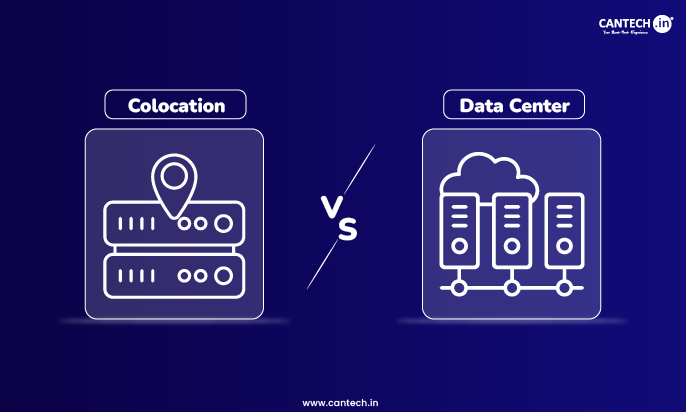
A colocation data center lets businesses rent space in a third-party facility to house their own servers and hardware, while a data center is the actual facility that provides the infrastructure. The key difference is ownership: in colocation, you own the hardware; in a data center, the provider owns and manages everything, including the hardware.
What is Colocation?
The term colocation or ‘colo’ is used to describe the process of locating privately-owned servers and networking equipment in a third-party data facility. Rather than purchasing and operating your own facility, you lease space, which may be rack, cabinet, cage, or room, in a professionally operated data center.
Read more about what is colocation in detail.
Key Features of Colocation
- You own the hardware.
- The plant offers bandwidth, power, cooling and physical security.
- You have control over your systems but use the infrastructure of a bigger provider.
- Colocation is the most suitable where the company needs to have control of its IT equipment but will not own the data center so that they will not have to spend huge sums of money in constructing their own data center.
What is a Data Center?
A data center is a special purpose building that is built to contain computer hardware, like servers, storage systems and networking devices. These facilities are designed to be highly available, redundant, and secure, and are the workhorse of digital operations in the present day. Learn more about what is a data center.
Be it a hyperscale data center run by tech giants or a local center that caters to the needs of local businesses, the definition of data center will always be the same: it is a central processing, storage, and distribution facility of data.
Colocation vs Data Center: Which One to Choose?
In making the decision of whether to use colocation or a data center solution, you should consider the following:
| Feature | Colocation | Data Center |
| Hardware Ownership | Business owns it | Provider owns it |
| Control | High | Low to Medium |
| Infrastructure | Provider manages | Provider manages |
| Cost | Medium | Low to High |
| Scalability | Limited | High |
| Best For | Businesses needing hardware control | Businesses wanting fully managed solutions |
To most companies, a hybrid model in which core systems are colocated and cloud data centers are used as a scalability solution is the best of both worlds.
What are the Key Benefits of Colocation?
Reduced Capital Expenditure
A migration to a data center service will eliminate the requirement to make a large capital investment. Businesses can take advantage of the existing facilities of a service provider, as opposed to investing huge amounts of money in constructing or expanding a personal data center, including the cost of land, construction, hardware and infrastructure such as power and cooling.
This reduction of capital expenditure (CapEx) to operational expenditure (OpEx) enables businesses to pay a fixed, continuous fee, which leaves capital available to use in the business, research, and development. This model is specifically helpful when working with a start-up and small to medium-sized enterprises that might lack the funds needed to invest in a large infrastructure project. Cantech’s Small business colocation provides these organizations with access to secure, high-performance data center facilities at a fraction of the cost of building and maintaining their own.
Improved Availability and Reliability
Data centers provide better uptime and performance through the use of enterprise infrastructure and professional management. To ensure that they do not have single points of failure, they use redundant systems to support power, cooling, and network connectivity so that services stay online when a component fails or power goes off.
Most facilities also have numerous links to various power grids and ISPs to ensure that they are running at all times. This degree of redundancy can be too costly or complicated to be handled by an individual company, and a data center can be a more sound and dependable way of supporting mission-essential activities.
High-Speed Connectivity
High-speed accessibility is one of the features that data centers are designed with. They are stationed in urban or suburban regions with access to large fiber optic networks and do direct peering with other internet service providers (ISPs).
This enables companies to enjoy low latency and high data bandwidth which is crucial when using cloud computing, mass data transfer and real time applications. By using a data center, organizations are able to overcome the constraints of a typical office network to offer a stronger and more effective connection to operations and services provided.
Disaster Recovery and Business Continuity Support
Data centers are a highly important part of business continuity planning and disaster recovery (DR). They offer an off-site backup storage area, which is secure. When a fire, flood, or other calamity strikes the main office of a firm, the business can easily redirect to the resources within the data center, reducing downtime and loss of data.
To assist businesses to get online within a short period, several data centers provide dedicated DR services such as warm sites and hot sites. This will be essential in keeping operations going and cushioning against severe financial and reputational losses.
Compliance-Ready Infrastructure
In regulated business, data centers offer infrastructure that is compliant. These plants are designed and maintained to high-industry standards and governmental requirements, including the HIPAA standards concerning healthcare data, the PCI DSS standards addressing credit card data, and GDPR standards relating to personal data in Europe. They are subjected to periodic third party audits and keep records to demonstrate their compliance to these standards.
Mid-sized enterprises, SaaS vendors, and financial institutions that seek control, performance, and compliance- without the burden of managing a facility- often rely on enterprise colocation servers to achieve secure and scalable infrastructure.
How Does Colocation Work?
It is important to know how does colocation work in order to determine the suitability of colocation to your business.
Step-by-Step Breakdown
- Equipment Procurement: You buy your own servers and networking equipment and assemble them yourself.
- Facility Selection: Select a colocation provider by location, connectivity, compliance and support.
- Installation: Physical installation refers to the physical placement of your equipment in the racks or cages of the provider.
- Connection: You can connect to the internet or the intra-network through the provider bandwidth.
- Continued Management: You operate your systems remotely or through visits to the location, and the provider does the power, cooling, and physical security.
Colocation provides you with the best of both worlds, with the freedom to control your own IT and take advantage of an expertly-managed data center infrastructure.
What are the Common Data Center Use Cases?
Data centers are sources of versatility that are not replaceable in any industry. The following are typical data center applications:
Cloud Hosting
Data centers are used by the public and private cloud providers to provide scalable computing resources.
Read more about what is cloud hosting.
Disaster Recovery
Data centers provide backup and recovery services as a measure to continued business in the event of an outage.
Explore our complete guide on what is data center disaster recovery.
Content Delivery Networks (CDNs)
Data centers are used by streaming services and media companies to serve content to viewers around the world with little latency.
Financial Services
Data centers provide secure transaction processing and compliance to banks and other fintech companies.
Healthcare
Patients have sensitive and confidential information that is kept and processed in safe data centers by hospitals and research institutions.
Government & Defense
Citizen services and mission-critical applications are located in very secure and compliant data centers.
Data Center Pros and Cons
We will consider the pros and cons of the data center in order to determine its strategic value.
Pros:
- High Availability: Redundant systems mean that there is uptime.
- Scalability: Add resources easily when more are required.
- Security: Sophisticated physical and cyber immune system.
- Norms: Adheres to regulations.
- Professional Service: Availability of qualified technicians and engineers.
Cons:
- Economy: It is costly to construct and operate a private data center.
- Complexity: It involves expertise and personnel.
- Vendor Lock-in: The data centers of the cloud can be inflexible.
- Latency: Geographical distance between users may have an influence.
How Does Data Center Work?
To understand how does data center work, let’s break it down into core components:
Power Infrastructure
The best backbone of any data center is its well-developed power infrastructure, which serves to sustain its operations during outages or grid failure. This involves Uninterruptible Power Supplies (UPS) which offer instant backup during interruption of power, diesel-powered generators in case of long term power outage, and redundancy of power circuits to eliminate single points of failure. These systems together will ensure high availability and reliability which are essential to mission critical applications and 24/7 uptime.
Cooling Systems
To ensure the high operation rates and to prevent the wear out of hardware, data centers install highly developed cooling systems that control the temperature and humidity. Strategic placement of precision air conditioning units and liquid cooling technologies dissipates heat that arises as a result of the dense placement of servers. Cooling efficiency is not only crucial to ensuring a longer life of equipment, but also to minimizing the usage of energy, which is a critical part of ensuring both stability and sustainability in operations.
Network Connectivity
The digital arteries of a data center consist of high-speed and redundant fiber connections that interconnect it with the internet service providers (ISPs), cloud service providers and enterprise networks. These connectivity solutions allow high-speed data transfer, minimal latency, and effortless access to hosted applications and services. Data centers have a variety of carriers and peering options to ensure a strong connection that supports real-time analytics to delivering content around the globe.
Physical Security
Servers are hardened with multi-layered physical security measures to ensure unauthorized access and protection of vulnerable equipment. The biometric authentication systems, surveillance cameras, security guards and mantraps (secure entry vestibules) operate together to monitor and regulate access. These are necessary steps to meet industry best practices and mitigate external risks as well as insider risks.
What are the Future Trends in Data Centers?
The data center environment is changing quickly. These are some trends that will influence the future:
Edge Computing
Micro data centers that are nearer to the users lower latency and enable real time applications.
Don’t miss our detailed guide what is edge computing.
Green Data Centers
Sustainability is creating new energy-saving cooling, green power and operations that are carbon-neutral.
Want to know more? Explore this guide what is green data center.
AI-Driven Management
Machine learning algorithms maximize the allocation of resources, anticipate failures, and improve security.
Hybrid Cloud Adoption
Companies are combining colocation, private and public clouds to provide flexibility and resiliency.
Understand What is hybrid cloud in detail.
Modular Design
Scalable data center modules built in advance can be deployed faster and easily expanded.
Conclusion
Understanding the difference between colocation and data center is the first step to making the right infrastructure decision for your business. Colocation gives you hardware ownership and control within a professionally managed facility, while a data center provides fully managed infrastructure without the capital burden of owning hardware. Whether you are a growing startup or an established enterprise, Cantech’s colocation centers offer the security, connectivity, and flexibility your business needs to scale with confidence.
FAQs
What is the Difference Between Colocation and Data Center?
Colocation is a service that lets you rent space inside a third-party data center to house servers and hardware that you own and manage. A data center, on the other hand, is the actual facility itself, built and maintained to provide power, cooling, security, and connectivity for IT equipment. In short, colocation is something you do inside a data center, not a separate type of facility. The real difference comes down to who owns the hardware and how much control you have over it.
Is Colocation Cheaper Than a Data Center?
Whether colocation is cheaper depends on your scale and existing hardware. Colocation has higher upfront costs since you purchase your own hardware but lower monthly fees since you only pay for rack space, power, and connectivity. A fully managed data center may have lower upfront costs but higher ongoing fees, including hardware management and support. For businesses with existing hardware that need reliable infrastructure, colocation often proves more cost-effective long-term.
What are the 4 Types of Data Centers?
The 4 main types of data centers are Enterprise Data Centers, Colocation Data Centers, Managed Hosting Data Centers, and Cloud Data Centers. Enterprise data centers are owned and operated by a single company for internal use. Colocation data centers rent space to multiple businesses who bring their own hardware. Managed hosting data centers handle everything on behalf of the client, while cloud data centers deliver computing resources virtually over the internet.
What are the Disadvantages of Colocation?
While colocation offers many benefits, it does come with some limitations. You are still responsible for purchasing, maintaining, and upgrading your own hardware, which can be costly over time. Remote management can also be challenging since your team needs to either access systems remotely or travel to the facility for hands-on work. Additionally, if the colocation provider experiences a major outage or connectivity issue, your business operations can be directly affected.
What is an Example of a Colocation Data Center?
A good example of colocation in action is an average e-commerce business that owns its servers but does not want to manage a full data center facility. Instead of building their own infrastructure, they rent rack space at a professional colocation facility like Cantech’s colocation centers in Mumbai, Noida, or Pune, where their servers are kept secure, connected, and running 24/7 without any facility management burden on their team.