Cloud computing has transformed how businesses build, deploy, and manage applications. Instead of maintaining physical servers, organizations now rely on cloud service models that offer flexibility, scalability, and cost efficiency.
However, each cloud service model comes with its own advantages and disadvantages. Understanding these differences can help you choose the right model for your business needs.
What Are Cloud Service Models and Advantages and Disadvantages?
The three models of cloud services are IaaS, PaaS, and SaaS, and they provide varying degrees of control, flexibility, and management. IaaS gives full control and needs technical skills, PaaS offers the least customization and simplified application development, and SaaS offers the ready to use software with the least control and the most ease of use.
What Are Cloud Service Models?
Cloud service models determine the way cloud computing services are provided to the users. They dictate the level of control you possess on infrastructure, platforms and applications.
There are three key cloud service models:
- Infrastructure as a Service (IaaS)
- Platform as a Service (PaaS)
- Software as a Service (SaaS)
Types of Cloud Service Models Explained
IaaS (Infrastructure as a Service)
What is IaaS?
Infrastructure as a Service (IaaS) is a virtualized computing service that is offered via the internet like servers, storage, and networking. It provides users with full control of the infrastructure and avoids the use of physical hardware.
PaaS (Platform as a Service)
What is PaaS?
Platform as a Service (PaaS) is a platform on which developers can create, test, and deploy applications without controlling underlying infrastructure. It encompasses tools, frameworks and run times.
SaaS (Software as a Service)
What is SaaS?
SaaS Software as a Service Software applications on the internet are provided under a subscription model. Applications can be accessed by the user through a browser without installation or maintenance.
Advantages of Cloud Service Models
Each cloud service model offers unique benefits depending on the use case.
Advantages of IaaS
-
Provides full control over infrastructure
-
Highly scalable for growing businesses
-
Flexible resource allocation
-
Suitable for complex applications
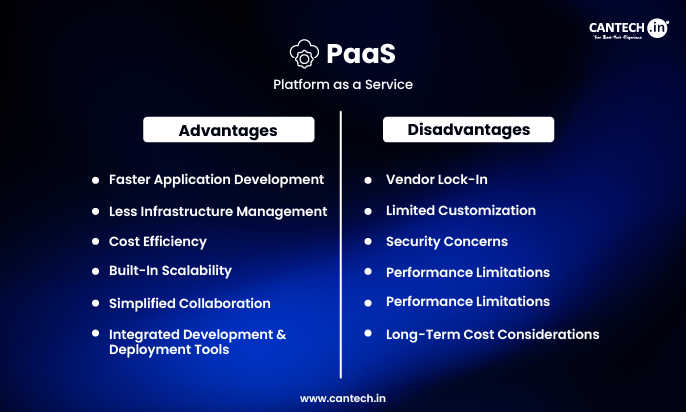
Advantages of PaaS
-
Faster application development
-
No need to manage infrastructure
-
Built-in development tools
-
Simplifies deployment process
Advantages of SaaS
-
Easy to use and accessible from anywhere
-
No installation or maintenance required
-
Cost-effective subscription model
-
Automatic updates and backups
Disadvantages of Cloud Service Models
Despite their benefits, cloud service models also have limitations.
Disadvantages of IaaS
-
Requires technical expertise
-
Complex to manage
-
Security responsibilities lie with the user
Disadvantages of PaaS
-
Limited customization options
-
Vendor lock-in risk
-
Less control over infrastructure
Disadvantages of SaaS
-
Limited control over software features
-
Data security and privacy concerns
-
Dependence on service provider
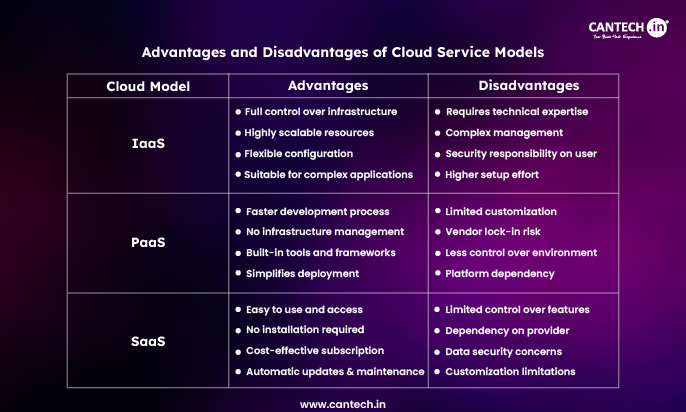
Advantages and Disadvantages of Cloud Service Models
| Cloud Model | Advantages | Disadvantages |
|---|---|---|
| IaaS (Infrastructure as a Service) |
|
|
| PaaS (Platform as a Service) |
|
|
| SaaS (Software as a Service) |
|
|
Conclusion
Cloud service models play a crucial role in modern IT infrastructure by offering scalable, flexible, and cost-effective solutions.
IaaS, PaaS, and SaaS each have their own advantages and disadvantages, making them suitable for different use cases. By understanding these differences, businesses can choose the right model that aligns with their goals, technical capabilities, and long-term growth strategy.
Frequently Asked Questions
What are the 3 cloud service models?
The three main cloud service models are Infrastructure as a Service (IaaS), Platform as a Service (PaaS), and Software as a Service (SaaS). Each model offers different levels of control, flexibility, and management, allowing businesses to choose the most suitable option based on their technical needs and resources.
Which cloud service model is best?
There is no single best cloud service model, as the choice depends on your requirements. IaaS is best for full control, PaaS is ideal for developers building applications quickly, and SaaS is suitable for users who need ready-to-use software without technical complexity.
What is the difference between IaaS, PaaS, and SaaS?
The main difference lies in the level of control and management. IaaS provides infrastructure control, PaaS offers a development platform, and SaaS delivers complete software solutions. As you move from IaaS to SaaS, control decreases while ease of use increases.
Is SaaS better than PaaS?
SaaS is better for end users who need ready-to-use applications, while PaaS is better for developers building and deploying applications. The choice depends on whether you need software or a platform to create software.
What are the risks of cloud service models?
The main risks include data security concerns, vendor lock-in, rising costs, and limited control depending on the model. Proper planning, security practices, and choosing the right provider can help reduce these risks.