When you are building a system for artificial intelligence, your graphics card decides the speed at which your model will learn. You should have sufficient power to handle heavy data without slowing down your computer.
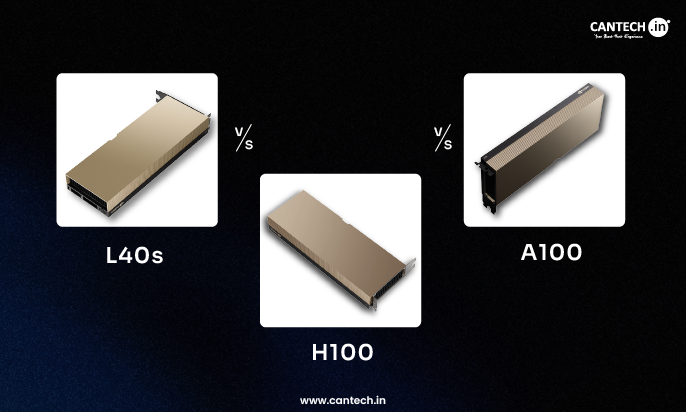
Many tech experts compare the various models to determine which one offers the most value. We will compare the L40S vs H100 vs A100 in this in-depth guide to assist you in making a choice on which one fits best for your deep learning projects.
What are L40S, H100 and A100 GPUs?
NVIDIA designs these specific GPUs for data centers and heavy enterprise use. They are the engines behind modern chatbots and image generators that we use daily. Each model comes from a different generation of technology that influences its speed and cost.
The A100 was the first big star that made massive AI training possible.
NVIDIA subsequently launched the H100 to provide a massive leap in power in very large models.
The L40S is the latest one that attempts to provide a balanced performance of graphics and AI work.
Choosing between these NVIDIA H100 vs A100 vs L40S GPUs requires examining your specific project objectives.
The Role of Data Center GPUs
These cards lack fans as they are in special server racks. They use high-speed connections to talk to other GPUs so they can work as a single large brain.
A100 (Ampere): This is the workhorse for general-purpose AI and scientific math.
H100 (Hopper): This is the speed king that was created specifically for “Transformer” models like GPT.
L40S (Ada Lovelace): It is a multi-purpose card, which manages AI, 3D rendering, and video.
Basics of AI Computing
Deep learning requires billions of tiny calculations to happen at the exact same time. These GPUs have special cores that complete these tasks significantly quicker than a regular computer processor.
Tensor Cores: These are the most important parts for AI because they accelerate matrix math.
Memory Bandwidth: This defines the speed at which the GPU can read data from its own internal storage.
FP8 and FP16: These are mathematical formats that assist AI models in running faster using less memory.
NVLink: This technology connects multiple GPUs together so they can work as one giant unit.
NVIDIA H100 vs A100 vs L40S GPU Specs
The difference in the raw hardware is quite obvious when you compare NVIDIA H100 vs A100 vs L40S GPU Specs.
The H100 has the fastest memory known as HBM3, which provides an enormous data speed of 3.35 Terabytes per second. The L40S is based on GDDR6 memory that is slower but much cheaper to produce for high-volume servers.
The A100 continues to be a powerful card, and it still forms the benchmark for most cloud service providers today. It has 80 GB of memory that is sufficient to run most of the medium-sized language models smoothly. The L40S, however, has a memory of only 48 GB that may become a limit for the largest AI jobs.
However, for “Fine-tuning” (not just inference), 48GB is often plenty for 7B or 13B parameter models, making it a “sweet spot” for mid-sized business applications.
| Feature | NVIDIA A100 (80GB) | NVIDIA H100 (SXM) | NVIDIA L40S |
| Architecture | Ampere | Hopper | Ada Lovelace |
| Memory Capacity | 80 GB HBM2e | 80 GB HBM3 | 48 GB GDDR6 |
| Memory Bandwidth | 2.0 TB/s | 3.35 TB/s | 864 GB/s |
| CUDA Cores | 6,912 | 16,896 | 18,176 |
| Tensor Cores | 432 (3rd Gen) | 528 (4th Gen) | 568 (4th Gen) |
| TDP (Power) | 400 Watts | 700 Watts | 350 Watts |
| FP64 (Scientific) | 9.7 TFLOPS | 34 TFLOPS | 1.2 TFLOPS |
| FP8 Support | No | Yes | Yes |
Key Differences in Memory and Power
The type of memory is important for the performance of these cards. HBM (High Bandwidth Memory) is very expensive to make, but it is necessary for training the biggest AI models.
H100 Power: It requires a massive 700 watts, which needs special cooling in your data center.
L40S Efficiency: It consumes 350 watts, and it can be installed in any PCIe slot.
A100 Versatility: It supports Multi-Instance GPU (MIG) to split one card into seven small ones.
Close Comparison of NVIDIA H100 vs A100 vs L40S GPUs
The market for NVIDIA H100 vs A100 vs L40S GPUs is divided by the nature of work.
H100 is the obvious option in the case of “Pre-training,” in which you build a giant AI model from zero. A100 would be an excellent choice in general research as it is highly stable and widely available in every country. The L40S is gaining popularity for “Inference,” that is, to run an already trained model to get answers.
One of the main reasons is that the H100 is compatible with a feature known as the Transformer Engine, which makes training 9 times faster.
The L40S does not support NVLink as well as the other two, so it is harder to join many of them together.
L40S is PCIe only, while H100 and A100 come in both PCIe and the more powerful SXM (on-board) versions
The majority of companies select their hardware based on whether they are building new AI or just using existing AI.
Specific Advantages and Use Cases
Large Language Models (LLM): The H100 is the most suitable model in this case, as it handles large data loads easily.
Computer Vision: L40S excels in this field since it has built-in RT cores for image processing.
Scientific Research: The A100 is very reliable for simulations that need high double-precision math.
Benefits Analysis of Each GPU
Each of the cards in the L40S vs H100 vs A100 line has a unique advantage that makes it unique for certain users.
H100 Benefits
The H100 Benefits are all about extreme speed and future-proofing your business. It is the card capable of training the world’s largest AI models within a reasonable time. It also saves electricity in the long run because it completes the task much quicker than older cards.
A100 Benefits
The A100 Benefits include amazing versatility and an extremely well-developed software ecosystem. As it has been available since 2020, all AI software is compatible with this card without bugs. It also supports MIG technology that allows you to divide one single GPU into seven smaller pieces for different users.
L40S Benefits
The L40S Benefits are based on the price-to-performance and availability in the market. You can usually buy an L40S much faster than an H100, which often has long waiting lists. It is the best choice for small companies that want to run their own AI chatbots cost-effectively.
Read More about NVIDIA T4 GPU for AI Inference and Media Streaming.
Pros and Cons of each NVIDIA GPU
Knowing the pros and cons of each NVIDIA GPU helps you avoid costly mistakes during your purchase.
NVIDIA H100
Pros: Best performance in the world and huge memory speed.
Cons: It is very costly and needs special server cooling as it becomes very hot.
NVIDIA A100
Pros: Very stable and supports advanced virtualization for multiple users.
Cons: It is getting older and does not have the latest AI acceleration features found in Hopper.
NVIDIA L40S
Pros: Very affordable and excellent for generating images and short videos.
Cons: Slower memory speed and lower VRAM capacity compared to the 80 GB models.
GPU Solutions from Cantech
Our team provides expert advice on NVIDIA H100 vs A100 vs L40S GPUs to ensure you get the most AI power for your specific budget.
We will do the hardware and software installation. We offer different configurations to suit startups and large enterprises. We build systems that maximize the throughput of your GPUs.
Get multi-GPU clusters that are compatible with PyTorch and TensorFlow. We provide 24/7 support and a guarantee of 99.97% uptime.
Conclusion
The final choice in L40S vs H100 vs A100 depends on the stage of development. When you are a large tech firm, and you are training the next GPT, the only choice that makes sense is the H100. It saves you months, which is worth more than the high price of the card.
The L40S is the smartest purchase for most businesses that are engaged in image generation or fine-tuning models. The A100 is still a good option in case you already have the infrastructure, or in case you need to share one GPU among many.
FAQ
Which GPU is best for training a Large Language Model like LLaMA?
H100 is the most suitable for training any Large Language Model due to the Transformer Engine. This feature specifically speeds up the math used in these models by a huge margin. It also has 80 GB of HBM3 memory, which allows you to use larger batches of data. A100 is a good second option, though it will require a long time to complete the training.
Can I use the L40S for high-end 3D rendering?
Yes, the L40S is actually better for 3D rendering than the A100 or H100 because it has dedicated RT cores. These Ray Tracing cores are designed to calculate light and shadows in 3D scenes very quickly.
The A100 and H100 are “compute” cards, and they do not have these specific graphics cores. This makes the L40S the perfect hybrid for AI and creative design work.
Is the A100 still worth buying in 2025?
The A100 is still worth buying if you find it at a significant discount or if you need a very stable card. It has a massive 80GB of HBM2e memory, which is still very useful for large datasets.
However, it lacks the newest AI acceleration features found in the H100 and L40S. If you are starting a new generative AI project, the newer cards will usually give you better value.
What is the difference in speed of the H100 and the A100 on real work?
The H100 is approximately 3 to 4 times faster than the A100 of the same model in most AI training tests. It is also up to 30 times faster than the old architecture on certain tasks, such as inference on large models. Such a speed difference implies that you are able to complete your research in days rather than weeks.