Introduction
In FinTech, a few seconds can be a long time. A payment awaits approval, a trading platform responds to a market movement, and a fraud detection system is processing thousands of signals, all while customers demand it all happen in real time.
That pressure is so great on the infrastructure that runs behind the scenes. A bare metal server offers physical hardware that is not shared with other unrelated tenants. This provides businesses with greater direct control over their environment’s configuration and optimization.
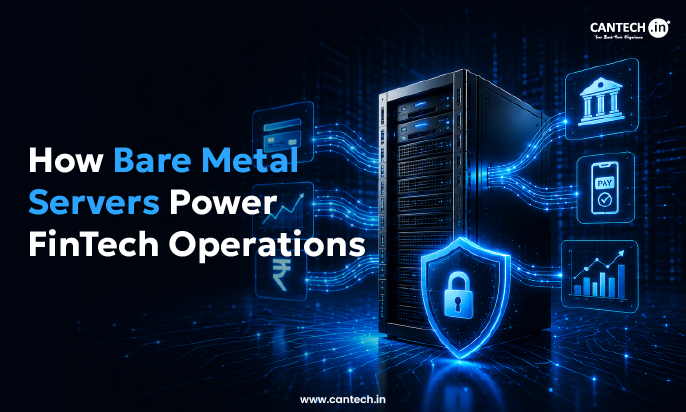
Bare Metal FinTech Infrastructure can deliver the consistent performance, low latency, workload isolation and control necessary to ensure critical operations remain consistent even with demanding financial workloads.
Why FinTech Companies Need Bare Metal Servers
Most business software is not subjected to the pressures that FinTech applications are. A payment gateway might have to handle thousands of transactions, while a trading platform adjusts to market fluctuations in real-time. When activity suddenly increases, response times can be impacted by even minor performance variations.
Sensitive financial and customer information must also be safeguarded, as well as resource-intensive workloads like fraud detection, risk modelling and real-time analytics. This is why it is particularly crucial to have consistent computing power and more control over security configurations.
These workloads can be hosted on a bare metal server with dedicated CPU, memory, storage, and network resources, without competing with unrelated workloads from other tenants. Bare Metal computing is engineered to provide a predictable environment and greater system control for FinTech companies with demanding or latency-sensitive applications.
Challenges of Running FinTech Applications on Shared Infrastructure
While shared infrastructure is suitable for many use cases, critical workloads in the FinTech space can reveal its drawbacks. When multiple tenants are running on the same underlying hardware, a sudden increase in resource consumption by other tenants can cause a noisy neighbour effect, causing fluctuations in CPU, memory, storage I/O or network performance.
The uncertainty can be challenging for latency-sensitive applications such as payment processing and trading systems. In addition, multi-tenant environments might provide less customization and control over the isolation and configuration of workloads at the hardware level.
This is not to say that shared infrastructure is not appropriate for FinTech. But as performance becomes business-critical and infrastructure control becomes more critical, bare metal infrastructure can offer the dedicated environment these workloads need.
Key Benefits of Bare Metal Servers for FinTech
Having powerful hardware is not the only thing that makes a bare metal server valuable. The real benefit for FinTech applications is knowing exactly what resources are available and being able to flex them to the application.
Predictable Performance and Dedicated Resources
Resources are allocated exclusively to one environment, such as CPU, RAM, storage, and network. Applications can be run without having to compete with other unrelated tenants for computing resources, which helps to ensure consistent performance during heavy workloads.
Low and Consistent Latency
In the world of payments, trades, and financial APIs, every millisecond counts. For workloads that require consistent response times, dedicated resources can help minimize performance variability, allowing bare metal hosting to be used.
Greater Workload Isolation
FinTech teams can select the operating system, software stack, storage configuration, and security policies, and fine-tune the environment for specific applications.
Performance for Sustained Workloads
Bare Metal computing offers dedicated capacity for databases, analytics and continuously running compute-heavy applications, without sharing resources. This is where Bare Metal solutions are very useful for stable, resource-heavy workloads that run 24/7.
FinTech Workloads That Benefit From Bare Metal
Not all FinTech applications require special hardware. However, if speed, processing volume, or sustained computing requirements are paramount, a bare metal server may be a good choice.
Payment Processing
Stable processing capacity and response times are crucial, particularly during peak periods, for high transaction volumes.
Trading Platforms
Market information is constantly changing. Trading systems receive incoming data and execute orders without competing for shared computing resources with dedicated resources.
Fraud Detection
Real-time fraud systems are crucial for detecting unusual transaction patterns in large volumes of data, requiring reliable processing power.
AI and Machine Learning
Financial forecasting, credit scoring, and risk models can demand a lot of CPU, GPU and memory resources.
Financial Databases
Fast Storage I/O and consistent access to compute and memory resources are suitable features for high-volume databases, known as financial databases.
Blockchain and Digital Assets
Nodes, transaction validation and platforms require continuous compute, storage and network resources.
Bare Metal FinTech Infrastructure offers dedicated resources that Bare Metal computing can allocate consistently for these demanding workloads.
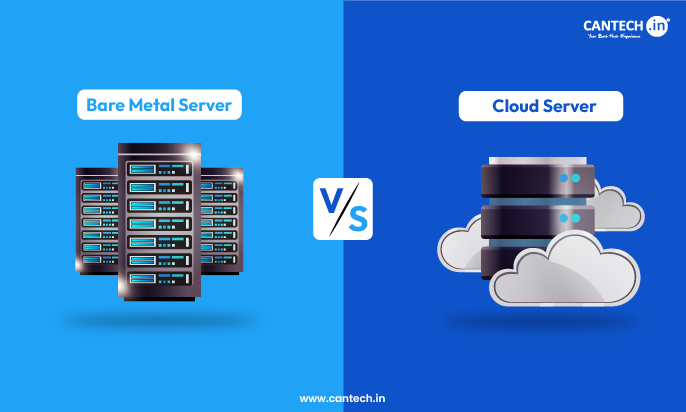
Bare Metal vs Cloud Servers for FinTech
The decision between a bare metal server and cloud infrastructure will depend on the performance of your FinTech application in real-world scenarios. For platforms that need consistent performance, resources, and more infrastructure control, bare metal may be a better choice. Cloud servers, on the other hand, are great for apps that have erratic traffic or require rapid scalability. Let’s do a quick comparison:
| Factor | Bare Metal Servers | Cloud Servers |
| Resources | Dedicated physical resources | Often virtualized resources |
| Performance | Predictable for sustained workloads | Depends on instance and architecture |
| Scalability | Requires capacity planning | Fast, flexible scaling |
| Deployment | Can take longer to provision | Usually rapid |
| Control | High hardware and software control | Depends on the cloud provider and service model |
| Isolation | Physical server-level isolation | Typically virtualized isolation |
| Best Fit | Stable, compute-intensive, or latency-sensitive workloads | Dynamic, seasonal, or rapidly changing workloads |
Many FinTech businesses don’t rely on a single infrastructure model. A hybrid model is when a bare metal server is used for mission-critical applications, like payment processing or financial databases, and cloud resources are used for development, testing, backups, or traffic surges. This enables organizations to choose the most appropriate Bare Metal solutions or bare metal hosting for the workloads they are using, based on their needs for performance, flexibility and cost.
For a detailed comparison, see our Bare Metal vs Cloud Servers guide.
Compliance Requirements for FinTech Infrastructure
Infrastructure choices are closely linked with regulatory and security considerations, particularly for FinTech companies that deal with sensitive financial and personal information. The applicable standards are determined by the services provided, the countries provided to and the nature of the data processed. Payment businesses might be required to comply with PCI DSS, organizations that process personal data could be required to adhere to GDPR, and SOC 2 and ISO/IEC 27001 are well-known frameworks for security controls and information management. Other businesses may also have to adhere to data residency laws and sector-specific financial regulations. A well-designed bare metal infrastructure provides organizations with more control over data location, access management, network architecture, logging and security configurations. It is crucial to note, however, that Bare Metal FinTech Infrastructure does not make an organization compliant, but rather it can help to achieve compliance.
How to Choose the Right Bare Metal Server for Your FinTech Application
The highest specification bare metal server is not always the best; it is the one that fits your application’s workload. Carefully assess your infrastructure needs before selecting a solution.
Checklist:
- Select a CPU with sufficient cores and processing power for your workload.
- Use the size of RAM according to the use of the application and the requirements of the database.
- For quick data retrieval, opt for NVMe SSDs or other high-performance storage solutions.
- Take into account network bandwidth and latency, particularly for real-time services.
- Choose a data center location based on customer proximity and data residency needs.
- Check for any built-in DDoS protection and robust network security features.
- Check backup, redundancy and disaster recovery.
- Check the provider’s SLA and uptime guarantees.
- Make sure the server can be upgraded to accommodate your workloads.
- Choose between managed or unmanaged bare metal hosting based on your team’s skills.
- Look for a provider with 24/7 technical support that is responsive.
- It’s not just about the most powerful hardware that’s available; it’s about the right
Bare Metal solutions, based on application requirements, compliance requirements, and long-term growth.
Is Bare Metal the Right Choice for Your FinTech Business?
There’s no single infrastructure model that fits every FinTech company. A dedicated server makes the most sense when applications run continuously under heavy load, require predictable performance, process latency-sensitive transactions, or need greater control over hardware and security configurations. These are common requirements for payment platforms, financial databases, and trading applications.
On the other hand, cloud infrastructure may be a better choice for development environments, rapidly changing workloads, or services that need to scale up and down frequently. Many organizations combine both approaches, using bare metal infrastructure for critical production systems and cloud resources for testing, analytics, or temporary capacity. Choosing the right Bare Metal solutions comes down to understanding how your applications actually perform, not simply following infrastructure trends.
Conclusion
The selection of the infrastructure depends on the workload you are running, not on the latest trend, and every FinTech application has its own infrastructure needs. A bare metal server can serve as a solid base for long-term success if your platform requires consistent performance, dedicated resources, low latency, and more control over security and infrastructure. Consider your application’s performance, compliance and scalability requirements before deciding. Cantech’s dedicated server solutions are engineered to deliver enterprise-class performance and infrastructure, making them ideal for businesses with demanding applications.
FAQs
What is a bare metal server in FinTech?
A bare metal server is a physical server that is dedicated to running financial applications and is not shared with other tenants. It provides FinTech organizations with more control over performance, infrastructure setup, and workload isolation for heavy workloads.
Are bare metal servers more secure than cloud servers?
Not automatically. While bare metal servers offer dedicated hardware and improved workload isolation, the security of these servers relies on the system configuration, access controls, monitoring, patch management, and operational practices.
Which FinTech applications benefit most from bare metal?
Applications such as payment gateways, trading platforms, fraud detection systems, financial databases, AI and machine learning models, risk analysis platforms, and more that require consistent performance and dedicated resources often benefit from the performance and resources of bare metal infrastructure.
Can FinTech companies use bare metal and cloud together?
Yes. Many organizations use a hybrid strategy, keeping mission-critical workloads on bare metal and leveraging cloud services for development, backups, disaster recovery, or to accommodate spikes in demand.
Does bare metal infrastructure help with FinTech compliance?
Yes, bare metal infrastructure can help ensure compliance because it offers more control over the data location, network design, logging, and security settings. Compliance, however, is also reliant on organizational policies, operational processes and fulfilling the requirements of relevant regulations and standards.