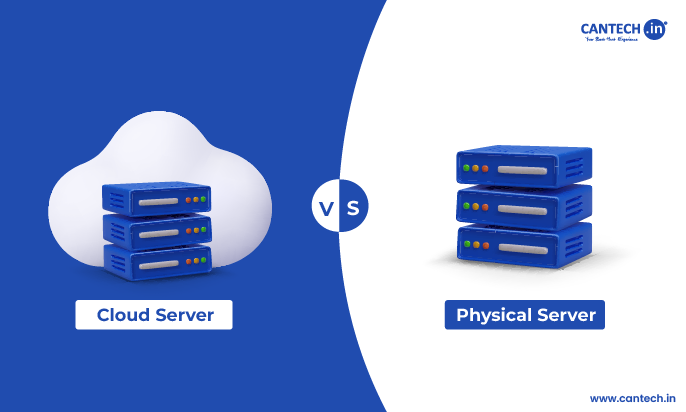
Cloud server is a virtual server which uses a common physical infrastructure and can increase or decrease resources on-demands whereas physical server is a dedicated computer with set hardware reserved to one user. Cloud servers are flexible, quick to deploy and priced on a use basis. Physical servers offer stability in performance, complete hardware control and better isolation. This blog describes the functionality of cloud and physical servers, their performance differences, cost, performance differences, scaling, security, and applications, so you are able to select the proper server model based on the workload.
Cloud Server vs. Physical Server: Practical Comparison
One of the underlying infrastructural choices is whether to use a cloud server or a physical server. These two models are used to drive modern applications and they serve very different workloads and operate in very different ways.
This guide describes the functionality of each type of server, their comparison under major technical and business variables and assists you in choosing the alternative that is right to you.
What Is a Cloud Server?
The cloud server is a virtual machine that is developed by the virtualization technology and deployed on a cluster of physical servers within a data centre. It acts as a normal server but utilizes common infrastructure resources including CPU, RAM and storage.
Cloud servers can be instantiated, reinstantiated or terminated in minutes. They are dynamic and hence suit workloads with varying demands.
Key characteristics:
- Virtualized environment
- Shared underlying hardware
- On-demand scaling
- Pay-as-you-use pricing
What Is a Physical Server?
A physical server (also referred to as dedicated server) is a single, dedicated computer dedicated to one user or organization. Any hardware resources are the property of such user, and a virtualization layer is not added automatically.
The physical servers are typical of a private data center or a hosting provider.
Key characteristics:
- Dedicated hardware
- Fixed resource limits
- Full OS and hardware control
- Predictable performance
Read More : What is Physical Server?
How Cloud Servers and Physical Servers Work?
Cloud Server Architecture
- A hypervisor is used to virtualize physical servers.
- Several virtual servers operate on the same hardware.
- The allocation of resources is adjusted to demand.
- Traffic and failover are handled by load balancers and automation.
Physical Server Architecture
- There is one server that operates on a single operating system.
- None of the resources share with other users.
- Scaling also needs hardware upgrade or new servers.
- Availability is reduced to redundancy.
Performance Comparison
Cloud Server Performance
Cloud performance tends to be high and fluctuate based on:
- Virtualization overhead
- Shared hardware usage
- Throttling resources at peak times.
These problems are reduced in modern cloud platforms, although not all workloads will be guaranteed to perform consistently.
Physical Server Performance
Physical servers deliver:
- Direct access to storage, RAM and CPU.
- No virtualization overhead
- Stable and foreseeable performance.
They are more applicable in CPU intensive, memory intensive or latency sensitive applications.
Scalability and Flexibility
Cloud Servers
The greatest benefit of cloud servers is scalability.
- Spin up and spin down scale resources immediately.
- Automatic traffic spikes.
- Load balancing and support auto-scaling.
This is what makes cloud servers to be effective in dynamic or unpredictable workloads.
Physical Servers
It is more difficult to scale physical servers.
- Needs manual hardware upgrades.
- May involve downtime
- Capacity planning should be preemptive.
- Physical servers are suited to long-term, stable workloads.
Cost Structure and Pricing
Cloud Server Costs
- None of the initial hardware investment.
- Pay only for resources used
- Flexible billing (hourly or monthly)
Nevertheless, sustained workloads might prove to be costly without any cost controls.
Physical Server Costs
- Increased initial or fixed monthly expenses.
- Predictable billing
- Less expensive when used continuously and frequently.
Workloads with high utilization throughout the year generally leading to full capacity tend to be better served by physical servers.
Security and Isolation
Cloud Server Security
- Cloud servers are based on shared responsibility model:
- Infrastructure is insured by providers.
- The OS, applications and data are secured by the user.
Although cloud platforms are providing powerful security mechanisms, the shared environment must be configured with care.
Physical Server Security
Physical servers provide:
- Complete privacy with others.
- More control of security policies.
- Simpler regulations to the controlled industries.
They are commonly used in sensitive information and high-compliance needs.
Reliability and Availability
Cloud Servers
Cloud environments are failure tolerant:
- Built-in redundancy
- Automatic failover
- Distributed systems with high uptime.
Workloads are automatically transferred to another server in the event of a failure of one.
Physical Servers
- Reliability is set up-dependent:
- Single server = single point of failure.
- High availability needs additional hardware.
- Backup and redundancy should be done manually.
Management and Maintenance
Cloud Servers
- Controlled by dashboards and APIs.
- Quick provisioning and automation.
- Less maintenance of hardware.
Cloud servers: Cloud servers are easier to manage, particularly when using small teams.
Physical Servers
- Complete access to both hardware and OS.
- Needs managed or in-house support.
- Increased maintenance and upgrade responsibility.
Cloud Server vs Physical Server: Which One to Choose?
Choose a Cloud Server If:
- Traffic is unpredictable
- You need fast scaling
- You want low upfront costs
- You are dependent on automation and DevOps workflows.
Choose a Physical Server If:
- Consistency of performance is essential.
- The workloads are resource intensive.
- It must comply or be isolated in data.
- Usage is stable and long-term
Cloud Server vs Physical Server: Summary Table
| Factor | Cloud Server | Physical Server |
|---|---|---|
| Resource type | Virtual | Dedicated |
| Scalability | Instant | Manual |
| Performance | Variable | Consistent |
| Cost model | Usage-based | Fixed |
| Security isolation | Shared | Full |
| Deployment speed | Minutes | Hours to days |
Final Takeaway
Physical server and cloud servers address various issues. Cloud servers are more flexible, fast, and scalable. Physical servers revolve around control, performance predictability and isolation.
The correct decision will rest on your behaviour at work, your budget model, your requirements in terms of compliance and your operational strength. A common way of using both cloud servers and physical servers is to have a balanced, hybrid infrastructure to support a physical server system that is performance-intensive.