1. Why Teams Are Leaving Lambda Labs in 2026
Lambda Labs earned its reputation honestly. It was among the first GPU cloud providers to offer a clean developer experience, pre-installed PyTorch and TensorFlow environments, and competitive H100 pricing – all without the complexity of AWS or GCP. With over 50,000 customers including Intuitive, Writer, Sony, and Samsung, it’s not a bad product.
But the cloud GPU server market in 2026 looks nothing like it did in 2022. Over 300 new GPU cloud providers entered the market in 2025 alone. H100 rental rates have dropped 64–75% since Q4 2024. What cost $8–10/hr two years ago now runs $2–3/hr from specialized providers. And in that environment, Lambda’s specific limitations have become more visible.
The three pain points that drive teams to switch:
GPU availability gaps. Lambda’s H100 PCIe instances regularly go out of stock during peak demand. Teams who build workflows around a specific instance type find themselves manually checking availability multiple times a day. For time-sensitive training runs or production inference, this is more than an inconvenience.
Hourly billing on short jobs. Lambda rounds up to the full hour. A 23-minute training run costs the same as a 60-minute one. A 47-minute preprocessing job is billed as an hour. When you’re running dozens of iterative experiments daily, this adds up materially. Several newer providers bill per minute or per second.
No spot instances or flexible commitment tiers. Lambda offers on-demand pricing only, with reserved options requiring multi-year lock-in for meaningful discounts. There’s no spot/preemptible tier for workloads that can tolerate interruption – the discount tier most sophisticated teams use to reduce costs by 40–70%.
The egress advantage is real but overstated. Lambda’s free unlimited egress is genuinely valuable, especially for teams downloading large model checkpoints or datasets frequently. We’ll account for this in the alternatives below – because some competitors do charge significant egress fees that change the true total cost of ownership.
2. How We Evaluated These Alternatives
This list is built on four criteria, weighted by what actually matters when you’re choosing a GPU cloud provider for real AI workloads:
Pricing accuracy (2026): All H100 and GPU pricing figures in this article are sourced from live provider pricing pages, verified comparison tools (GetDeploying.com, IntuitionLabs.ai, AwesomeAgents.ai), and Cantech’s direct deployment experience. GPU cloud pricing changes frequently – we note where prices are directional and recommend verifying before provisioning.
Workload fit: A provider that is perfect for a solo researcher running LoRA fine-tunes is not the same as one that’s right for an enterprise training a 70B model on a 64-GPU cluster. We match each alternative to its actual best use case.
Total cost of ownership: Headline GPU $/hr is not the full picture. We include egress costs, storage costs, and billing model impact where they materially change the comparison. For a broader breakdown, see our guide to Cloud GPU pricing comparison.
Operational experience: We include notes from Cantech’s hands-on deployment experience across these platforms, which goes beyond what any pricing table can capture.
3. Quick Comparison: All 10 Alternatives at a Glance
| Provider | H100 $/hr | Best GPU Available | Billing | Spot/Reserved | Best For |
| Lambda Labs (baseline) | $2.49–$3.78 | H100 SXM, B200 | Hour | Reserved only | Research, startups |
| CoreWeave | $6.16/GPU (8× cluster) | B200, GB200, H200 | Hour | Spot + Reserved | Enterprise multi-node |
| RunPod | $1.99 (community) | H100, B200 | Hour | Spot (community) | Startups, budget training |
| Vast.ai | $1.38–$1.87 | H100, A100 | Hour | P2P market pricing | Lowest-cost experimentation |
| Azure H100 VMs | $3.29+ | H100 NVL, H200 | Hour | Spot + Reserved | Enterprise compliance, Azure ecosystem |
| AWS P5 | ~$3.90/GPU | H100 SXM | Hour | Spot + Reserved | AWS-native enterprise |
| GCP A3 | ~$3.50/GPU | H100 SXM | Hour | Spot + Reserved | GCP-native AI, TPU hybrid |
| DigitalOcean | $1.99 | H100, H200 | Hour | None | Developers, simple setup |
| Nebius AI | ~$2.10 | H100 SXM | Hour | Volume discounts | EU-based teams |
| Modal | ~$1.50 | H100 | Second | Serverless scaling | Serverless inference, bursty workloads |
| Hyperstack | ~$1.60 | H100, A100 | Hour | None | Price-performance balance |
Pricing reflects June 2026 on-demand rates. All prices are per GPU per hour unless noted. Always verify current rates before provisioning.
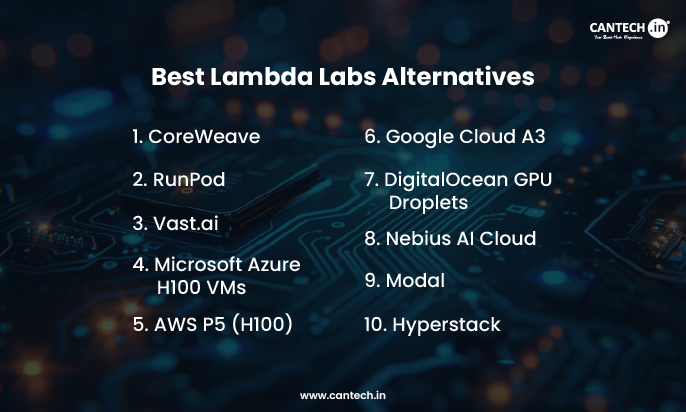
4. The 10 Best Lambda Labs Alternatives
1. CoreWeave – Best for Enterprise Multi-Node Training
H100 SXM pricing: $6.16/GPU/hr on-demand (8× cluster = $49.24/hr) | Up to 60% off with reserved
CoreWeave is the GPU cloud that hyperscalers use as their GPU cloud. Its customer list – OpenAI, Mistral AI, Jane Street, NovelAI – reflects its positioning at the serious, enterprise end of the spectrum. It was built from the ground up as a Kubernetes-native platform, not a VM provider with GPUs bolted on.
What makes it different from Lambda:
CoreWeave’s minimum unit is typically an 8-GPU cluster, not a single GPU. If you’re deciding between flexible cloud infrastructure and dedicated hardware for machine learning, see our guide to cloud vs dedicated GPU server for ml. This is the biggest structural difference. If you need 1 H100, CoreWeave is the wrong tool. If you need 64 or 512, CoreWeave is purpose-built for you. Its 3.2 Tbps InfiniBand interconnect fabric, NVLink 4.0 within clusters, and GPU Direct RDMA support are essential for the gradient synchronization that large distributed training runs require.
The GPU portfolio goes beyond Lambda’s: CoreWeave offers H200 GPU server, B200 (8×, 1.4 TB VRAM), GB200 (4×, 744 GB VRAM), B300, and RTX Pro 6000 configurations that Lambda currently doesn’t match.
Pricing reality check:
On-demand, CoreWeave is more expensive than Lambda for H100 ($6.16/GPU vs Lambda’s $3.78 SXM). But committed pricing changes the math: with 60% reserved discount, CoreWeave’s effective H100 rate drops to approximately $2.47/GPU/hr – cheaper than Lambda’s on-demand SXM rate. For teams running continuous multi-week training jobs, the reserved path is the correct comparison.
Where Lambda still wins: Single-GPU work, free egress, and simpler onboarding for teams without Kubernetes expertise.
Best for: Enterprises training foundation models, teams running 8+ GPU distributed jobs, organizations that need the newest NVIDIA GPU generations (B200, GB200, B300).
Spot instances: Yes – can reduce costs 60–80% for interruptible workloads.
Egress: Charged per GB (plan for this in your total cost).
Minimum commitment: None for on-demand; significant for reserved pricing.
2. RunPod – Best Budget Option for Startups and Researchers
H100 pricing: ~$1.99/hr (community cloud) | ~$2.39/hr (secure cloud) | Spot from ~$1.25/hr
RunPod is the most popular Lambda Labs alternative for cost-conscious teams, and for good reason. Its community cloud H100 rate of $1.99/hr is 20% cheaper than Lambda’s on-demand price – with no long-term commitment required. Spot instances push that even lower, to around $1.25/hr for workloads that can tolerate interruption.
The dual-cloud model explained:
RunPod operates two tiers. The community cloud lets independent GPU owners monetize idle capacity – think of it as Airbnb for GPUs. Prices are lower because you’re renting from individuals, not a data center. The secure cloud is managed infrastructure with SLA guarantees, closer to Lambda’s model in terms of reliability, at ~$2.39/hr for H100.
For research and experimentation with checkpoint-based training, community cloud is perfectly adequate. If you’re comparing different ways to rent GPUs for AI training and inference, the workload and billing model are important factors. For production inference serving where availability matters, use the secure cloud.
Serverless capability:
RunPod’s serverless offering is a meaningful differentiator – you define a handler function, pay only when it’s processing requests, and RunPod scales containers automatically. Cold start times are typically under 3 seconds for A100 workloads. For unpredictable inference loads, this eliminates the cost of idle capacity entirely.
Where Lambda still wins: Free egress (RunPod charges for data transfer), academic credibility for published research, and slightly more stable community.
Best for: Startups doing model development and experimentation, researchers on tight budgets, teams running checkpoint-based training that tolerates spot interruption, serverless inference workloads.
GPU selection: H100 PCIe, H100 SXM, A100, RTX 4090, RTX 3090, and many more through community hosts.
Billing: Hourly (community/secure cloud); per-request (serverless).
Spot/Reserved: Community cloud functions as spot-equivalent; secure cloud is on-demand.
3. Vast.ai – Best for Absolute Lowest Prices
H100 pricing: From $1.38/hr (marketplace) | Market low as $1.87/hr typical | A100 from $0.29/hr spot
Vast.ai operates a pure peer-to-peer GPU marketplace. If you need the lowest possible GPU cost and can architect your workloads to tolerate reliability variability, no platform beats it. H100 instances have been available as low as $1.38/hr – well below what any managed provider charges.
How it works:
GPU owners (data centers, mining operations, research institutions) list their idle hardware on Vast.ai’s marketplace. Renters bid or accept listings. Prices fluctuate based on supply and demand, region, and machine specification. You’re interacting directly with hardware owners through a marketplace, not a managed cloud layer.
The reliability tradeoff is real:
This is the most important thing to understand about Vast.ai. Hosts can take their machines offline. Your instance can be terminated with limited warning. For any workload that isn’t checkpoint-based and fault-tolerant, this creates genuine operational risk. Vast.ai is not the right platform for production inference serving or any training job that can’t resume from a checkpoint.
For checkpoint-based training runs, batch inference jobs, and research experimentation, the reliability risk is manageable and the cost savings are substantial. A team running a 1-week checkpoint-based training job on Vast.ai H100 instances at $1.87/hr spends ~$3,147 vs ~$4,184 on Lambda – a $1,037 saving for the same compute.
Where Lambda still wins: Managed infrastructure guarantees, free egress, predictable availability, and much simpler operational experience.
Best for: Budget-constrained researchers, teams with checkpoint-based training pipelines, batch inference workloads that can be re-queued, experienced ML engineers comfortable managing infrastructure variability.
GPU selection: Extremely wide – A100, H100, H200, RTX 4090, RTX 3090, and hundreds of other configurations from individual hosts.
Billing: Hourly, varies by host.
Spot/Reserved: Marketplace pricing functions as spot-equivalent.
4. Microsoft Azure H100 VMs – Best for Enterprise Compliance and the Azure Ecosystem
H100 pricing: NC H100 v5 (1× H100 NVL PCIe) from ~$3.29/hr | ND H100 v5 (8× H100 SXM) from ~$6.16/GPU | Azure Spot: 60–80% off
Microsoft Azure offers something no other GPU cloud provider currently does: confidential computing on H100 GPUs. The NCC H100 v5 VM series uses Trusted Execution Environments (TEEs) to protect data and model weights in memory even during GPU computation – meaning the cloud provider itself cannot access your data while it’s being processed.
Three Azure H100 VM families:
The NCads H100 v5 uses NVIDIA’s H100 NVL (dual PCIe-linked) configuration – the world’s first cloud instance with this GPU variant, exclusive to Azure. It supports 1–2 H100 NVL GPUs per VM, making it the Azure option for teams that need more than a single GPU but less than an 8-GPU cluster.
The ND H100 v5 deploys 8× H100 SXM GPUs per VM with 3.2 Tbps InfiniBand interconnect and NVLink 4.0, directly competitive with CoreWeave for large-scale distributed training. It scales to thousands of GPUs through Virtual Machine Scale Sets.
The NCC H100 v5 is the confidential computing variant – appropriate for healthcare, finance, government, and any regulated industry that needs GPU acceleration without compromising data privacy.
When to choose Azure over Lambda:
Azure is almost never the cheapest GPU option on a per-hour basis. But for organizations already operating in the Azure ecosystem – using Azure Active Directory, Azure Kubernetes Service, Azure Blob Storage, or Azure DevOps – the operational integration value is substantial. You’re not adding a vendor; you’re adding a GPU tier to existing infrastructure.
Spot VM pricing can reduce Azure H100 costs by 60–80%, which changes the economics significantly for interruptible workloads.
Best for: Enterprise teams in the Azure ecosystem, healthcare/finance/government organizations needing confidential GPU computing, teams requiring HIPAA, FedRAMP, or SOC 2 Type II compliance, large-scale distributed training on Azure.
GPU selection: H100 NVL (exclusive), H100 SXM, H200, and upcoming GPU generations.
Billing: Hourly (on-demand), Spot VM (60–80% discount), Reserved Instances (up to 65% off).
Egress: Standard Azure egress pricing (plan accordingly for large data workloads).
5. AWS P5 Instances – Best for the AWS Ecosystem
H100 pricing: ~$3.90/GPU/hr on-demand (after 44% price cut in June 2025) | Spot: ~$1.50–$2.00/GPU
AWS cut its H100 pricing by approximately 44% in June 2025, which finally made its P5 instances competitive with the neocloud tier for teams already in the AWS ecosystem. The P5 family uses H100 SXM GPUs, the same high-bandwidth SXM variant used by CoreWeave’s ND-equivalent clusters.
The AWS case:
For organizations with existing AWS infrastructure – S3 data lakes, SageMaker pipelines, EC2-based services, EKS clusters – migrating to a specialized GPU cloud means adding cross-cloud data transfer costs, separate IAM systems, and new vendor relationships. If your dataset lives in S3 and your model will be served on EC2, AWS P5 instances with their native ecosystem integration may be cheaper in practice than a lower per-GPU rate from Lambda or RunPod that comes with significant egress costs moving data in and out.
SageMaker integration is AWS’s strongest GPU differentiator. If you’re using SageMaker for experiment tracking, model registry, or automated deployment, P5 instances slot directly into that workflow.
Where Lambda wins: Lambda is still 36–50% cheaper than AWS P5 at comparable on-demand rates, and Lambda’s free egress is a significant advantage for teams that regularly move large datasets.
Best for: Organizations with large AWS-native data infrastructure, teams using SageMaker, enterprises with existing AWS enterprise agreements, AWS-native inference serving with minimal egress.
Spot availability: Yes – AWS Spot instances for P5 can be significantly cheaper, but spot capacity for H100 is less predictable than on-demand.
Reserved pricing: 1-year or 3-year Savings Plans can reduce costs 30–40%.
6. Google Cloud A3 – Best for GCP-Native AI Pipelines
H100 pricing: ~$3.50/GPU/hr on-demand | Spot: competitive rates available | TPU hybrid architectures available
Google Cloud’s A3 VM family uses H100 SXM GPUs and is Google’s answer to the enterprise AI training market. Its differentiation from AWS and Azure is less about raw H100 performance (the GPU is the same) and more about integration with Google’s AI-specific infrastructure.
GCP’s unique advantages:
Vertex AI is Google’s end-to-end ML platform, and A3 VMs slot natively into Vertex pipelines for experiment tracking, hyperparameter tuning, and model deployment. For teams building on the Google Cloud ecosystem – using BigQuery ML, Vertex AI, or Google’s TPU infrastructure – A3 GPU VMs enable a hybrid architecture where TPUs handle certain training phases and H100s handle others, optimizing cost and performance.
Google’s networking infrastructure – specifically its Jupiter network fabric inside its data centers – provides high-bandwidth, low-latency connectivity between A3 instances that is competitive with CoreWeave’s InfiniBand for many workloads.
Where Lambda wins: Again, Lambda is cheaper on a per-GPU basis, and GCP’s egress fees can be substantial for large data pipelines.
Best for: Teams embedded in the GCP ecosystem, Vertex AI users, organizations running TPU + GPU hybrid training architectures, BigQuery ML users extending to GPU compute.
Spot/Reserved: Both available. Spot can achieve 60–70% savings on interruptible workloads.
7. DigitalOcean GPU Droplets – Best for Developer Simplicity
H100 pricing: $1.99/GPU/hr | H200: $3.44/GPU/hr | RTX 4000: $0.50/hr
DigitalOcean’s Gradient AI GPU Droplets occupy a specific niche: developers who want GPU access without enterprise cloud complexity. If you’ve used DigitalOcean before for VPS hosting or managed Kubernetes, you already understand the product philosophy. GPU Droplets follow the same approach – straightforward, well-documented, predictable pricing.
What makes it accessible:
GPU Droplets come with pre-installed PyTorch, TensorFlow, and Jupyter environments with CUDA 11.8+ ready to use. You don’t configure CUDA drivers. You don’t set up framework compatibility. You launch a Droplet and you’re running. This is Lambda-level developer simplicity at H100 pricing ($1.99/hr) that is actually competitive.
DigitalOcean Kubernetes (DOKS) with GPU node pools and autoscaling makes it straightforward to build scalable inference endpoints without the operational complexity of AWS EKS or GCP GKE.
Limitations:
GPU Droplets are single-GPU focused. For multi-GPU distributed training requiring InfiniBand interconnect, DigitalOcean is not the right platform. The GPU selection is also more limited than CoreWeave or Lambda. This is a platform for AI application development and inference, not frontier model training.
Where Lambda wins: Lambda has broader GPU selection and free egress. DigitalOcean charges for outbound data transfer.
Best for: Application developers building AI-powered products, teams that want Lambda-level simplicity at competitive pricing, inference API development, teams already using DigitalOcean for other infrastructure.
GPU selection: RTX 4000 Ada, A40, A100 80GB, H100 80GB, H200 141GB.
Billing: Hourly.
Spot/Reserved: Not available.
8. Nebius AI Cloud – Best for EU-Based and Data-Sovereign Teams
H100 pricing: ~$2.10/GPU/hr on-demand | Volume discounts available
Nebius is the rebranded AI cloud spun out of Yandex following Yandex’s corporate restructuring. It operates data centers in Finland, the Netherlands, and France, with a focus on the European AI market. For EU-based teams with data residency requirements – particularly under GDPR – Nebius offers H100 GPU infrastructure in European data centers at pricing that is competitive with Lambda.
Why it matters for European teams:
Most GPU cloud providers have the majority of their H100 capacity in US data centers. Getting GDPR-compliant GPU compute means either paying the premium for AWS/Azure EU regions or using one of the limited EU-focused GPU clouds. Nebius fills this gap with H100 SXM availability in multiple EU jurisdictions at ~$2.10/hr – meaningfully cheaper than Azure EU or AWS EU H100 pricing.
Nebius integrates with standard MLOps tooling including Kubernetes, and offers managed storage and networking within its EU data centers. Volume discounts are available for teams with predictable monthly spend.
Where Lambda wins: Lambda’s free egress is a notable advantage (Nebius charges for egress), and Lambda’s availability and community are larger.
Best for: EU-based AI teams with GDPR or data sovereignty requirements, organizations that must keep training data within the EU, European startups and research institutions.
GPU selection: H100 SXM, A100, and expanding portfolio.
Billing: Hourly.
Data centers: Finland, Netherlands, France (EU-only).
9. Modal – Best for Serverless AI and Bursty Inference Workloads
H100 pricing: ~$1.50/GPU/hr effective (per-second billing) | A10G: ~$0.19/GPU/hr | Cold start: typically <1s
Modal is architecturally different from every other provider on this list. It’s not a VM rental platform – it’s a serverless GPU compute layer where you pay only for the exact seconds your code is running on GPU hardware. There are no idle costs, no minimum instance runtime, and no per-hour rounding.
How Modal works:
You write Python functions decorated with Modal’s SDK. You specify GPU requirements. Modal handles provisioning, scaling, and teardown automatically. A function call that takes 47 seconds of GPU compute costs 47 seconds of GPU pricing, not 60 minutes. For workloads with unpredictable or bursty demand, this fundamentally changes the economics.
python
import modal
app = modal.App()
@app.function(gpu=“H100”)
def run_inference(prompt: str) -> str:
# Your inference code here
return result
Where it excels:
Production inference serving with variable load is Modal’s strongest use case. Instead of sizing an always-on GPU instance for peak traffic and paying for it 24/7, you define serverless endpoints that scale to zero during quiet periods and scale up (with sub-second cold starts) during load spikes. For many inference workloads, this reduces actual GPU spend by 60–80% compared to Lambda’s always-on model.
Where it doesn’t fit:
Long, continuous training runs are not Modal’s use case. The serverless model is optimized for jobs that start, execute, and complete within minutes or hours. For multi-day distributed training across many GPUs, the VM-based providers (CoreWeave, Lambda, Azure) are more appropriate.
Where Lambda wins: For training workloads that run continuously, Lambda’s on-demand GPU access is simpler. Modal’s per-second billing can get complex to reason about for long jobs.
Best for: Serverless inference APIs with variable traffic, batch processing pipelines, rapid model evaluation scripts, teams that want to pay for compute used rather than compute reserved.
GPU selection: H100, A10G, A100, T4 – selectable per function.
Billing: Per second of GPU execution time.
Cold start: Typically under 1 second.
10. Hyperstack – Best Price-Performance Balance
H100 pricing: ~$1.60/hr (H100 SXM) | A100 from $1.35/hr | No long-term commitment required
Hyperstack is a newer entrant in the GPU cloud market that has gained traction for offering H100 SXM GPUs at pricing significantly below Lambda’s on-demand rates with no commitment required. At ~$1.60/hr for H100 SXM, it sits between RunPod’s community cloud and Lambda’s managed pricing while offering a more managed experience than Vast.ai’s marketplace.
The value proposition:
Hyperstack’s pitch is simple: H100 and A100 GPUs at competitive pricing without the complexity of marketplace platforms or the lock-in of reserved instances. For teams who find RunPod’s community cloud too unreliable but find Lambda too expensive, Hyperstack occupies an interesting middle ground.
The platform supports standard Docker containers, Kubernetes workloads, and integrates with common MLOps tools. It has been particularly popular with EU and UK-based AI teams due to its European data center presence alongside US capacity.
Limitations to know:
Hyperstack is smaller than Lambda, CoreWeave, or the hyperscalers. Its GPU inventory, while growing, is more limited. Teams with very high-volume or enterprise SLA requirements may find the scale and support tier insufficient. It’s a strong option for startups and mid-sized teams but may not meet enterprise procurement requirements.
Best for: Startups and scale-ups looking for a managed GPU cloud at prices below Lambda, teams needing H100 or A100 access with no commitment, EU and UK-based teams wanting European GPU capacity.
GPU selection: H100 SXM, A100, and expanding catalog.
Billing: Hourly, no minimum commitment.
Egress: Standard cloud egress pricing.
5. Head-to-Head: Lambda Labs vs Each Alternative
On Price (H100 SXM, on-demand, per GPU)
| Provider | H100 Rate | vs Lambda ($3.78) | Egress Impact |
| Lambda Labs | $3.78/hr | – | Free ✅ |
| Vast.ai | $1.38–$1.87/hr | 51–63% cheaper | Paid ⚠️ |
| Modal | ~$1.50/hr effective | 60% cheaper | Paid ⚠️ |
| Hyperstack | ~$1.60/hr | 58% cheaper | Paid ⚠️ |
| RunPod (community) | $1.99/hr | 47% cheaper | Paid ⚠️ |
| RunPod (secure) | $2.39/hr | 37% cheaper | Paid ⚠️ |
| Nebius | ~$2.10/hr | 44% cheaper | Paid ⚠️ |
| DigitalOcean | $1.99/hr | 47% cheaper | Paid ⚠️ |
| GCP A3 | ~$3.50/hr | 7% cheaper | Paid ⚠️ |
| AWS P5 | ~$3.90/hr | 3% more expensive | Paid ⚠️ |
| Azure (NC H100 v5) | ~$3.29/hr (PCIe) | 13% cheaper | Paid ⚠️ |
| CoreWeave (on-demand) | $6.16/hr | 63% more expensive | Paid ⚠️ |
| CoreWeave (reserved) | ~$2.47/hr | 35% cheaper | Paid ⚠️ |
The egress factor: Lambda’s free egress policy is worth $50–$500+/month for teams with heavy data workflows. When comparing total cost, add estimated monthly egress to each alternative’s compute price.
On GPU Availability (H100 SXM, On-Demand)
| Provider | Availability | Notes |
| CoreWeave | ✅ Excellent | Enterprise-grade, dedicated capacity |
| AWS P5 | ✅ Excellent | Hyperscaler inventory |
| Azure ND H100 v5 | ✅ Excellent | Enterprise-grade, multiple regions |
| GCP A3 | ✅ Good | Hyperscaler inventory |
| RunPod Secure | ✅ Good | Managed infrastructure |
| Hyperstack | ✅ Good | Growing inventory |
| Nebius | ✅ Good | EU-focused |
| DigitalOcean | ⚠️ Moderate | Smaller GPU fleet |
| Modal | ⚠️ Managed | Serverless; capacity managed by Modal |
| Lambda Labs | ⚠️ Moderate | Known availability gaps at peak |
| RunPod Community | ⚠️ Variable | Host-dependent |
| Vast.ai | ⚠️ Variable | P2P marketplace; host-dependent |
6. How to Choose the Right Lambda Labs Alternative
Use this decision framework based on your actual workload:
“I need 1–2 GPUs for fine-tuning a 7B–13B model”
→ RunPod secure cloud ($2.39/hr) or DigitalOcean ($1.99/hr). Both offer managed single-GPU access at better rates than Lambda. If your job takes under an hour frequently, Modal’s per-second billing may be even cheaper.
“I’m running large-scale distributed training on 8+ H100s continuously”
→ CoreWeave reserved (effective ~$2.47/hr after 60% discount) if you can commit. CoreWeave’s InfiniBand and Kubernetes-native orchestration reduce engineering overhead for multi-node jobs. Azure ND H100 v5 if you’re in the Azure ecosystem.
“I need the absolute lowest H100 price and my training is checkpoint-based”
→ Vast.ai ($1.38–$1.87/hr marketplace). Lowest prices available anywhere, with reliability that is appropriate for fault-tolerant workloads.
“I’m building a serverless inference API with variable traffic”
→ Modal. Per-second billing eliminates idle GPU costs entirely. For traffic that isn’t constant, this is almost always cheaper than any always-on provider including Lambda. For more options, see our comparison of serverless GPU providers in India.
“My company has GDPR or EU data residency requirements”
→ Nebius (EU data centers) or Azure EU regions (enterprise compliance + GPU).
“I’m in healthcare/finance/government and need confidential GPU computing”
→ Microsoft Azure NCC H100 v5 exclusively. No other major cloud offers TEE-protected GPU compute as of 2026.
“I’m already deep in the AWS/GCP/Azure ecosystem”
→ Use the native GPU offering (AWS P5, GCP A3, Azure H100 VMs). Cross-cloud egress and operational complexity often cost more than the per-GPU savings from switching.
“I want the best price-performance balance with managed infrastructure and no commitment”
→ Hyperstack (~$1.60/hr) or RunPod secure cloud ($2.39/hr), depending on whether you prefer Hyperstack’s lower price or RunPod’s larger ecosystem.
8. Frequently Asked Questions
What is the cheapest alternative to Lambda Labs?
As of June 2026, Vast.ai offers the lowest H100 prices through its P2P marketplace, with instances available from $1.38/hr – approximately 63% cheaper than Lambda’s on-demand SXM rate. However, Vast.ai instances have variable reliability since they’re hosted on independently operated hardware. For managed reliability at the lowest price, RunPod community cloud at ~$1.99/hr or Hyperstack at ~$1.60/hr are stronger options.
Does Lambda Labs have a free tier or trial?
Lambda Labs does not offer a free tier for GPU compute. Some providers on this list – Modal, Google Cloud (credits), and AWS (new account credits) – offer limited free compute access for new users, though these are typically insufficient for meaningful training workloads.
Is Lambda Labs the cheapest GPU cloud?
No. Lambda Labs was among the most price-competitive GPU clouds in 2022–2023, but the market has changed significantly. In 2026, Lambda’s on-demand H100 SXM rate (~$3.78/hr) is more expensive than RunPod community ($1.99), DigitalOcean ($1.99), Hyperstack (~$1.60), Modal (~$1.50 effective), and Vast.ai ($1.38+). Lambda’s main pricing advantage is its free egress policy, which adds real value for data-heavy teams. Without accounting for egress, most alternatives are cheaper.
What happens to my data if I switch from Lambda Labs?
Lambda offers free egress, which means downloading your training data, model checkpoints, and datasets from Lambda to transfer to a new provider costs nothing on Lambda’s side. The cost to ingest that data into your new provider’s storage varies – check your new provider’s ingress pricing before migrating. Cantech can help structure a migration that minimizes data transfer costs.
Can I run Llama 3, Mistral, or other open-source LLMs on Lambda Labs alternatives?
Yes. All providers on this list support running open-source LLMs including Llama 3, Mistral, Qwen, and others. The easiest paths are providers with pre-built containers or one-click templates: RunPod has a library of pre-built containers for common models, Modal lets you define model loading in code, and DigitalOcean GPU Droplets come with pre-configured ML environments. For teams that need dedicated infrastructure for these workloads, explore GPU server hosting options.
Which Lambda Labs alternative is best for regulated industries like healthcare?
Microsoft Azure NCC H100 v5 is the only current option for organizations requiring GPU compute with confidential computing (data and model weights protected in memory via TEE). This is specifically relevant to HIPAA-covered healthcare organizations, financial institutions processing sensitive data, and government agencies. No other major GPU cloud provider currently offers this capability. Cantech specializes in deploying confidential AI workloads on Azure NCC H100 v5.
Do any Lambda Labs alternatives offer free egress like Lambda?
Lambda’s free unlimited egress is unusual in the market. DigitalOcean includes a generous free egress allowance in its Droplet plans. Modal charges minimally for data transfer given its per-second billing model. All other providers on this list charge for outbound data transfer, typically $0.08–$0.12/GB. For teams moving large volumes of data, this should be factored into total cost comparisons.
Is CoreWeave actually better than Lambda Labs?
It depends entirely on your use case. For single-GPU work, Lambda Labs is far superior to CoreWeave – CoreWeave’s cluster-minimum model makes it inaccessible and uneconomical for single-GPU jobs. For 8+ GPU distributed training at scale with InfiniBand interconnect needs, CoreWeave’s managed orchestration and reserved pricing make it competitive with or better than Lambda. For most teams in the middle, RunPod or Hyperstack are better alternatives to both.
What should I look for beyond GPU $/hr when comparing Lambda Labs alternatives?
Five factors matter beyond headline pricing: (1) egress costs – Lambda’s free egress can offset per-hour price differences significantly; (2) billing granularity – hourly vs per-minute vs per-second affects cost for short jobs; (3) spot/reserved availability – a provider with spot instances may effectively be cheaper even at higher on-demand rates; (4) storage integration – data loading bottlenecks in training are often storage problems, not GPU problems; (5) operational complexity – a platform that requires 2 days of setup time has a real cost too.