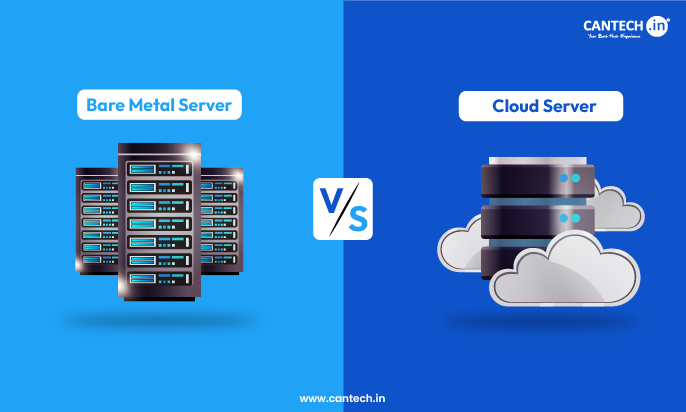
Cloud and bare metal are two rapidly distinct approaches to hosting infrastructures. Bare metals offer a physical server not virtualized- optimum performance and total hardware control alongside high isolation. Cloud servers are virtualized engines of shared physical hardware, capable of self-scaling elastically, rapidly-provisioned, and pay-as-you-use economic functionality. Use bare metal when there is predictable, intensive work, which requires high performance and security; use cloud when it is a dynamic workload, cost flexibility, and can be scaled quickly. This blog explains the differences, areas of application, the advantages and disadvantages, pricing, performance and how to choose what is the appropriate option to fit your projects.
What is a Bare Metal Server?
A bare metal server refers to a physical machine that is committed to one tenant. No virtualization layer, no shared CPU, RAM or storage with other customers. You can have direct access to the hardware and complete control over the way it is configured.
Features of bare metal server:
- Specialized CPU, RAM and storage.
- No hypervisor overhead
- Full OS and stack control
Bare metal traditionally represented the possession or leasing of instances of physical servers within a data center. Today, there is an option of modern bare metal cloud that is being on-demand provisioned similarly to cloud services, although still using fully dedicated hardware.
learn more about what is bare metal server in our depth blog
What Is Cloud Hosting?
Cloud servers function on virtualized machines which are developed on common hardware. A slice of resources on a pool, which the cloud provider administers, is used by each program instance of a server.
Core characteristics of cloud server:
- Virtualized environments
- Highly scalable and elastic
- Pay‑as‑you‑go billing
- Managed automation and services
The cloud offerings include public cloud (AWS, Azure, GCP), a private cloud, and hybrid solutions that combine on-premises resources.
Learn more about what is cloud hosting?
Bare Metal vs Cloud: Side-by-Side Comparison
| Feature | Bare Metal | Cloud |
|---|---|---|
| Performance | Highest (no virtualization) | Variable (hypervisor overhead) |
| Scalability | Manual, slower | Instant, automated |
| Control | Full hardware control | Limited to virtualized layer |
| Cost Model | Fixed, predictable | Pay-as-you-go |
| Security Isolation | Strong (single tenant) | Shared responsibility model |
| Provisioning Speed | Slower (hardware setup) | Fast, near instant |
| Maintenance | You manage it all | Provider handles many layers |
Bare Metal vs Cloud Performance Differences:
Bare Metal:
- Virtualization overhead is removed by direct hardware access.
- The predictable performance is essential to tasks that are latency sensitive.
- Ideal in high-performance computers, big databases, AI training, and real-time applications.
Cloud Server:
- Virtualization is a minor performance cost.
- Multi-tenant environments are prone to the interference of the so-called noisy neighbor.
- Most typical applications are adequate with performance.
Scalability & Flexibility
Cloud is more scalable.
Scaling of resources can be done on the fly according to the changing workload, seasonal peaks, and unexpected traffic.
Physical hardware additions or upgrade of bare metal requires more time and is less responsive.
Cost Considerations
Cloud
- Low upfront cost
- Pay only for what you use
- May be expensive to scale and not optimised.
Bare Metal
- Higher upfront or fixed cost
- Foreseeable monthly cost.
- Can be cheaper in situations where it is needed continuously and heavily utilized.
Security & Compliance
The isolation of bare metal finds affordability in under-regulated fields like finance and medics where data sovereignty and high compliance standards are critical.
Cloud systems provide high levels of security too; however, multi-tenant and shared responsibility models require special attention to configuration.
Pros & Cons at a Glance
Bare Metal Server
Pros:
- Peak performance
- Deep customization
- Strong isolation & control
Cons:
- Slower scaling
- Higher upfront investment
- Requires more ops expertise
Cloud Server
Pros:
- Instant scaling
- Lower entry cost
- Managed tools & services
Cons:
- Variable performance
- Less hardware control
Bare Metal Server VS Cloud: Which one to Choose?
Choose Bare Metal if:
- You always have a heavy workload.
- You must have high performance that is predictable.
- Either compliance or data isolation is a necessity.
Choose Cloud if:
- You need rapid scaling
- Peak performance is less important than predictability of the budget.
- You appreciate automation and outsourcing.
Conclusion:
It is not a yes-no question whether to use bare metal or cloud: each of them is a tool. Bare metal is good in cases where it is required to be very fast, isolated very strictly, and have total control over it. Cloud is more suitable when quick scaling, agility and effortless operations are required. The decision should be based on the requirements of your workloads, the amount you can afford to spend, and what technical objectives are the most important.
A hybrid approach is the most superior balance which is realized by most teams today. It provides the best efficiency at the same time maintaining performance and flexibility.