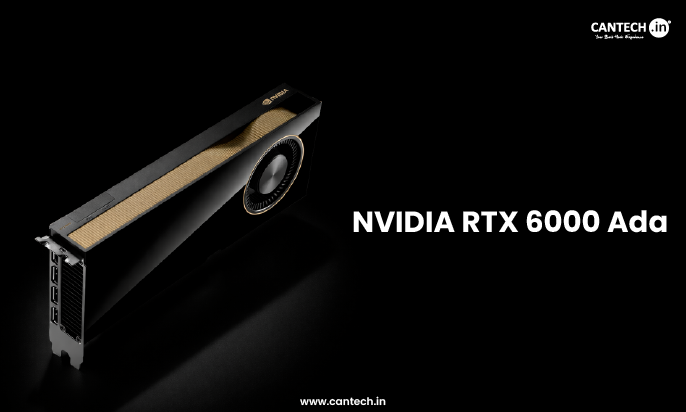
The NVIDIA RTX 6000 Ada Generation is the latest powerful tool for people who need massive speed. This card replaces the older RTX A6000 and is a massive technological leap. It assists specialists in areas such as artificial intelligence and 3D design to complete their tasks much more quickly.
This blog will discuss the reason as to why this card is a huge deal and its contribution to various industries. We will look at the facts about its power and the special features it provides.
What is RTX 6000 Ada? Overview
The RTX 6000 Ada Generation is a high-end professional graphics card that uses the new Ada Lovelace architecture. It offers massive memory and processing power to desktop workstations. This card handles complex mathematical and graphic work in major companies.
Experts use this card to create realistic movies and train smart AI models. It serves as an interface between regular computers and huge data centers.
Technical Specifications of RTX 6000 Ada
The RTX 6000 Ada is highly technical with a lot of improvements, which makes it far superior to the earlier model A6000. It possesses more cores and faster memory to support a heavy workload without delay.
The memory on this card includes Error Correction Code technology to prevent data crashes. It has a 384-bit memory interface that transfers data fast between the chip and the storage. The card fits into a standard dual-slot space inside a computer case.
The table below shows the main technical facts for the RTX 6000 Ada Generation:
| Feature | Specification Details |
| GPU Architecture | NVIDIA Ada Lovelace |
| CUDA Cores | 18,176 |
| Tensor Cores | 568 (4th Generation) |
| RT Cores | 142 (3rd Generation) |
| Memory Size | 48 GB GDDR6 with ECC |
| Memory Bandwidth | 960 GB/s |
| Power Consumption | 300 Watts |
| Interface | PCIe 4.0 x16 |
| Display Ports | 4x DisplayPort 1.4a |
Related blog: NVIDIA T4, L40s, RTX A600 or H600
Performance Improvements Over the A6000
Ada Lovelace architecture is a massive improvement in terms of raw speed over Ampere architecture. In most professional software programs, users experience almost twice the performance.
Enhanced CUDA Core Throughput
The new CUDA cores provide two times the speed of single-precision floating-point operations. This change is beneficial to engineers who carry out complicated simulations on their desktops. It makes the rendering of 3D models feel very smooth and responsive.
Fourth-Generation Tensor Cores
These cores are built specifically for AI tasks and deep learning math. They support a new FP8 data format that doubles the AI performance compared to the last version. This means you can train your AI models in half the time.
Third-Generation RT Cores
The RT cores handle how light and shadows look in a digital scene. These cores provide up to two times the throughput for ray-tracing tasks. They also help with rendering motion blur to make animations look more realistic.
Related: H200 vs L40S
Ideal A6000 Use Cases for Professionals
This card is a very specialized piece of hardware. It serves people who work with very large files and need high accuracy in their results.
Artificial Intelligence and Machine Learning
The 48 GB of memory enables researchers to run large language models directly on their desk. It is capable of dealing with models that have 13 billion parameters without any difficulty. It is a card used by startups to test new AI tools before they can be transferred to the cloud.
Professional 3D Rendering and Film
Movie studios use the RTX 6000 Ada to create photorealistic visual effects for big films. The high memory bandwidth ensures that large textures and 3D scenes load quickly. It supports real-time rendering so artists see their changes instantly.
Healthcare and Scientific Research
Scientists use this GPU to process medical images and run genomics research. The ECC memory ensures that the data remains accurate during long calculations. It helps doctors in scanning and identifying health problems more quickly with the assistance of AI.
Related: NVIDIA L40S GPU Use-Cases
Cantech’s RTX 6000 Ada Features
Cantech offers special cloud hosting services that use these powerful NVIDIA GPUs.
High Processing Power and Stability
Cantech offers workstation-level GPUs such as the RTX 6000 Ada for hard workloads. Our servers have excellent parallel computing capabilities for deep learning tasks. You have a stable environment that will not crash during heavy use.
Scalable Multi-GPU Architecture
The service allows users to run multiple GPUs together for even more power. We adopt technologies such as PCIe Gen4 to ensure that the cards communicate with each other in a fast way. This setup is perfect for training very large AI models.
24/7 Technical Support and Uptime
Cantech offers a 99.97% uptime guarantee for all our GPU cloud plans. Our expert team is available every hour of the day to help with any technical issues. This will make sure that your mission-critical projects never go down. You can check our service details at Cantech GPU Dedicated server.
Conclusion
The NVIDIA RTX 6000 Ada Generation offers large memory and high-speed cores for modern tasks in professional computing. It may be costlier, but the time saved on rendering and training AI makes it a worthwhile investment in large teams. It can easily undertake the most challenging tasks and is very reliable.
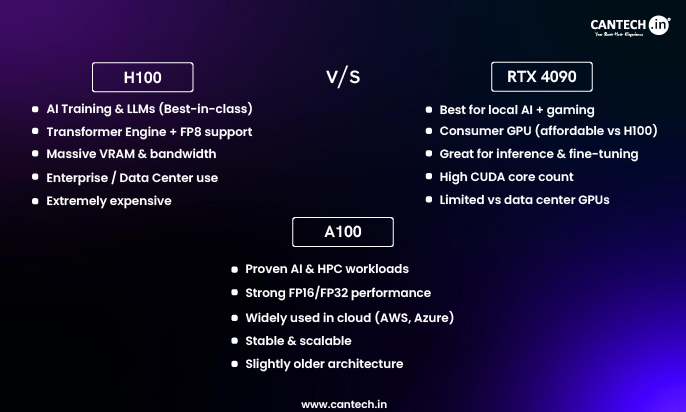
Related: H100 vs A100 vs RTX 4090
Frequently Asked Questions
What is the power requirement for the RTX 6000 Ada?
The card has a total board power rating of 300 watts during full operation. It has a single 16-pin PCIe CEM5 power connector that receives electricity from the power supply. The level of power is highly efficient in relation to the performance that the card offers. The majority of professional workstations are able to accommodate such power consumption using a standard high-quality power unit.
Can I use the RTX 6000 Ada for gaming?
You can use this card for gaming because it has very powerful hardware inside. The drivers are, however, optimized for professional applications such as AutoCAD and Premiere Pro rather than games. The card costs much more than gaming cards like the RTX 4090.
How much VRAM does the RTX 6000 Ada have?
The card comes with 48 GB of GDDR6 memory that includes ECC support for data safety. This high capacity is required to handle large 3D scenes or large AI datasets. It allows you to keep entire projects inside the GPU memory for faster processing. The memory speed is also improved to 960 GB/s for better data flow.
Is the RTX 6000 Ada better than the RTX 4090?
The RTX 6000 Ada has double the memory of the RTX 4090 and better driver support for work. It is built to run 24/7 in a professional environment without any stability issues. The RTX 4090 is faster in some gaming tasks but lacks the professional features of the 6000. Professionals choose the 6000 Ada because it handles larger workloads and offers better reliability.
Does the RTX 6000 Ada support NVLink for memory pooling?
No, NVIDIA removed the NVLink bridge support from the Ada Generation professional cards. It is not possible to physically join two cards and create a memory pool, which would have a capacity of 96 GB. The end users have no option but to use software-based multi-GPU scaling to handle their heavy loads. This is a big change from the older A6000 model, which supported the bridge.