Vibe coding is based on prompt-driven development assisted by AI, and is in which manual coding is replaced by natural language coding on much of the workflow. Although a good fit to prototyping fast and experimenting creativity, it is not always a good fit to production-level systems, applications with security concerns, or structured engineering processes.
To know more about vibe coding read our in-depth guide on What is Vibe Coding?
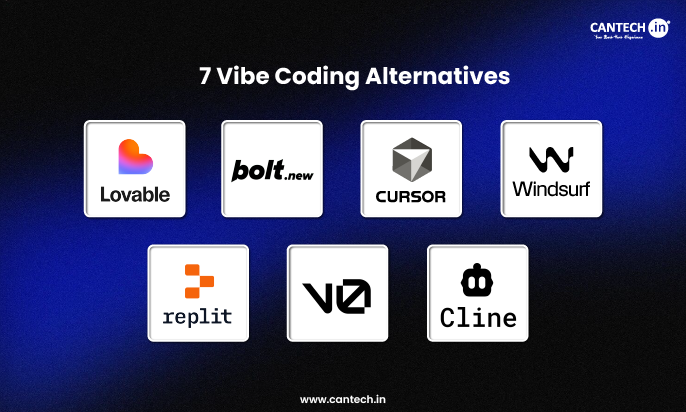
Top 7 Vibe Coding alternatives today are:
- Lovable – product-oriented AI application developer
- new – AI project generator in real time
- Cursor AI-native developer IDE
- Windsurf – AI-aided engineering environment
- Replit Cloud IDE with AI copilots
- v0 – UI-first AI generator
- Cline – automation of agent-based coding
These platforms substitute the vibe-based exploration with formal AI construction that merges automation, engineering, scale, and production readiness.
Related Blog: Top 6 Vibe Coding Tools
What Makes a Strong Vibe Coding Alternative?
An actual alternative to vibe coding has to offer something beyond creative prompt output. It must enable:
- Structural engineering – foreseeable processes.
- Scalability – production grade architecture.
- Maintainability – clean code generation
- Security control – environment visibility dependency.
- Integration – CI/CD, version control, deployment.
Vibe coding is focused on rapidity and imagination. These options focus on reliability, repeatability, and operational maturity.
Related Blog: Vibe Coding vs Traditional Coding
1. Lovable
Core strengths:
- Turns concepts into web applications.
- UI + backend generation
- Product-first workflows
- Fast MVP creation
Best use cases:
- Startup MVPs
- SaaS prototypes
- Business tools
- Internal dashboards
Why it is a good alternative: Lovable switches vibe-based creativity with structured AI product engineering, which would be appropriate in real practice.
2. Bolt.new
Core strengths:
- One-prompt app generation
- Preconfigured environments
- Full-stack project setup
- Rapid ideation execution
Best use cases:
- Hackathons
- Rapid prototyping
- Concept validation
- Proof-of-concept builds
Why it is a good alternative: It is not only creative outputs but converts ideas into coded bases.
3. Cursor
Core strengths:
- Context-aware AI coding
- Complete knowledge of the codebase.
- AI refactoring
- Intelligent debugging
Best use cases:
- Professional developers
- Production systems
- Large codebases
- Enterprise projects
Why it makes a good alternative: Cursor has engineering discipline with AI acceleration added.
4. Windsurf
Core strengths:
- Multi-file reasoning
- Architecture-level planning
- Task automation
- Engineering workflows
Best use cases:
- Complex applications
- Team projects
- System design
- Structured builds
The reasoning behind its being a good substitute: It is a sub-replacement of vibe coding by agency-based engineering logic.
5. Replit
Core strengths:
- Browser-based development
- Built-in AI assistance
- Deployment pipelines
- Collaboration features
Best use cases:
- Learning environments
- Rapid builds
- Collaborative coding
- Minimalist production applications
Why it makes a good substitute: Replit allows the creation of AI in a structured form, and not only creative prompting.
6. v0
Core strengths:
- Component-level generation
- Design-to-code conversion
- Frontend acceleration
- UI system building
Best use cases:
- Frontend teams
- Design systems
- UI libraries
- Rapid interface builds
Why it is a good alternative: v0 translates the design intent into production UI code.
7. Cline
Category: AI coding agent
Cline is an independent coding agent within IDEs.
Core strengths:
- Task-based automation
- Multi-step reasoning
- Agent workflows
- Autonomous execution
Best use cases:
- DevOps tasks
- Automation pipelines
- Code maintenance
- System operations
Why it is a good alternative: Cline gets off the vibe based creativity and is on his own in autonomous engineering.
Comparison Matrix
| Tool | Focus Area | Best For | Production Readiness |
| Lovable | Product building | MVPs | Medium–High |
| Bolt.new | Rapid generation | Prototypes | Medium |
| Cursor | AI IDE | Developers | High |
| Windsurf | Engineering AI | Teams | High |
| Replit | Cloud IDE + AI | Learning + Apps | Medium–High |
| v0 | UI generation | Frontend | Medium–High |
| Cline | AI agent | Automation | High |
Selecting the Right Alternative
- Select Lovable or Bolt.new when you are aiming to be fast and create an MVP.
- Select Cursor or Windsurf when you are interested in production engineering and scalability.
- Select Replit when developing and cooperating in the cloud.
- Select v0 in frontend-first workflows.
- Select Cline when intense automation and agent-driven development is required.
Related Blog: Vibe Coding vs AI Code Editors
Conclusion
Vibe coding is effective for experimentation and creative exploration, but it is not designed for structured, scalable, production-grade software development. As AI-assisted engineering matures, the industry is shifting from prompt-driven creativity to reliable, automated, and disciplined development workflows.
Tools like Lovable, Bolt.new, Cursor, Windsurf, Replit, v0, and Cline represent this shift. They combine AI automation with engineering structure, system reliability, deployment readiness, and long-term maintainability.
If your objective is real-world application development, business scalability, or enterprise deployment, these platforms offer a far more sustainable path than vibe coding. The future of AI development is not just faster creation-it is structured engineering, operational stability, and production-ready automation.
Related Blog: Vibe Coding vs Cursor Editor
FAQs
What AI tools are superior to Vibe Coding to the actual development?
Tools like Cursor, Windsurf, Cline, Lovable, and Replit are vibe coding alternatives in real development since they can offer:
- Structured code generation
- Project reasoning Multi-file.
- Debugging and refactoring
- Integration of version control.
- Deployment workflows
These platforms facilitate production level software engineering, not just experimentation of ideas.
Can Vibe Coding be applied in production?
Vibe coding cannot be used with production systems. It lacks:
- Architecture control
- Security governance
- Dependency management
- Scalability planning
- Maintainability frameworks
The production environment demands organized AI development systems such as Cursor, Windsurf, and Cline, which is developed on the long-term stability of the system and its scalability in the operational environment.
Which is the most user-friendly Vibe Coding substitute?
Replit is the most suitable place where beginners should start since it provides:
- Browser-based development
- Built-in AI assistance
- Simple deployment
- Learning-friendly workflows
- Shared code environments.
It enables the user to graduate to real software development skills without being overwhelmed with complexity.
Which AI coding tool is most appropriate to startups?
In the case of startups, Lovable and Bolt.new are the best alternatives. They enable:
- Rapid MVP creation
- Product-first architecture
- Full-stack app generation
- Fast validation cycles
These tools assist startups in their transition between idea and workable product without big engineering groups.
What is the difference between Cursor and Vibe Coding?
Cursor is not a creative code environment, but rather an AI-native IDE. It focuses on:
- Codebase-level understanding
- Structured AI refactoring
- Engineering workflows
- Production-grade development
Vibe coding is more focused on creativity and experimentation whereas Cursor focuses on professional software engineering.
How can AI agents such as Cline be used in the process of coding?
AI agents such as Cline are autonomous engineering assistants. They:
- Execute multi-step tasks
- Manage workflows
- Automate operations
- Maintain systems
- Handle DevOps processes
This changes AI to support creativity to autonomous engineering.
Are AI coding tools replacing developers?
No. AI coding tools do not replace developers, but enhance them. They improve:
- Productivity
- Speed
- Accuracy
- Code quality
- Workflow efficiency
The architecture, security, logic design, and decision-making still require human expertise.
Is it possible to apply AI coding platforms to enterprise projects?
Yes. Enterprise ready platforms such as Cursor, Windsurf and Cline are prepared to support:
- Large codebases
- Team collaboration
- Security compliance
- CI/CD integration
- Scalable system design
They can be used in regulated, complex and mission critical applications.