Companies are shifting to AI-driven processes, and automation solutions are no longer a nice-to-have extravagance, but rather a component of the business. MoltBot is not a better AI automation platform that talks better, but rather a better working one among new AI automation platforms.
MoltBot is not a conventional chatbot. It is an AI automation system that can learn what people desire, act, and handle business processes.
This article explains how MoltBot works in non-technical, simple terms, including its intelligent capabilities and the way it performs tasks. Explore a simple guide on What is MoltBot.
MoltBot’s Core Architecture
MoltBot works on a simple but powerful foundation:
Understand → Decide → Execute → Automate → Optimize
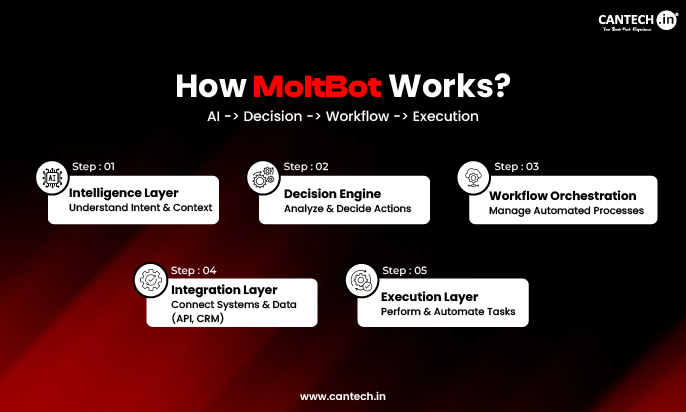
It is not a single-function tool. It is a multi-layer AI automation system made up of five core components:
-
Intelligence Layer
-
Automation Engine
-
Workflow Orchestration
-
Integration Layer
-
Execution Layer
Each layer plays a specific role in how MoltBot functions as a complete operational system.
1. Intelligence Layer (Understanding Users & Intent)
MoltBot starts here. It does not simply obey set instructions, but instead it relies on AI to:
- Determine the desire of the user.
- Understand the context
- Seek trends in what they write.
- Comprehend natural language.
- Know the user’s goal
Example:
User requests, I would like to make a demo next week.
MoltBot doesn’t see this as text. It sees intent:
- Action type: booking
- Category: sales
- Timeframe: next week
- Objective: demo request
This allows MoltBot to be intelligent rather than providing a general response.
2. Decision Engine (Logic + AI Processing)
MoltBot enters decision mode once the intent is clear. This layer mixes:
- AI models
- Business rules
- Logic systems
- Workflow conditions
- Priority rules
It decides:
- What action to take
- Which workflow to start
- Which system to use
- What process to run
Example:
When somebody asks to be supported, MoltBot will ask itself: is this sales or support? Is it high priority? Is it computerized or requires a human operator? Which workflow should start? That makes MoltBot a decision system, not a response system.
3. Workflow Orchestration Layer
It is here that MoltBot becomes potent. It does not do single steps, it handles multi-step processes. A workflow can include:
- Data collection
- Validation
- Processing
- Routing
- Notifications
- Automation triggers
- System updates
- Follow‑ups
- Task creation
Example
Lead submission
- Capture data
- Verify input
- Store in CRM
- Notify sales team
- Assign lead owner
- Trigger follow‑up
- Schedule reminders
- Send confirmation
Everything automated, everything interrelated, everything smart.
4. Integration Layer (System Connectivity)
MoltBot is linked to business systems to act as an engine. It links with:
- Websites
- CRMs
- ERPs
- Databases
- Messaging platforms
- Internal tools
- APIs
- SaaS platforms
- Cloud systems
This lets MoltBot:
- Read data
- Write data
- Sync data
- Route data
- Automate data flows
AI cannot work without integration. AI is used as infrastructure with integration.
5. Execution Layer (Action Engine)
This is where MoltBot is different to normal bots. It does not end with decisions, it does things, like:
- Sending messages
- Triggering workflows
- Updating systems
- Creating tickets
- Assigning tasks
- Processing requests
- Running automations
- Executing logic flows
MoltBot does not only recommend what to do, it does it.
How MoltBot Works: Step-by-Step Flow
Here is the full cycle:
- User interacts
- AI reads what they want
- System checks context
- Decision engine turns on
- Workflow is picked
- Automation runs
- Integrations start
- Actions are taken
- Data is handled
- Result is sent
This makes a closed loop.
MoltBot in a Real Business Scenario
Example: Customer Support Automation
User submits query –
MoltBot:
- Understands the problem
- Classifies the type
- Checks how urgent it is
- Checks in the knowledge base.
- Provides a fix
- Logs the call
- Updates the CRM
- Creates a ticket if needed
- Notifies the support crew
- Starts follow‑up automation
Human help only when needed
Example: Sales Automation Flow
Lead interaction →
-
Intent detection
-
Lead qualification
-
Data enrichment
-
CRM entry
-
Lead scoring
-
Funnel routing
-
Team assignment
-
Auto follow-up
-
Demo scheduling
-
Conversion tracking
This is not chat automation- it’s sales operations automation.
Why MoltBot Is Not Just a Workflow Tool
Traditional automation tools:
- Connect apps
- Trigger actions
- Move data
- Follow logic flows
MoltBot:
- Understands users
- Makes decisions
- Runs processes
- Handles operations
- Runs workflows
- Automates business logic
It combines AI, automation, workflows, and execution.
Business Architecture Model
Traditional Model:
Human input → Manual processing → System updates → Delays → Errors
MoltBot Model:
AI input → Intelligent processing → Automated execution → Real-time actions → Optimization
Operational Intelligence Framework
MoltBot acts as:
- AI brain
- Automation engine
- Workflow controller
- Process manager
- Execution system
- Integration hub
It is not a tool but a business operating layer.
Why This Model Matters
Since businesses are built by systems, not individuals.
With MoltBot you get:
- Autonomous ops
- AI‑run workflows
- Smart automation
- Process improvement
- Scale operations
Read a detailed comparison of MoltBot vs n8n.
Conclusion
The principle of MoltBot is to transform AI, which is a passive assistant, into an operation system. It is not just a reaction to the input but an interpretation of intent, analysis of context, activation of the appropriate workflows, and action across interconnected systems. This closed-loop process, learn, make decisions, machine code this, is what makes MoltBot unlike other bots and simple automation systems.
MoltBot is not only a tool, as it integrates AI intelligence, workflow orchestration, system integrations, and real execution to act as a business operating layer. It eliminates human labor, minimizes the time waste and allows the business to grow with systems instead of human beings. Concisely, MoltBot does not only assist operations but drives them, which is the basic element of AI-first business automation.