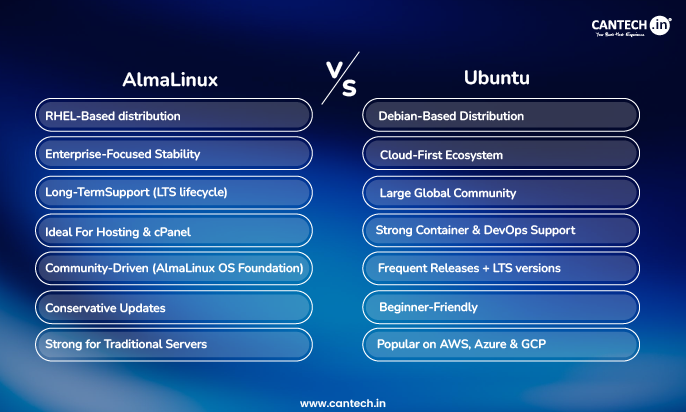
Selecting the appropriate Linux distribution may influence greatly your server stability, performance of your application, security posture and maintenance cost in long-term. Two current options which are gaining popularity are AlmaLinux and Ubuntu, both strong, stable and ubiquitous, yet designed with entirely different philosophies and use cases in mind.
When deploying a production server, cloud infrastructure, websites, or developing enterprise applications, you will need to know the difference between AlmaLinux and Ubuntu.
This guide is the one that breaks everything you need to know such as performance, stability, security, package management, support lifecycle, use cases and which one will suit your specific needs.
What Is AlmaLinux?
AlmaLinux is a free and open-source Linux distribution based on a binary-compatible replica of RHEL (Red Hat Enterprise Linux). It was developed once CentOS had transitioned to a rolling-release.
Key Characteristics:
- Enterprise-focused
- RHEL-compatible
- Predictable, stable release cycle.
- RPM based (uses DNF/YUM package manager)
- Extended maintenance (10 years with each major release)
AlmaLinux finds common usage in enterprise environments and in hosting providers which need to be RHEL compatible and not incurred any licensing fees.
What Is Ubuntu?
Ubuntu is a Linux distribution that is based on Debian and has been created by Canonical. It is among the most worldwide used Linux distributions.
Key Characteristics:
- Beginner-friendly
- Large community support
- APT package manager
- Regular (interval of 6 months) releases.
- LS (Long Term Support) versions up to 5 years.
Ubuntu is deployed to desktops, cloud, server, containers, and IoT devices.
AlmaLinux vs Ubuntu: Core Differences
Let’s compare both distributions across the most important technical and practical factors.
1. Stability and Release Model
AlmaLinux
AlmaLinux follows a stable, enterprise-grade release cycle aligned with RHEL. Updates prioritize stability over cutting-edge features.
-
Major releases supported for 10 years
-
Predictable updates
-
Minimal breaking changes
-
Ideal for production servers
Ubuntu
Ubuntu offers:
-
Regular releases (every 6 months)
-
LTS releases (every 2 years)
-
5 years standard LTS support (extended support optional)
Ubuntu LTS versions are stable, but regular releases may introduce newer packages faster.
Verdict:
For long-term enterprise stability, AlmaLinux has the edge. For flexibility and faster innovation, Ubuntu is stronger.
2. Package Management
AlmaLinux
-
Uses RPM packages
-
Managed via DNF/YUM
-
Compatible with RHEL ecosystem tools
Ubuntu
-
Uses DEB packages
-
Managed via APT
-
Massive repository ecosystem
Ubuntu generally has a broader range of community packages, while AlmaLinux benefits from RHEL-certified software compatibility.
3. Performance and Resource Usage
Both distributions perform efficiently, but their optimization focus differs.
AlmaLinux
-
Designed for enterprise workloads
-
Optimized for server stability
-
Minimal overhead
Ubuntu
-
Optimized for versatility (server + desktop)
-
Slightly more pre-installed components in default setup
-
Excellent cloud performance
In real-world scenarios, performance differences are minimal if properly configured.
4. Security and Enterprise Readiness
AlmaLinux
-
Enterprise-grade security updates
-
RHEL-aligned patches
-
SELinux enabled by default
-
Suitable for regulated industries
Ubuntu
-
Strong security team
-
AppArmor by default
-
Frequent security updates
-
Ubuntu Pro for extended security support
Both are secure, but AlmaLinux often aligns better with enterprise compliance requirements.
5. Community and Support Ecosystem
AlmaLinux
-
Backed by AlmaLinux OS Foundation
-
Growing enterprise-focused community
-
Strong hosting provider adoption
Ubuntu
-
Massive global community
-
Extensive documentation
-
Large ecosystem of tutorials and forums
-
Commercial support available via Canonical
Ubuntu clearly wins in community size and documentation availability.
6. Cloud and Container Compatibility
Ubuntu
Ubuntu dominates cloud environments. Many cloud providers use Ubuntu images by default.
-
Strong integration with AWS, Azure, and Google Cloud
-
Popular in Docker and Kubernetes ecosystems
AlmaLinux
-
Supported in cloud environments
-
Preferred for RHEL-like enterprise workloads
-
Used in managed hosting and cPanel environments
For container-based deployments and cloud-native setups, Ubuntu is often preferred.
7. Ease of Use
Ubuntu
-
Beginner-friendly
-
Clear documentation
-
Easier for new Linux users
-
Widely supported by developers
AlmaLinux
-
More suited for experienced system administrators
-
Enterprise configuration focus
-
Familiar to RHEL/CentOS users
If you’re new to Linux, Ubuntu is generally easier to start with.
8. Software Compatibility
AlmaLinux
-
Fully compatible with RHEL
-
Ideal for applications certified for Red Hat environments
-
Common in enterprise hosting stacks (cPanel, WHM)
Ubuntu
-
Huge software repository
-
Broad developer tool support
-
Popular for modern application stacks
Choose AlmaLinux if you require RHEL-certified software compatibility. Choose Ubuntu for broader development ecosystem flexibility.
AlmaLinux vs Ubuntu: Comparison Table
| Feature | AlmaLinux | Ubuntu |
|---|---|---|
| Base | RHEL | Debian |
| Package Manager | DNF/YUM (RPM) | APT (DEB) |
| Support Lifecycle | 10 years | 5 years (LTS) |
| Enterprise Focus | Strong | Moderate |
| Cloud Popularity | Growing | Very High |
| Beginner-Friendly | Moderate | High |
| Security Framework | SELinux | AppArmor |
| Best For | Enterprise servers | Cloud & development |
When Should You Choose AlmaLinux?
AlmaLinux is ideal if:
- You need RHEL compatibility
- You operate business applications.
- You need long term predictable support.
- You utilize hosting panels such as cPanel.
- You are more of a stability-oriented person.
It is a powerful option to CentOS-moving businesses.
When Should You Choose Ubuntu?
Ubuntu is better if:
- You are developing cloud-native applications.
- You require a lot of documentation and community assistance.
- You desire more convenient system management.
- You are in DevOps, or container environments.
- You are new to Linux
It is particularly prevalent in startups, SaaS infrastructure and present-day development processes.
Which is Better for Web Hosting?
RHEL compatibility with AlmaLinux would usually be preferred in traditional shared hosting and cPanel environments.
In the case of VPS, cloud hosting, and current web stacks (Node.js, Python, Docker), Ubuntu is popular.
Long-Term Considerations
Before choosing, consider:
- Team expertise
- Certification requirements of software.
- Compliance regulations
- Cloud integration needs
- Maintenance budget
- Long-term update strategy
It may be time-consuming to switch distributions later, and therefore the choice of the correct distribution early is important.
Conclusion
The final decision between AlmaLinux or Ubuntu should be made based on your technical specifications, infrastructure aspirations, and level of expertise on your side.
When your organization is dependent on RHEL compatibility, enterprise-level reliability, and the ability to support long-lived lifecycle, particularly in conventional hosting or corporate server deployment, AlmaLinux is an excellent and reliable option. It provides predictable performance, security patches and compatibility with enterprise stacks of software.
However, in case you are more focused on usability, cloud-native deployments, containerization, and solid community support, Ubuntu is the best choice. Its expansive ecosystem, regular updates, and domination in cloud platforms make it best suited to startups, developers, and current DevOps processes.
Both operating systems are safe, free, and production worthy. The decision is whether to have enterprise compatibility and stability (AlmaLinux) or flexibility and cloud-first innovation (Ubuntu).
FAQs
What is the difference between AlmaLinux and Ubuntu?
AlmaLinux is a RHEL-compatible enterprise Linux-based distribution that is committed to stability and longevity, whereas Ubuntu is a distribution based on Debian and is characterized by easy-to-use, wide hardware support, and good adoption in the cloud.
Which is better for servers: AlmaLinux or Ubuntu?
In enterprise, AlmaLinux is favored under RHEL compatibility and this is likely to be a constraint, but Ubuntu is very popular with cloud servers, VPS hosting, and overall DevOps processes.
Is AlmaLinux free to use?
Yes, AlmaLinux is fully free and open source including updates and security patches.
Is Ubuntu a paid product?
Ubuntu is open-source, however, Canonical sells business support packages to those companies that need enterprise-level support.
Which operating system is easier to learn?
The Ubuntu operating system is typically accessible to beginners because of its user-friendly interface, vast community, and documentation.
Is AlmaLinux suitable in web hosting?
Yes, AlmaLinux is popular in shared hosting and cPanel/WHM systems due to its compatibility and stability with RHEL.