Drupal is one of the most potent open-source content management systems (CMS) nowadays. Governments, universities, media sites, big enterprises and complicated digital platforms use it because it is flexible, scaled, and secure. However, as with any platform, Drupal is not the best fit, and it has its advantages and disadvantages that are important according to your objectives in a project.
Here, we shall take a stroll through the major pros and cons of Drupal in order to make an informed decision regarding whether it is the appropriate platform to use in your next site or application.
What Is Drupal?
Drupal is an open-source, free, and PHP-based CMS that lets developers and organizations create highly customized and feature-rich websites and applications. It has a modular structure and a large collection of extensions that allow it to be adapted to almost any purpose, simple blog or robust multisite network.
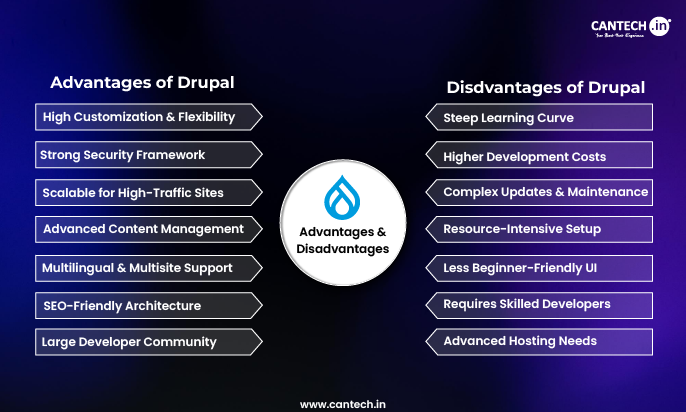
Advantages of Drupal
1. Very Customizable and Flexible
The modular design of Drupal gives it the ability to be expanded in a large scale in terms of its core functionality. Having thousands of modules and themes contributed to it, developers can add literally anything functionality, such as customizable content types and sophisticated data structures, as well as advanced user roles and integrations. This renders Drupal suitable to websites that require customized behavior instead of are based on templates.
2. Strong Security Features
One of the strengths of Drupal is security. There is a special security team that actively watch over the platform and issues updates and patches regularly. Drupal also offers such features as strong access control, user permissions, CAPTCHA integration, and session protection, which is why it can be used in government, enterprise, and regulated sectors where the security is paramount.
3. High-Traffic Site Scalability
Drupal is capable of managing extremely large websites that have high traffic. Its caching systems, integration capability with CDNs, and scalable infrastructure make it suitable to sites with a high number of visitors or unforeseen traffic surges. Large companies such as Harvard University and large media have been able to scale Drupal deployments to become the servicers of millions of users.
4. Excellent Content Management and Taxonomy
Drupal is superior when it comes to structuring and organization of content that is complex. Its taxonomy architecture permits fine-grained categorization, tagging, and cross-linkage between types of content – particularly when the content is rich and diverse (as in news portal, academic library, or knowledge base) sites.
5. Multisite and Multilingual Support
Drupal also has a strong multilingual capabilities that are provided by default, allowing websites to support more than one language without having to overdepend on external modules. It also enables the management of multiple locations using one codebase, and this is useful in business ventures with regional branches or subsidiaries.
6. Active Community and Ecosystem
Drupal enjoys a huge global network of users, contributors and developers. This dynamic ecosystem implies constant changes, numerous documents, community forums, events, and shared modules – all these can assist in overcoming difficulties and becoming innovative.
7. SEO-Friendly and Accessible
The clean architecture of Drupal, the ability to customize URLs, and the built-in search engine optimization modules, such as Pathauto, Metatag, and XML Sitemap, contribute to search visibility. Together with accessibility requirements (e.g., WCAG compliance), Drupal is capable of sustaining SEO and accessibility design practices.
Disadvantages of Drupal
1. Steep Learning Curve
The complexity of Drupal is one of the most mentioned disadvantages. In contrast to certain other CMS systems, the interface and terminology of the Drupal system are confusing to novices or non-technical users. Thus, to build an effective site, one might need to be familiar with such concepts as Views, Fields and configuration management. It usually requires training or developer expertise.
2. Increased Development and Maintenance Costs
Due to the advanced customization and technical requirements involved in the development of Drupal, a project might be more costly than a simpler CMS platform such as WordPress. Drupal developers are in high demand, and configuration, testing, and updates may add to the total cost of the project.
3. Performance Can Be Resource Intensive
The flexibility and modularity of Drupal can also be a performance drawback – when a large number of modules are enabled, but not optimized, the site may get slower or require more server capacity. Caching, highly-optimized hosting environments, and technical expertise may be needed to ensure efficient performance.
4. User-complicated Updates and Compatibility Problems
Major version upgrades of a Drupal site can be lengthy and difficult. Custom modules or themes may not survive the update and may need to be tested and modified. Although recent versions have enhanced the process, it requires coordination and technical management.
5. Less User-Friendly Backend as a developer
Although the strength of Drupal cannot be underestimated, its administrative dashboard may be less user-friendly than its competitors. The UI might also not be as user-friendly as content editors used to drag-and-drop simplicity, unless a developer has set up custom workflow and/or custom admin themes.
6. Hosting and Infrastructure Requirements
Drupal has a powerful feature that might demand a stronger hosting platform, particularly in high traffic or enterprise websites. Hosting can also be shared which can result in increased cost of hosting and the necessity of server-specific infrastructure like dedicated servers or neuromorphic cloud hosting.
Drupal: When is the Drupal the Right Solution?
Drupal is best suited to:
- Big businesses and organizations with intricate content requirements.
- Sites with high traffic that need to be scalable and performant.
- Projects that have high security and compliance issues.
- Multilingual, multisite or API-first/headless applications.
- Access to knowledge of developers.
In these applications, complexity may not be a limiting factor because Drupal is flexible, secure, and extensible.
Who Might Want to Consider Alternatives?
When you have more basic needs such as small business brochure site, personal blog or the simple e-commerce storefront, sites like WordPress, Joomla or hosted builders (e.g., Squarespace, Wix) might be more user-friendly and more affordable.
Conclusion
Drupal is a strong and versatile CMS that can serve some of the most intensive websites the world. The customization, security, scalability, and community are its strong points and make it a good option with complex or enterprise applications. But it may not be the most suitable choice because of its steep learning curve, cost of development, and resource consumption.
When you select Drupal, you should make a strategic choice that is based on your objectives, technical capacity, and future requirements and not an impulse move because to make the right choice, you need to know the advantages and disadvantages of the selected option.