In the modern world of information technology, server virtualization encompassing cloud computing is a technology, but is also the very foundation that makes the cloud what it is. It is the technology that turns physical hardware into a flexible, easy to use pool of resources. However, what is this technology, and why has it become so important? This post covers the importance, the value, and different types of server virtualization and is important in the provision of Infrastructure as a Service (IaaS).
What is Server Virtualization in Cloud Computing?
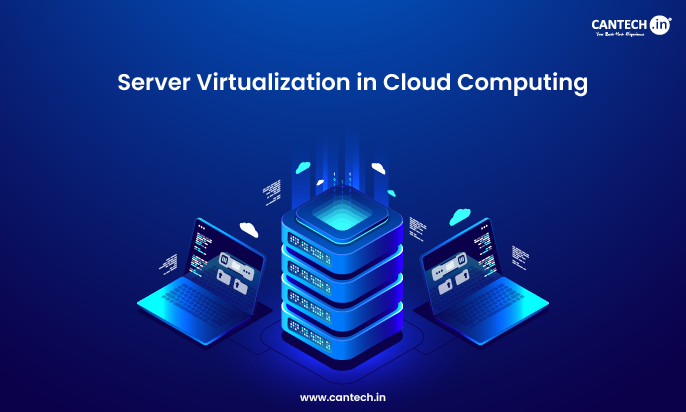
Simply put server virtualization is the practice of taking a single physical server, and dividing it into a number of separate, isolated, virtual environments. These virtual environments are known as virtual machines (VMs). Each virtual server has the properties of a physically stand alone server, as it has its own operating systems, applications, and resources allocated to it (CPU, memory, storage). The technology used to achieve this is known as a hypervisor (or Virtual Machine Monitor).
In order to visualize a physical server, consider a large, imposing, powerful apartment building. The architectural plan that partitions the inside into self-contained apartments is server virtualization. Each apartment, which is a virtual machine, has its own locks, utilities, and space. They operate independently of each other, but coexist within the same building infrastructure.
In the context of clouds, this idea is scaled to another dimension. Clouds providers use hypervisors to virtualize thousands of physical servers in huge Datacenters, creating a massive and elastic pool of virtual server resources. That pool is what customers pay for and self-managed on-demand, which is the core of the Infrastructure as a Service (IaaS) model. When you spin a VM in AWS, Azure, and Google Cloud, you are utilizing the benefits of server virtualization. Read more our detail guide blog on virtual machine monitor in cloud computing.
Virtualization of Servers Pricing Factors
Virtualization of servers started due to the great need of different inefficiencies. What follows is the backbone of cloud economics. Here are some of the reasons why Virtualization of servers is essential.
- Increased Economic Value of the Hardware: In the past, each physical server was assigned to one application. This application only made use of 10-15\% of the server. Virtualization makes it possible for multiple servers to be used. This leads to 80\% utilization as opposed to less than this. This makes a more economical use of the servers, reduces capital expenses, and lessens the issues with server sprawl.
- Efficiency and Cost: Organizations tend to spend more to consolidate servers Virtualization of servers leads to savings as the costs of hardware, the physical space of data centers, energy consumption, and cooling are less. In cloud computing this is the IaaS pay as you go model
- Speed: In cloud computing, it only takes a few minutes to provision a new virtual server as it is a simple software process. This is a massive improvement from the previous model, taking weeks to physical hardware.
- Improved Disaster Recovery: Virtual servers are portable, making it very easy to back up and clone. Virtual servers don’t require a long process, allowing for a continuous flow of business.
- Streamlined Functionality: Centralized management systems enable IT teams to efficiently streamline processes by monitoring, allocating, and controlling a vast array of virtual servers from a sole interface, enhancing operational management.
The Hypervisor
The hypervisor is the foundational, essential candidate of the enabling software. It occupies the space between the real physical components and the virtual units and is responsible for the allocation of real physical resources to the virtual machines and their isolation to ensure that the virtual machines are secure from each other. The types of hypervisors are generally classified as:
Type 1 (Bare-Metal)
This type of hypervisor is directly installed on the hardware of the physical server, thereby circumventing the installation of a host operating system. It is itself a thin operating system that also acts as a hypervisor. Because of the direct access to the physical computing resources, the hypervisor has superior processing efficiency, performance, and security. This type of hypervisor is the type that is mostly utilized in enterprise data centers and is utilized by all major providers of cloud services. Examples of this type of hypervisor are VMware vSphere/ESXi, Microsoft Hyper-V, and the public KVM.
Type 2 (Hosted)
This type of hypervisor is implemented as a software application on top of a conventional host operating system like Windows or macOS. It tends to be a quicker installation for single users/developers, but the performance could be worse due to the extra layer. This includes Oracle VirtualBox and VMware Workstation. Within the operation of hypervisors, specifically, Type 1, two primary techniques emerged for CPU virtualization: full virtualization, and para virtualization.
Full Virtualization
Here, the hypervisor emulates and reproduces the actual hardware for every VM. The guest OS operates unmodified and is led to believe that it has the sole authority and control of a physical server. The hypervisor, though, captures and controls all privileged commands. While it is more compatible and flexible, it does come at a cost. The overhead, however, has been minimized by modern CPU hardware virtualization extensions (Intel VT-x, AMD-V) making full virtualization one of the most efficient and popularly used techniques today.
Para Virtualization
Here, modifying the guest operating system’s kernel is required. The guest OS must be made “aware” that it is operating within a virtualized setting. It performs hypercalls that allow it to bypass the overhead of instruction trapping, thus communicating directly to the hypervisor for significant operations. Despite the fact that this can result in a significant performance gain for certain workloads, it necessitates OS support and so the overall applicability is reduced. With the advancement of hardware-assisted full virtualization, this use has reduced.
Server Virtualization as the Foundation of IaaS
The relationship between server virtualization, and Infrastructure as a Service (IaaS) is direct and cannot be severed. IaaS is the model of cloud service, where the customer is provided with the most basic, computable, storable, and networkable resources as required, and server virtualization is the technology that enables and provides the ‘compute’ portion.
When a cloud service provider provides IaaS, they are, in effect, providing automated and API-controlled access to massive, virtualized resources. The amount of virtual machines (VMs) that you can deploy on the self-service portal is a front-end to a hypervisor management system. The extensibility, resource pooling, multi-tenancy that are defined as properties of IaaS are characteristics inherent in a virtualized environment whose design is proper. Without server virtualization, on the fly, and changing characteristics of the cloud would be very unreasonable economically and technically.
Exploring the Types of Server Virtualization in Cloud Computing
Though very common, hypervisor-based virtualization is not the only virtualization approach in cloud computing, as modern architectures increasingly focus on Cloud elasticity and scalability to dynamically allocate resources, optimize performance, and support evolving business workloads. The types of server virtualization are complex enough to form a better understanding of cloud infrastructure from the types of virtualization.
- Hardware Virtualization (Hypervisor-based): As discussed above, this is the traditional and most prevalent. It creates, and is ideal in the case of creating, full-fledged VMs, and is useful when running different OSs on a single host.
- Containerization: This is a more lightweight version where the virtualization layer is contained within the kernel of the host operating system. This allows several user-space instances (containers) to run, in isolation, over a single kernel of an operating system. Because containers share the host operating system, containers can start almost instantly. They also consume system resources more efficiently. Although it does not function as a virtual server in the conventional sense of a virtual machine, it is an important virtualization technology of cloud-native computing, where it is often used together with virtual machines.
- Paravirtualization: As it is clear, this is an approach within the domain of hardware virtualization, not a distinct type. This is the approach in which the guest operating system is altered to allow for a varying degree of performance optimization.
- Network and Storage Virtualization: Although it is server-centric, it should be noted that the principles of virtualization apply to networking and storage in the cloud. In Software-Defined Networking (SDN), the virtualized network hardware is used, and storage virtualization retrieves data from several physically separated storage devices.
Conclusion
Server virtualization in cloud computing, first and foremost, is not a technical feature. Server virtualization in cloud computing is the primary innovation that has made the cloud, and it has made the cloud what it is. It has underpinned the core IaaS model while delivering the required agility and efficiency, as well as the resilience that modern businesses expect. It has played, and continues to play, a fundamental role.
The virtualization of software from hardware through hypervisor techniques such as Type 1 bare-metal hypervisors, along with fully virtualized approaches and containerization, has addressed the issues of underutilization and inflexibility. Every business leader who utilizes a virtual server in cloud computing and every developer who deploys containers benefit from the unnoticeable but powerful architecture of server virtualization. The virtualization of software from hardware through hypervisor techniques such as Type 1 bare-metal hypervisors, along with fully virtualized approaches and containerization, has addressed issues of underutilization and inflexibility.