The modern data center infrastructure and cloud computing go through constant evolution. Graphics Processing Units (GPUs) become one of the central factors that drive this change.
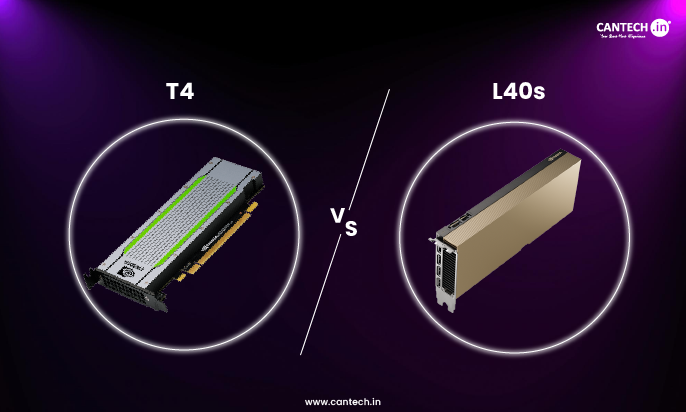
Two of the iconic GPUs for data-centres are NVIDIA’s Tensor T4 and L40s. These two cards speed up a range of workloads from Artificial Intelligence (AI) to advanced graphics rendering.
Where the T4 is a proven older model that has already gained wide usage, the L40s is a more recent, and much more powerful, hardware platform.
This article gives a clear understanding of the differences between these two GPU families for an informed decision-making process for specific workloads.
What are T4 and L40s GPUs?
NVIDIA T4 and L40s are types of accelerator cards that are to be installed in a server inside a data center setup. These cards perform compute-intensive workloads significantly faster than a standard central processing unit (CPU).
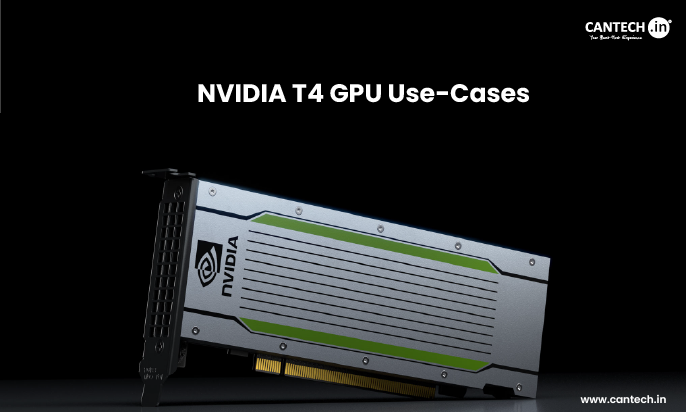
The T4 is part of the NVIDIA Tesla series and relies on the Turing architecture, with a focus on AI inference, ML, data analytics, graphics, and video-processing applications.
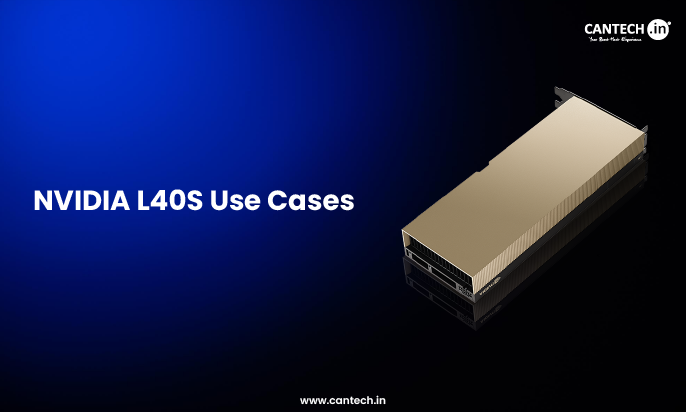
On the other hand, the L40s is based on the Ada Lovelace architecture and is designed to fulfill the needs of intensive AI applications as well as the requirements of demanding professional graphics applications.
The T4 is a Universal Deep Learning Accelerator.
The T4 is also known to have a low power usage with a maximum power consumption of 70 watts only. It is small and low-profile, so it can fit into an extremely diverse range of server setups. The card has a variety of numerical precisions, such as INT4, INT8, and FP16, which are faster in AI inference.
The L40s are known as NVIDIA’s Most Powerful Universal GPU.
The L40s is being sold by NVIDIA as the most powerful universal GPU in its product range, and this is a quantum leap in multiple workload performance, combining AI and graphics.
The device has 48GB GDDR6 memory, three times more than the memory on the T4. The L40s is powered by the Ada Lovelace architecture, which provides substantial improvements in computational speed.
T4 vs. L40s: Performance and Architecture Differences
The architecture of the GPUs is their basic design that determines the raw computational power and efficiency. The architectural difference between the T4 and the L40s creates a significant difference in the achievable performance. The section discusses critical technical differences.
- The older NVIDIA T4 is based on the Turing architecture; this architecture has Tensor Cores, specialised processors specifically optimised to execute AI and deep-learning tasks. The T4 provides up to 65 TFLOPs of mixed-precision (FP16/FP32) performance.
- The modern NVIDIA L40s is designed based on the Ada Lovelace architecture, with fourth-generation Tensor Cores and third-generation Ray-Tracing (RT) Cores. The L40s can support a maximum of 733 TFLOPS of FP8 Tensor-Core performance, which is a significant improvement over the T4. The L40s also has 18,176 CUDA Cores as compared to the 2,560 of the T4.
T4 vs. L40s: Key Performance Metrics
These raw numbers translate directly into how fast the cards process data. This raw speed is important for demanding applications.
- Floating-point performance: The L40s offers FP32 performance of around 91.6 TFLops, versus 8.1 TFLops of the T4. This shows the single-precision performance of L40s, which is more than tenfold faster.
- Memory: The L40s has 48GB of GDDR6 memory with a bandwidth of 864GB/s, compared to the T4, which has 16GB and 320GB/s. The bigger memory and bandwidth allow the L40s to support significantly larger AI models.
- Power consumption: The maximum power consumption of the T4 is no more than 70 W, compared to 350 W of the L40s. This highlights the high power efficiency of the T4.
T4 vs. L40s: Table of Core Technical Differences.
Below is the summary of the technical specifications for T4 vs. L40s:
| Feature | NVIDIA T4 | NVIDIA L40s |
| Architecture | Turing | Ada Lovelace |
| CUDA Cores | 2,560 | 18,176 |
| GPU Memory | 16 GB GDDR6 | 48 GB GDDR6 with ECC |
| Memory Bandwidth | 320 GB/s | 864 GB/s |
| Peak FP32 Performance | 8.1 TFLOPS | 91.6 TFLOPS |
| Peak INT8 Tensor Performance | 130 TOPS | 1,466 TOPS (with sparsity) |
| Max Power Consumption (TDP) | 70 W | 350 W |
| Form Factor | Low-Profile, Single Slot | Full-Height, Dual Slot |
| PCIe Interface | PCIe Gen 3.0 x16 | PCIe Gen 4.0 x16 |
T4 vs. L40s: Use Cases and Pricing
The differences in the performance and power needs define that the T4 and the L40s are best suited for different operational requirements. Each one has a unique value proposition depending on the particular budgetary and functional needs of a business.
T4 Application Use Cases: Efficiency and Scale-Out
The T4 is the best choice when it is necessary to have a server density and energy efficiency. The combination of its low power consumption and small size makes it highly applicable to specific applications such as:
- It is great for high-throughput, latency-sensitive inference tasks such as small-to-medium AI/ML models in production.
- Efficient video transcoding, as it has dedicated hardware to decode and encode video quickly. This makes it perfect for streaming services and smart video analytics.
- A lightweight virtual-desktop infrastructure is required. The T4 provides a smooth desktop experience for remote workers, consuming very little power per user.
- In terms of cost, the T4 offers a cost-efficient option to workloads that do not require the latest, largest AI models.
L40s Use Cases: Power and Graphics
The L40s is excellent for multi-workload. It excels in tasks requiring high-end computing power and advanced graphics capabilities.
- Generative AI and Large Language Models (LLMs) with massive 48 GB of memory and fast Tensor Cores.
- The L40s accelerates real-time ray tracing and 3D content creation with its RT Cores. This includes applications like NVIDIA Omniverse.
- The L40s provides strong training performance for smaller to medium AI models. It acts as a more flexible alternative to specialized training GPUs.
- The high price of the L40s comes from the fact that it can integrate several high-performance functions on one card. It has the capability to execute both compute-intensive AI training and high-quality graphics rendering concurrently. This reduces the need for multiple specialized cards.
Cantech’s NVIDIA T4 and L40s GPU Servers
Cantech specializes in providing high-performance computers (HPC) servers that are designed to meet the challenging requirements of modern GPU accelerators.
The Cantech’s services make it easy to deploy these powerful cards most effectively and efficiently.
Cantech provides cost-efficient and scalable high-performance computing servers to support both AI and graphics workloads.
- We allow users to customize hardware components with flexibility. The users can scale RAM, storage capacity, and central processing units in such a way that they can meet their unique operational needs.
- The infrastructure is best optimized to meet artificial intelligence, machine learning, and cloud-hosting needs.
- The servers have advanced security and compliance measures such as single-tenant security features, DDoS protection, and Tier-III & IV data centre hosting. All these characteristics ensure the protection of important data and lead to a high 99.97% uptime availability.
- Clients get complete control and customization over every aspect of their servers, including the choice of operating systems, security settings, and exact GPU specifications.
Conclusion
In modern data-center environments, the NVIDIA T4 and L40 series each serve a distinct and important role.
The T4 can be described as highly efficient and with cost-effective scaling; its relatively low power consumption and small size make it suitable for large-scale deployments of AI inference and video-streaming applications.
On the other hand, the L40 series is a high-performance, multi-purpose deep-learning platform. Its massive memory and superior speed are necessary for large, demanding Generative AI and advanced 3D graphics applications.
Thus, the choice between these two lines of GPUs depends on the type of workload.
FAQs
Is the T4 still a good choice for modern AI workloads?
Yes, the T4 is still a very powerful choice for most existing AI workloads. It is particularly useful in applications like image classification, natural language processing, and recommendation systems that require high throughput and low power consumption. Nevertheless, the T4 has a small memory and is thus not as applicable to the biggest, most up-to-date AI models, including very large language models.
What is the biggest advantage of the L40s over the T4?
The first and most obvious benefit is the significantly higher computing power and memory of the L40s. The L40s also have a maximum of 48GB of memory and significantly faster Tensor Core performance.
Thus, it can run large generative AI models that would simply not fit or run slowly on the 16 GB T4. The L40s also has dedicated RT Cores for superior graphics and rendering.
T4 vs. L40s: Which GPU is better for AI Training?
The L40s is the better AI training GPU, especially with small to medium-sized models. The T4 is mainly an inference card. This is because the L40s have a significantly faster FP32 performance, a larger memory capacity, and a higher memory bandwidth. This makes it much more capable of running the more intensive computations of training deep-learning models.